
Beyond JET-P: building country platforms that work for Africa’s climate and development goals
Can Africa turn ‘country platforms’ from donor-led projects into powerful vehicles for self-driven transformation? This piece explores how leadership, design and ownership will shape their impact.

Summary
- Africa’s climate and development finance systems remain fragmented and donor-driven, highlighting the need for new frameworks that enable genuine national ownership.
- Country platforms are emerging as a solution to link climate, finance and governance, but their success depends on strong political and institutional leadership.
- Lessons from South Africa, Vietnam, Senegal and Egypt show both progress and challenges in aligning national goals with international finance and climate objectives.
- Real transformation requires inclusive, transparent and locally-anchored platforms, underpinned by a development bargain where elites trade short-term gains for long-term growth.
- Without visionary leadership, strong institutions, de-risked finance and citizen engagement, country platforms risk becoming donor-driven exercises rather than engines of just and inclusive transitions.
Context and ‘exam question’
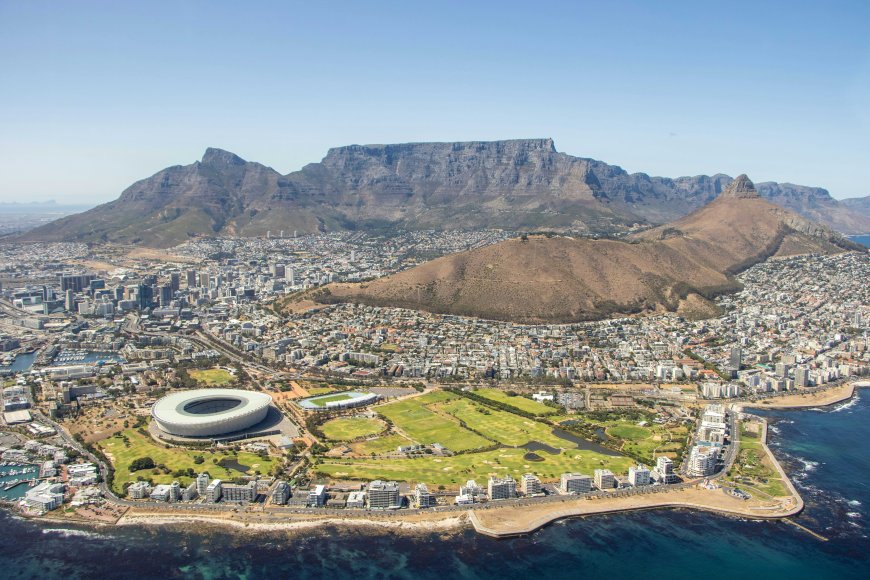
Anyone who has visited Cape Town may well have noticed the mystifying sight of its unfinished raised freeway. As you head towards the popular tourist destination at the Waterfront, one blunt end looms above you. Half a kilometre away, the other end hangs teasingly against the famous Table Mountain backdrop. These two ends, which were clearly built askew and never going to meet – hence the abandonment of the project – represent the perfect metaphor for international climate finance: The supply side lacks volume and the demand side is too weak. They need a buckle to pull them together – one that convinces asset managers and institutional investors throughout the world to pay attention to African investment opportunities, on Africa’s terms.
The very last part of this sentence is the kicker: on Africa’s terms. The question is: How can Africa attract the finance that is needed for the economic transition that will unlock the continent’s developmental potential in a way that escapes what Professor Carlos Lopes, former Executive Secretary for the UN Economic Commission for Africa, calls the ‘legacy economy’? For it is this approach that will assert African agency, re-balancing a traditionally skewed relationship between donors and recipients (Lopes 2025).1
As a part of the broader geopolitical realignment, the development aid paradigm is being shaken up. This represents more of an opportunity than a threat. Now is the time to define a new common strategic agenda on the most pressing issues of the age: peace and security, defence of the international rule of law, the maintenance of multilateralism, climate action, migration, pandemic preparation and global public health policy, and the governance of big tech.
Against this backdrop, country platforms are the flavour of the month (Calland 2025).2 On the developing country side, there is a race to join the country platform club: Think tanks and development organisations are ramping up their capacity to engage, and philanthropic foundations are piling into the space. But will the idea of a country platform prove to be a novel, robust way of governing development and climate finance or will its allure quickly fade, to be replaced by the next shiny toy?
Much of the current focus is preoccupied with the what and how of country platforms. This is understandable: People are tired of talking and want action. However, it is also essential to consider the why. In other words, what is the purpose of the exercise? What is the country trying to achieve? What positive impact will the country platform yield?3
Seizing the opportunity of a different economic development pathway will require a major investment push over the next two decades. Capital is simply not going where it is needed most. Africa must move from loan to leverage. African countries need to present a new balance sheet to the world and de-risk politics and economics, including commons and natural capital assets.
Country platforms are the latest attempt to re-order the development finance system. In this sense, the underlying basic concept of a country platform is hardly new. As the title of a 2022 Overseas Development Institute article put it: ‘Something Borrowed, Something New’ (Hadley et al., 2022, pp. 17-18).4
Properly designed and owned, country platforms could become institutional mechanisms through which African countries assert agency, align fragmented governance, mobilise private capital and deliver just, inclusive transitions. Badly designed, they risk being little more than donor-driven coordination forums, recycling old asymmetries of power.
Drawing lessons from initiatives like South Africa’s JET-P, this article will explore how African nations can design country-led platforms that prioritise national ownership and just transitions. It concludes that the decisive variable is leadership. This view, expressed in greater length in a new Cambridge Institute for Sustainability Leadership (CISL) Africa working paper (CISL, 2025)5, proposes that country platforms will succeed or fail depending on whether leaders – political, institutional, civic and business – can craft new development bargains and nurture deep trust between the key economic and governance actors so as to drive long-term economic transitions.
COP30 is likely to reinforce the idea that country platforms represent the way forward for climate finance and economic transition in emerging markets and developing economies (EMDEs). At least ten countries will be formally launching country platforms in Belem, several with support from the Green Climate Fund (GCF). Many more countries are waiting in the wings, including the African nations of Ethiopia, Rwanda, Nigeria, Madagascar, Zambia, Uganda, Tanzania, Morocco, Mauritania and Ghana (with Egypt and South Africa contemplating adding adaptation-focused country platforms to their existing mitigation ones). But amidst the flurry of activity and excitement about the potential for country platforms to unlock finance and tether demand and supply, we must not lose sight of the overarching exam question: Can African countries muster the leadership necessary for a country platform to be a game-changer?
A quick word on the notion of a ‘development bargain’
Before exploring the leadership issue, back to the question of why. Breaking the shackles that often constrain economic development and growth in Africa, and thereby the potential for transition, may require a bargain with powerful elites, whereby leaders and interest holders in a particular country forge and deliver a development plan for that country. Their ‘trade’ is that while they may risk losing some power and money, they will be part of a collective ‘gain’ – they too will rise as the tide rises. Hence, there is often a necessary ‘sacrifice’ in this development consensus.
In his seminal book, Gambling on Development (Dercon 2023),6 Stefan Dercon considers this ‘sacrifice’ as part of his concept of the ‘development bargain’. Dercon’s view is that in order for a country to develop, its elite must make a bargain between protecting their own interests and pursuing economic progress. Dercon believes that for a development bargain to work, it must have three features in common: First, the politics of the bargain favouring development are real and credible, not just some vague official statement or pronouncement; second, the capabilities of the state are used to achieve the goals of the bargain, but, importantly, the state avoids doing more than it can handle; and third, the state possesses a political and technical ability to learn from mistakes and correct course.
When thinking about whether to embark on a country platform, thought should be given as to whether it can achieve this kind of development bargain, because without such an ‘elite deal’, it may be either stillborn, or vulnerable to resistance from powerful vested interests.
What can African Countries learn from existing platforms?
South Africa’s Just Energy Transition Partnership (JET-P) is regarded as a pioneer of the new form of country platform. Announced at COP26 in Glasgow in 2021, it promised USD 8.5bn of concessional finance from international partners to support the decarbonisation of South Africa’s coal-heavy electricity system. It has since evolved into an USD 11bn Just Energy Transition Investment Plan (JET-IP).
The lessons are mixed. On the positive side, the JET-P has demonstrated that large-scale partnerships are possible and that the international community is willing to put real money on the table. It has foregrounded the concept of a ‘just transition’ protecting workers and communities from the costs of decarbonisation. The challenges, however, are sobering and some South African officials are disillusioned. Most of the finance has come in the form of loans, raising concerns about debt sustainability, and negotiations have often felt donor-led, with South Africa struggling to assert national ownership. Meanwhile, coordination across tiers of government has been weak, exposing institutional incapacity. For some perspective, consider that Vietnam’s JET-P is both larger than South Africa’s, with USD 15.5bn pledged, and its institutional anchoring within the Ministry of Planning and Investment has allowed for stronger integration into national planning. Senegal’s JET-P, on the other hand, was signed in 2023 for around USD 2.7bn, reflecting its smaller scale but also the importance of aligning with regional institutions such as the African Development Bank (AfDB). Senegal has a long tradition of national planning frameworks, which has helped maintain coherence.
In South Africa, Vietnam and Senegal, there is an underlying concern that the donors wield too much influence; that the country platform has not substantively rebalanced, or escaped, the fundamental power imbalance between donor and recipient. In each country, officials have sought to manage unreasonable expectations from donors about the pace of transition, while continuing to try – mostly unsuccessfully – to improve the terms of the finance. New country platforms will have to think hard about how to assess country interests in order to set the agenda, while recognising that country platforms also have to serve the collective global interest and, thereby, the interests of donor countries.
In this regard, Egypt represents an even more pertinent case study. At a 2023 meeting of the Independent High Level Expert Group on Climate Finance that I am a member of, we received a presentation from Dr Rania Al-Mashat, the Egyptian international development minister. She made a compelling case for how her country had first thought hard about the why before moving to the what and how. The documents she shared with me immediately afterwards were equally persuasive: Egypt first identified three strategic imperatives: water, agriculture and energy. They then designed the key elements of the transition needed for each, calculated the finance needed and determined the finance gap. Only then did they take it to the ‘market’. Three different international development finance institutions (DFIs) came to the party in response.
The key takeaway is that country platforms are not ‘plug and play’. They must be domesticated into national contexts, with strong political leadership, institutional anchoring and legitimacy across government, business and society.
Why move beyond donor-led JET-Ps?
Donor-led JET-Ps, while significant, risk repeating the very mistakes that Africa has suffered from for decades. Three reasons stand out:
- Narrow scope. The energy transition is vital, but Africa’s development needs are holistic: food systems, water security, industrialisation, education, adaptation. Platforms that focus narrowly on energy risk distorting priorities.
- Conditionality and dependency. Donor-led models often impose conditions that reflect the interests of funders rather than the needs of recipient countries. This undermines sovereignty and breeds mistrust.
- Paternalism. Without national ownership, country platforms can become modern versions of donor consultative groups – with African governments again in the role of supplicants.
Hence, to return to the earlier point, country platforms must be developmental bargains, rooted in national political economies, aligned with NDCs and long-term strategies, and accountable to citizens.
Political, institutional and financial factors
Political
Leadership at the highest level is indispensable. Only presidents or prime ministers can cut across entrenched silos and mobilise whole-of-government alignment. Yet country platforms must not become the personal projects of leaders. They require broader political legitimacy, anchored in parliaments and public discourse.
Institutional
Platforms need governance structures that are transparent and inclusive. This means a multi-stakeholder steering committee, a technically competent secretariat and independent monitoring frameworks. The example of South Africa’s Presidential Climate Commission – which brings together government, business, labour and civil society – offers a template. At the same time, aligning country platforms to existing continental frameworks, such as the African Continental Free Trade Area (AfCFTA) or Agenda 2063, may be useful in helping to shore up institutional wherewithal, while maintaining national autonomy and local ‘customisation’.
Financial
Country platforms must deliver investable propositions. This requires:
- Project preparation facilities to generate bankable pipelines.
- Blended finance structures to de-risk private investment.
- Guarantees and insurance instruments to lower capital costs.
- Green and sustainability-linked bonds to mobilise domestic and international capital.
- Carbon revenues and debt-for-climate swaps to create fiscal space.
Without this financial architecture, country platforms risk being little more than glossy plans.
Aligning stakeholders: a platform for all
The essence of a country platform is alignment – not just of finance, but of people, institutions and interests.
- All tiers of government. National strategies must cascade to provinces, municipalities and local governments. Land use, permitting and service delivery often depend on sub-national actors.
- Youth. Africa’s demographic profile makes youth inclusion essential. Platforms must create meaningful spaces for young leaders, innovators and entrepreneurs.
- Private sector. Country platforms must be attractive vehicles for investment, not just for donor funds. Business coalitions can shape reforms and build market confidence.
- Civil society and communities. Legitimacy depends on voice and participation. Worker unions, NGOs and community groups must be integral to country platform governance.
The leadership challenge is to weave these diverse voices into a coalition of consent, balancing interests without suppressing dissent.
Finance without more debt
Africa cannot afford country platforms that worsen its debt crisis. Innovative finance must be central:
- Blended tools where concessional capital absorbs first loss.
- Debt-for-nature / climate swaps that release fiscal space.
- Green/blue bonds are linked to measurable outcomes.
- Carbon revenues channelled to resilience and community projects.
- Domestic mobilisation through tax reform, levies on extractives, or carbon pricing.
The aim is to leverage concessional finance to crowd in multiples of private investment while protecting fiscal sustainability.
Engines of just and inclusive transitions
Country platforms must be more than technocratic instruments. To endure, they must deliver justice and inclusion:
- Social dialogue with workers and communities.
- Skills development and job creation as core metrics.
- Gender equity and youth employment hard-wired into programmes.
- Regional fairness to prevent widening inequalities.
- Adaptation and resilience, not just mitigation.
In short, country platforms must be engines of transformation, not just pipelines of capital. They need to support what I call a ‘whole economy’ transition (Calland, 2022).7
A leadership checklist for African country platforms – food for thought at COP30
At the core of country platforms is leadership. Not just charismatic political leadership, but leadership across institutions, business, civil society and communities. The CISL Africa working paper presents a 17-point checklist for leaders which invites African leaders who are attending the COP30 discussions on country platforms, and who are considering establishing their own country platform, to ask themselves some tough questions before embarking on the process, including:
- Have we articulated a compelling national narrative for the platform?
- Have we mapped and engaged all stakeholder groups, including youth and communities?
- Is there a sufficiently robust cross-party consensus to survive political change and/or the institutional apparatus to insulate the process from the vicissitudes of shorter term political/electoral cycles?
- Do we have an institutional home with the right technical skills?
- Does our financial architecture offer a credible pipeline for investors?
- Are justice, equity and resilience embedded in our design to help ensure that the approach has sufficient legitimacy and social buy-in?
- Are we prepared to spend political capital to see it through? Is there an elite developmental bargain to underpin the inevitable trade-offs that will need to be made to buttress the transition?
This framework is both daunting and inspiring. It shows that country platforms demand a new calibre of systemic, ethical and strategic leadership.
Conclusion: from fad to future
Country platforms could be dismissed as another development fad. But in Africa, they could also be the institutional breakthrough that allows the continent to seize agency, align fragmented systems and mobilise transformative finance.
The choice is stark. Country platforms could be donor-led talking shops, or they could be engines of a just, inclusive African future. What will determine the outcome is leadership. Leadership that is visionary and pragmatic, courageous and collaborative, technical and ethical. Leadership that is willing to take risks, forge bargains and hold the line against vested interests.
Country platforms are at an inflection point. The question is whether Africa’s leaders are ready to rise to the challenge.
Endnotes
[1] Lopes, C. (2025, August 11). The international order is shifting: African countries have an opportunity to reshape global power relations. The Conversation
[2] Calland, R. (2025, June 4). Development finance in a post-aid world: the case for country platforms. The Conversation.
[3] This is major learning from the CISL African Climate Finance Leadership programme, convened with FSD Africa over the past three years.
[4] Hadley, S., et al. (2022). Something borrowed, something new? Overseas Development Institute.
[5] University of Cambridge Institute for Sustainability Leadership. (2025). Country platforms in Africa and beyond: Transformational leadership for sustainable futures.
[6] Dercon, S. (2023). Gambling on development: why some countries win and others lose. Hurst & Co
[7] Calland, R. (2022). South Africa’s just transition. In A. Bhattacharya, H. Kharas, & J. Podesta (Eds.), Green transitions. Brookings.
About the author

Richard Calland
Richard Calland is Director of CISL Africa – the Africa Programme of the Cambridge Institute for Sustainability Leadership.