JET-Ps in times of geopolitical change: the case of the Germany-South Africa JET-P
Germany & South Africa's Just Energy Transition Partnership faces barriers amid recent political and geopolitical shifts. This analysis highlights success, failures and recommendations for impact.

Summary
- The South Africa JET-P is a novel, country-led minilateral partnership blending development and climate finance to support South Africa’s coal transition, renewable energy expansion, and green industrialisation.
- The JET-P has successfully established its institutional framework and has attracted international funding, with Germany as the largest contributor of grant funding.
- Despite these achievements, the JET-P faces significant challenges, including announced delays in coal plant decommissioning and environmental regulation exemptions, alongside criticism that a substantial portion of funds has been absorbed by international rather than local partners, raising justice implications, and a reliance on loans risks turning the partnership into a debt facility which could create high expectations for quick relief in a society with high poverty.
- The “just” framing has introduced complex expectations—especially for job creation and social inclusion in coal regions—but risks falling short unless deeper reforms in education, industrial policy, and rural development are integrated and scaled
- For JET-P to succeed, it must deliver tangible emissions cuts, multi-dimensional livelihood improvements, and clean energy access while ensuring transparent fund allocation, inclusive development, and trust-building among all actors.
Introduction
In 2021, both Germany and South Africa were in turmoil. A major change was underway in Germany’s political leadership, as outgoing Chancellor Angela Merkel of the Christian Democratic Union (CDU) handed power to a coalition government comprising the Social Democrats, the Greens and the Liberal Party after 16 years in office. Meanwhile, South Africa’s young democracy was put to the test when violent riots broke out in response to the arrest of the former president Jacob Zuma. The country pulled through, despite the fact that the economy had yet to recover from the impacts of structural corruption and harsh lockdown measures in response to the COVID-19 pandemic.
Since then, conflicts between Russia and Ukraine and between Israel and Gaza, and the repercussions of the elections in the US have changed the balance of power in the international system. The responses to the two conflicts crystallised profoundly different perspectives between Germany and South Africa and their global alliances in the G7 and BRICS+.1 Nevertheless, in the face of these challenges, the South African government initiated the proposal for a Just Energy Transition Partnership (JET-P) and began to update its Nationally Determined Contribution (NDC) in accordance with the Paris Agreement. The original proposal envisioned a structured exit from coal – supported by international finance – to help recover the debt of the country’s electricity utility, which had plunged its investment rating to junk status. Germany’s positive responses to the JET-P proposal reflected both the commitment to international climate policy of the outgoing government as well as the enthusiasm of the initial months of the incoming coalition. In this context, Germany, with other international partners, negotiated programmes to increase renewable energy and electric vehicles (EVs) and produce clean hydrogen for export. Over the past four years, the two countries have further developed their cooperation for the JET-P.
Over the past two decades, development and environmental cooperation – as well as parts of scientific and technical cooperation – between the two countries has focused on the climate and sustainable energy. This bilateral cooperation is structured in policy areas including climate change, defence, energy and economics, development, scientific cooperation, agriculture, and consumer protection. A binational committee meets twice a year to manage the bilateral cooperation between the two countries. In 2020, the German and South African governments held the respective presidencies of the European Union (EU) and the African Union (AU). Their leadership further strengthened the focus on sustainable development and clean energy cooperation between the two continents, in light of the European Green Deal and Agenda 2063. Agenda 2063 is the AU’s flagship programme to accelerate Africa's economic growth and sustainable development. Similarly, the Green Deal was created by the EU to support Europe's transition to carbon neutrality. EU programmes support pan-African efforts through specific projects and an AU-EU partnership focusing on energy access and sustainable growth.
In 2024, political change was set in motion in both countries. National elections left the ruling African National Congress (ANC) without a majority for the first time, paving the way for a Government of National Unity (GNU). The GNU has shaped its legislative programmes in line with voters' expectations that it will do better than the ANC on its own. The lost election and the new coalition limited the economy to moderate growth during the first 100 days in office. The relationships between the coalition partners faced their most difficult test so far when the first budget negotiations took place and tax policy was contested. Similarly, in Germany, continuous disputes over the national budget and finance policy led to worsening relationships between the German coalition partners over the course of the year and culminated in a confidence vote paving the way for the election in 2025. The election results gave the CDU the mandate to form a government with the Social Democratic Party – with a narrow majority of 52% of the seats in parliament.
Germany and South Africa share colonial histories of oppressive political regimes and coal-intensive development paths. Similar per capita emissions translate into high-income country GDP levels in Germany, while South Africa's economy is classified as upper-middle income, with more than a quarter of the working population formally unemployed. High levels of inequality and persistent poverty qualify South Africa for development assistance, which is partially provided by German wealth. The size of South Africa’s and Germany’s economies, and their respective populations of over 60 and 80 million, make them important trading partners.
These similarities and differences, exacerbated by the climate crisis, shape the German-South African partnership in the context of the common challenges of socially just transformation and energy transitions. This essay reflects on German-South African relations in the JET-P against a background of domestic and geopolitical change between 2021 and 2025. Specifically, it interrogates the design, objectives and progress of Germany’s support of South Africa’s JET efforts from the perspective of ‘minilateralism’ and institutional change in climate governance.
Innovation in minilateralist climate governance: what’s new in the JET-P compared to other climate clubs?
The JET-P can be characterised as a ‘minilateralist’ alliance on climate finance.2 The classic definition of minilateralism as 'a system of governance by a coalition of great powers' applies in part to minilateral alliances in climate governance. The UN Framework Convention on Climate Change (UNFCCC) has given rise to many different groupings over the course of its existence since the 1990s, given the inequalities between the negotiating parties. Examples range from the Brazil, South Africa, India, China (BASIC) group of emissions-intensive developing economies, to the Group of Small Island States, which are particularly vulnerable to the impacts of climate change. The concept of minilateralism is important within and beyond climate governance, as minilateral groups can have a significant impact on geopolitical dynamics and national policy responses. For instance, a growing literature has conceptualised 'climate club' governance, particularly in the Global North, which promotes the adoption of carbon pricing and border tax adjustments. The key feature of clubs is that any common benefit is only available to compliant members, subject to sanctions for non-compliance.
Germany and South Africa are both active in many different climate clubs and minilateral groupings in the international system. Sometimes they participate in the same group, such as the Group of 20 (G20). However, their different histories and positions in the international system mean that they are more often aligned with different groups. For instance, South Africa's foreign policy agenda grew out of resistance to colonialism and the promotion of human rights. The country’s membership of the Non-Aligned Movement and the G77 after 1994 played an important role in the struggle against apartheid and as a counterbalance to the Global North in support of decoloniality and South-South cooperation. In 2012, South Africa joined the Brazil, Russia, India, China, South Africa (BRICS) group as the smallest economy in the club and the largest economy in Africa. The country continues to receive official development assistance (ODA), albeit less than 1% of its Gross Domestic Product (GDP).
In contrast, Germany is a member of the Group of Seven (G7) of the world's richest economies and a major contributor to ODA and climate finance. The German government used their G7 presidency in 2022 to mobilise their own Climate Club, now co-chaired with the government of Chile, to incentivise action for industrial cooperation. The club is designed along more inclusive principles than climate clubs that strictly benefit from cost savings. The G7 has since expanded into the G20 and has been joined by a total of 47 countries.
While none of the BRICS nations joined the G7’s climate alliance, BRICS functions similarly to the G7 as a group with somewhat similar political and economic status and shared world views, and which has a rotating leadership and an annual summit. In contrast to the G7, however, the BRICS nations maintain their own finance organisation, the New Development Bank. The BRICS group of five counterbalances the G7 and has expanded from the initial group of five into a BRICS+ group of 10. The new members – Egypt, Ethiopia, Iran, Saudi Arabia and the United Arab Emirates – were formally welcomed at the BRICS summit in Russia in 2024.
The G20 is a significant forum where the interests of South Africa and Germany meet. It is currently the only minilateral forum to accommodate both the G7 and BRICS nations, plus the EU and AU. The South African government took over the presidency from Brazil in 2024 and adopted the G20 presidency theme of ‘Solidarity, Equality and Sustainability’, seeking ‘to strengthen the advance of our common pursuit of the Sustainable Development Goals by 2030’, which needs to be a priority for the coming five presidencies of the G20. The South African G20 presidency’s priorities of inclusive economic growth, industrialisation, employment, inequality and sustainable development align with the overarching goal of the JET-P: ‘to achieve a quality of life for all South Africans […] decent work for all, social inclusion and the eradication of poverty’.
What makes the difference in the JET-P?
With the JET-P, the South African government initiated its own version of minilateral climate governance, without calling it a climate club or alliance. The idea of the JET-P was born out of the need to reform the electricity sector, modernise the governance of the different functions of generation, distribution and transmission, and open up the market to private investment in renewable energy. Reforming Eskom through decarbonisation and international climate finance stood at the centre of the original JET-P proposal from a South African perspective.3
The formation of the international partners group merged the South African proposal with the climate funders' interests and ideas.4 As a result, the JET-P turned into a longer-term decarbonisation and industrialisation programme that spans across different sectors. These include the original transition from coal to renewable energy, developing a clean hydrogen industry as well as new and alternative vehicle industries and infrastructure.
The JET-P is a major coordination and relationship-building effort among seven countries, the EU and the World Bank's Climate Investment Fund. Other associated countries, including Spain, Switzerland and Canada, have contributed funds. The BRICS group's New Development Bank has also announced additional contributions. The JET-P builds on existing climate and development policy, including South Africa's National Development Plan, as well as its Climate Change White Paper, Climate Change Act and Nationally Determined Contribution to the Paris Agreement. South Africa's climate change policy emphasises the importance of aligning its efforts with its broader economic development agenda to reduce poverty and inequality. In the absence of an explicit implementation plan for the NDC, the JET-P and its investment and implementation plans fulfil this function by outlining some of the aspects of the transition. A just energy transition framework supports the implementation plans of the JET-P at a higher political level.
The novelty of the JET-P centres on two aspects: Firstly, it is a development country-led initiative which attracts climate finance in an innovative minilateral organisation, supported by large emitters from opposing geopolitical alliances. Secondly, a narrative on ‘justice’ and socio-economic benefits of the transition blends the lines between development cooperation, climate action, finance and energy planning towards new approaches in international cooperation and finance.
What has been achieved so far?
The framing of ‘just energy transitions’ has brought climate and development finance closer together. Over thirty government departments, development agencies and banks participate in the partnership and administer 146 programmes in six portfolio areas.
As of April 2025, the following funds have been allocated: i) the Electricity Portfolio – USD 160 million; ii) the JT-Mpumalanga Portfolio – USD 117 million; iii) the Green Hydrogen Portfolio – USD 141 million; iv) the Municipal Portfolio – USD 83 million; v) Skills – USD 83 million; and vi) NEVs5 – USD 563000. The funds take different forms depending on their aim and funding agencies. Examples are i) technical assistance grants – a known instrument of development cooperation – such as those from the GIZ6-administered South African German Development Partnership; ii) capacity development grants and studies; iii) infrastructure grants; iv) community development grants in support of municipalities in the mining areas; v) research grants; vi) project preparation grants; and vii) communication grants.
Climate finance and development cooperation can arguably unlock benefits for both the funders and recipients, as long as finance is applied for mutually defined areas of interest under conditions of trust and open knowledge exchange. The benefits have been contested in both recipient and donor countries and continuously receive criticism from nationalist parties who seek to put the funds into their own countries instead. The historical motivation of industrialised countries to support developing countries through development assistance has also helped the funders to keep a presence in former colonies and sustain their economic interests. Similarly, climate finance comes with the original motivation to help developing countries obtain access to climate technologies based on the principle of ‘common but differentiated responsibilities’ (CBDR), yet it also helps industrialised countries tap into new markets to sell climate technology and develop clean energy resources.
The JET-P has brought together established development cooperation and finance instruments with the investments necessary to access climate technologies in renewable energy, wind-generated hydrogen and post-combustion vehicles. The instruments of the development cooperation are meant to support the transition to be ‘just and inclusive’. The transformation of the coal regions and municipalities requires far-reaching, international and national collaborative efforts to achieve the desired benefits for the most vulnerable to the transition in the long term. However, the justice implications of the JET-P reach well beyond South Africa’s 100,000 mine and coal plant workers at direct risk, as these are part of a wider population of 8 million unemployed and an additional 800,000 underemployed.7 The JET-P is an initial step in support of changing South African development pathways, which requires domestic political commitments to absorb the international assistance accordingly.
The main achievement over the past four years is the fact that the JET-P has been set up institutionally and is operational as an innovative partnership. Setting up new minilateral partnerships takes time and requires upfront investment in human and financial resources, and so this achievement should not be underestimated. The JET-P is still a relatively new climate finance mechanism. It has required many hours of conversation, coordination, negotiations and harmonisation to define the objectives, roles and responsibilities of the different partners, who have aligned, but also competing, interests. The processes of coordinating plans and budgets between the nine governments and their agencies set out the following organisational structure.
Overview of the organisational structure of the JET-P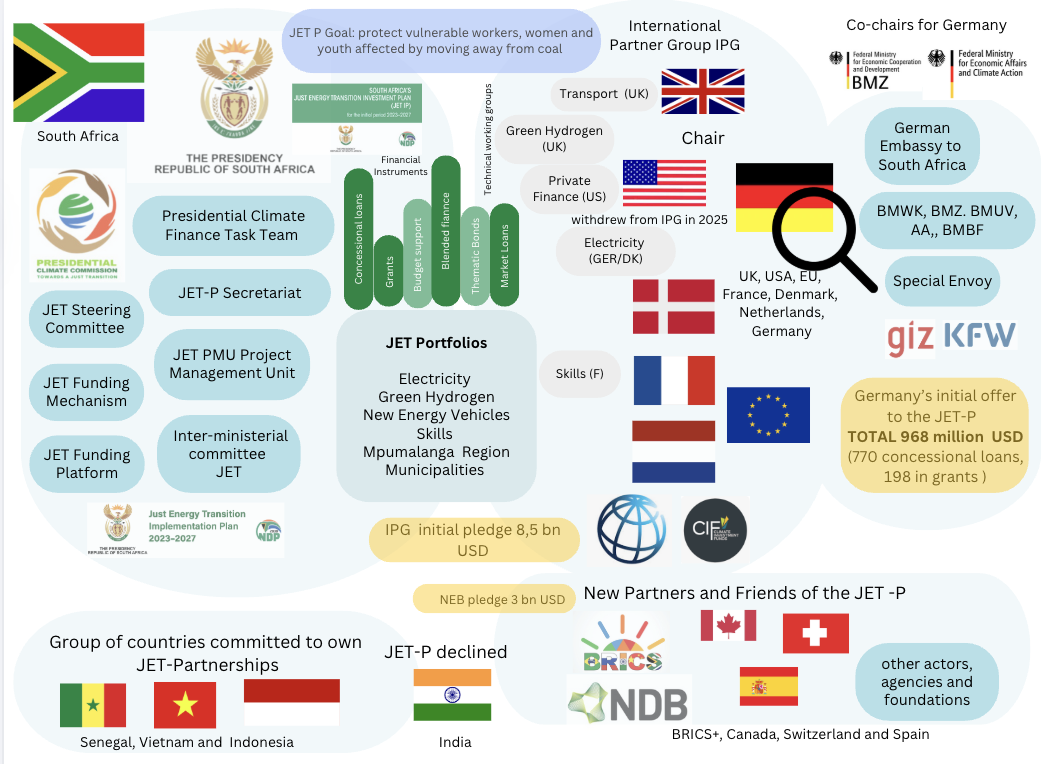
The governance of the JET-P has evolved into an extensive organisational construct, with several layers of inter-ministerial and inter-governmental coordination at the country level, a project management unit in the South African presidency and several thematic portfolios. The presidency – in close coordination with the Presidential Climate Commission, which started as an advisory body – leads the JET-P in the process of being institutionalised as a scientific council. Line departments, including the National Treasury, Environment, Electricity, Energy and Mineral Resources, and Science and Innovation, are closely involved and coordinated with other ministries through an inter-ministerial committee.
The International Partners Group (IPG), chaired by the United Kingdom (UK), coordinates the contributions of its members: Germany, France, the EU, Denmark, the Netherlands and the World Bank's Climate Investment Fund. The IPG member countries focus on specific themes and associated technical working groups. Germany and Denmark co-lead the technical working group on electricity. Other working groups focus on transport, skills, clean hydrogen and private finance, but are only partially active. These working groups align with the focus of the thematic portfolios.
The German government’s contribution to the JET-P channels all available instruments for international cooperation, except for defence forces. These include the deployment of a special envoy to promote the transition partnership in the form of a State Secretary at the Ministry of Development and Economic Cooperation (BMZ), based at the German Embassy in Pretoria. The Deputy Ambassador, seconded by the Federal Foreign Office, supports the JET cooperation together with representatives of the federal ministries of Economic Affairs and Climate (BMWK), Environment (BMUV), BMZ, and Education and Research (BMBF).8
The German Ministry for Education and Research supports research projects related to JET-P topics, including renewable energy-based hydrogen research. It has announced a bilateral research chair which seeks to support a collaborative research group at two universities in both countries. A ‘centre of excellence’ seeks to support engineering skills development through scholarships administered by the German Academic Exchange Service (DAAD).
The implementing agencies the GIZ and the German state-owned investment and development bank KfW have historical mandates to reduce poverty through financial and technical assistance funded by Official Development Assistance (ODA). Thus, both the GIZ and KfW can legitimately operate in developing countries and build on a history of development finance and technical cooperation in South Africa. German development agencies and banks increasingly administer climate finance funds, as they have established structures to operate in developing countries. Germany’s development organisations have adapted to administer climate finance within their existing instruments and bureaucracies without major reform.
Rapid implementation of grant funding while decommissioning schedules for coal plants are delayed
As of 2025, Germany's commitments to the JET-P, as listed in the Implementation Plan, amount to a total of USD 1,289 billion, of which USD 241 million is in the form of grants and USD 1,048 million is in the form of concessional loans.9 Germany is the largest contributor of total grant funding in the consortium of international partners. The total funding mobilised under JET-P from Germany is EUR 276 million. The Project Register allows a closer look at the projects funded by the German government under JET-P. The register discloses a total of 21 projects directly supported by the German government.
Table 1:
Overview of German-funded grants and projects in the JET-P in EUR
| Portfolios / priority areas | EUR | Implementing entity | Institutional / South African partner | Beneficiary | Status |
|---|---|---|---|---|---|
| Electricity – coal plant decommissioning | 7,000,000 | Eskom | Eskom | Study facility serves experts, managers of Eskom and IPPs; population impacted by coal plant decommissioning | B. Approved |
| Electricity – enabling environment | 9,500,000 | DMRE | DMRE, Eskom, NT, SALGA, NERSA, Universities, NTCSA, SACN, private sector | Experts and managers from the policymaking, management, administrative and technical levels in public organisations in the power sector | D. Completed |
| Electricity – enabling environment | 15,500,000 | DMRE | DMRE, Presidency, MoE, OV, NERSA, Eskom, NTCSA, SALGA, municipalities | Intermediaries to the broader target groups incl. decision-makers, regulators and stakeholders on national level; municipalities | C. Implementation Phase |
| Green hydrogen – enabling environment | 3,000,000 | DTIC | DTIC, CSIR | Government representatives at national and provincial level; municipal representatives; NGO representatives; project developers; companies | C. Implementation Phase |
| Electricity – enabling environment | 4,167,000 | DMRE, private sector, civil society | DMRE | Government representatives at the national level | C. Implementation Phase |
| Electricity – enabling environment | 4,500,000 | DMRE | DMRE, NTCSA, NERSA, SALGA | Experts and managers from the policymaking, management, administrative and technical levels in public organisations in the power sector | C. Implementation Phase |
| JT-Mpumalanga – diversifying local economies | 15,000,000 | DFFE | JUST SA Consortium (Green Cape, NBI, TIPS, Yes4Youth, WWF SA, GIZ) | Decision-makers at the national level; Government of Mpumalanga; coal value chain representatives; SMMEs | C. Implementation Phase |
| Electricity – piloting social ownership models | 20,000,000 | INFRA IMPACT (PTY) LTD | INFRA IMPACT COMMUNITY TRUST FUNDING (PTY) LTD | Municipality community trusts | C. Implementation Phase |
| Electricity – piloting social ownership models | 20,000,000 | INFRA IMPACT (PTY) LTD | INFRA IMPACT COMMUNITY TRUST FUNDING (PTY) LTD | Municipality community trusts | B. Approved |
| Municipalities – preparing a conducive environment for private sector investment | 20,000,000 | DMRE / Presidency/ IDC; public and private companies | DMRE, NBI, the Presidency, IDC | Municipalities | C. Implementation Phase |
| Green hydrogen – infrastructure | 23,000,000 | IDC, public and private companies | IDC | Catalytical project developers in the field of green hydrogen in South Africa | B. Approved |
| Green hydrogen – infrastructure | 15,500,000 | MoEE, DTIC, DMRE, IDC, DFFE, DPWI, SABS, HySA, SANEDI | MoEE, HySA Network, Infrastructure SA, SANEDI, HSRC | Government representatives at the national and provincial level; municipal representatives; NGO representatives; project developers; companies | C. Implementation Phase |
| Skills – mobilise PSET funding for JET | 22,000,000 | NBI, TVET Colleges | National Business Initiative (NBI) | Youth in South Africa at selected TVET colleges (participants of IRM skills development) | B. Approved |
| Skills – mobilise PSET funding for JET | 15,000,000 | CPUT, Selected TVET Colleges, ESKOM, IPPs | South African Renewable Energy Technology Centre (SARETEC) | Youth in South Africa at selected training institutions (participants of skills development in renewable energies) | B. Approved |
| Skills – mobilise PSET funding for JET | 12,500,000 | DHET, TVET college | NBI, Lulalab, Yes4Youth, IEPA, Resolution Circle, Wits Real, Techniserve, ILO, UNDP | Underprivileged groups: youth, women, workers and their dependants affected by the structural changes | C. Implementation Phase |
| Skills – mobilise PSET funding for JET | 6,000,000 | The Presidency | The Presidency | D. Completed | |
| Municipalities – Climate Support Programme (CSP4) | 5,000,000 | DFFE, municipalities, provinces | DFFE, municipalities, provinces | Intermediaries to the broader target groups | C. Implementation Phase |
| JT-Mpumalanga – JET innovation regions | 260,000 | TBD | Stakeholders relevant for the development and implementation of regional Just Energy Transition Plans in coal regions | C. Implementation Phase | |
| JT-Mpumalanga n | 30,000,000 | The funding specifically targets JET implementation | Capacity building at the subnational level | B. Approved | |
| Green hydrogen – Catalyst Research for Sustainable Kerosene, CARE-o-SENE | 30,000,000 | Helmholtz Center Berlin (HZB), Karlsruhe Institute for Technology (KIT), Fraunhofer Institute), INERATEC GmbH | C. Implementation Phase | ||
| Green hydrogen – greening the production and use of liquefied fuel gas in Southern Africa, Green‐QUEST | 4,000,000 | FZ Jülich GmbH, HZB, University of Cape Town, Nelson Mandela University, CSIR, Hydrogen Energy Applications (Pty) Ltd (HYENA) | C. Implementation Phase | ||
| Electricity – infrastructure | 500,000 | City of Cape Town | City of Cape Town | B. Approved | |
| Total EUR 282,427,000 / USD 305,021,160 | |||||
Source: JET Grants Register, SONA 2025 (Q1)
The progress in designing and allocating grant funding was relatively quick, especially compared to the more difficult tasks of decommissioning coal plants and building new capacity in renewable energy. Previous analyses of the progress of the JET-P criticised the fact that most of the funds had been absorbed by international, as opposed to local, partners. This can probably be explained by the initial efforts of setting up the organisational structures of the programme and the ways international development agencies administer funds in support of local projects and organisations. Yet it can lead to controversial messaging of the justice implications of the partnership, where funders are perceived as main beneficiaries over local organisations. For this reason, disclosure and transparency around the allocation of public funds are critical to ensure that the funds are received by the recipients for whom they are intended. To this end, the public interface of the presidential office publishes the grants register. However, information on individual projects is limited.
In addition, the term ‘justice’ in the energy transition partnership does not necessarily make the transition easier as it brings additional requirements and expectations. The experiences with the Renewable Energy Independent Power Producer Procurement Programme (REIPPPP) since 2011 have shown that the socio-economic development criteria to incentivise local manufacturing and community development produce trade-offs between the programme’s benefits and its pace, quality and price of implementation. Furthermore, the interruptions and political uncertainties caused by corruption and state capture undermined the successes of the REIPPP in attracting investments for the benefit of local manufacturing jobs. Thus, public scrutiny and evaluation are necessary for accountability and implementation of the JET-P. However, new partnerships also require time to build and produce the desired outcomes. The experiences of the German energy transitions in the Ruhr valley, where coal mining is being phased out, show the importance of long term commitment to regional development, building universities and colleges for vocational training and higher education to up- and re-skill graduates to work in new industries.
Current progress shows a mixed pace in the implementation of JET-P. The programme is well established and continues to attract new pledges and partners. The German grant funding was rapidly allocated, and most projects are in the process of implementation. This has been largely facilitated by existing partnerships. The South African German Energy Partnership (SAGEN) in support of the transition towards renewable energy has been operational since 2013. The South African Renewable Energy Technology Centre at the Cape Peninsula University of Technology, for example, has been training technicians to support renewable energy industries with the necessary skills for over a decade.
However, the progress in skills development for renewable energy jobs in climate-compatible economic activities requires that nuanced attention be paid to the beneficiaries of technological change. South Africa’s economy still counts almost a third of its formal workforce as unemployed. The transition towards renewable energy can support ‘greener’ economic development, where the full potential of the transition and its emission reductions is finally unleashed. Yet the assumption of positive ‘trickle down’ effects of accumulating investment into renewable energy, green hydrogen and electric vehicle industries may not naturally translate into reducing inequalities if the benefits only reach those who are already participating in the formal economy.
Skills development in conjunction with public employment and higher education programmes in rural and mining areas is essential to support the just transition. The JET-P has created important institutional innovation, which will be more difficult to undo by individuals in future South African and partner groups’ governments, such as the US. Yet, it requires continuous support of skills focused on new industrial development that can be fuelled by a clean energy sector extending beyond renewable energy.
The institutional dynamic of the JET-P and its growing financial commitments should support the transition, yet its opponents continue to hamper its progress. Eskom has already announced delays in closing three coal plants, and the Minister of Environment has granted exemptions to the Air Quality Act to another eight. The mixed pace of compliance with the implementation of the JET–P plans will test both the South African government and the patience of the international partners.
Ways forward: rethinking justice elements and reflecting on collaborative transition experiences in South Africa and Germany
The main tasks for the South African and German partnership as they move the Just Energy Transition partnership (JET-P) towards success are the management of expectations, legitimation and focus on justice. There is cause for optimism: Building on trust and mutual respect, the two governments have formed a long-standing bilateral partnership that sustains the contribution to the JET-P. The partnership is likely to withstand the political uncertainties.
Transparency and management of expectations
JET-P lacks the funds for the provision of public goods beyond private investment and market forces. The current focus on attracting finance in the form of private and concessional loans runs the risk of turning the partnership into a debt facility. Mobilising finance is important, given the need for renewable energy and transmission infrastructure. However, the messaging of these relatively large figures has created high expectations for quick relief, which can be problematic in a society where 70% of the population lives in or is at risk of poverty and deprivation.
Focusing on absorbing funds well is equally important if the funding for the JET-P related projects is to be spent on the intended purposes without increasing the public debt. The experiences of corruption that undermined the energy transition during South Africa’s ‘lost decade’, when the state was captured by the 2009-2018 Zuma administration, as well as the quick accumulation of relief for COVID-19, still reside in the memory of the wider public. Transparency is a critical factor of good governance, and the presidency is putting effort into publishing the details of the grant expenditure, as listed above. However, while the state of knowledge on the JET-P expenditure available to the public is improving, it is still aggregated and requires high-level analysis of the JET-P and its role in the energy transition. The overarching messaging for mobilisation of more finance then conflates the nuances of whom the funding is for and who requires support in what way.
Strengthening actors’ relations and connections in the innovation systems of the JET-P
Both South Africa and Germany bring their experiences of overcoming division, discrimination and inequalities, which are valuable to strengthening the JET-P’s approaches. The inequalities between the coal regions in the West and East of South Africa require strategic industrial development and incentives to attract private companies. This must be underpinned with support for technical colleges and universities attracting first-generation learners and investment in research and development (R&D).
The partnership, so far, has created an innovative organisational structure and attracted international attention for climate finance. Yet, the implementation and impact towards transformational change will still take more time. Beyond mutual interests, both countries have existential stakes in the success of the transition to renewable and clean energy: Only with the recent opening to the private sector has South African electricity production exceeded levels achieved in 1999, while German industrial production has slid by almost 10% since Covid and the Ukraine invasion, as a result of the loss of access to Russian gas. Consumer energy prices in Germany have risen by 50% since 2020. Affordable and reliable renewable energy in both countries is therefore an urgent necessity for the long term. German companies, know-how and financing have played a considerable role in developing South Africa’s wind and solar energy technologies, while clean hydrogen from South Africa and Namibia can play a significant role in Germany’s future energy mix.
The challenge for South Africa's just transitions to decent work and the knowledge economy, as outlined in its decadal plan for low-skilled and low-wage sectors, is serious and requires dedicated support that goes beyond loans and short-term grants. Germany's transition in the Ruhr coal region offers many lessons about the critical importance of universities, technical colleges and vocational training in supporting first-generation academic learners. It also shows that transition is never easy; it requires patience, learning, feedback loops, a long-term horizon and a committed focus on communities and their respective capacities and needs. Changing centuries-old traditions of mining work takes time and close collaboration with trade unions and community organisations. This reaches beyond the scope of the classic instruments of technical and financial development cooperation.
Innovation and the development of inclusive economic opportunities require a closely connected network of actors and integration between private companies, trade unions, NGOs and universities, with the support and engagement of local and national governments. The JET-P’s wide range of instruments can facilitate new partnerships under longer-term funding horizons. For instance, Germany’s BMBF typically funds German universities that can only channel limited funds to their partner universities. The bilateral research partnership through BMBF and the National Research Foundation has developed a chair model that predominantly supports a joint research group hosted between a research chair in South Africa through a collaboration with a German-based junior professorship. This model demonstrates that innovation within existing funding structures and constraining bureaucracies is possible where there is political will for equitable partnerships. JET-P offers opportunities for all funders and partners to develop new partnerships that can strengthen relationships and overcome path dependencies towards equitable outcomes.
Values of reconciliation, peace and sustainability under the G20 leadership
Finally, the JET-P is an opportunity for Germany and South Africa to promote their values of reconciliation, peace and democracy in a polarising world. With elections in Africa, Europe and the US, 2024 marked a year of political change. Increasing polarisation and strengthening of fossil fuel lobbies around the world require close collaboration and commitment to ensure that the institutional achievements of the JET-P in changing the path dependency of fossil fuel-focused political economies will not be undone.
The G20 presidency presents a timely opportunity to move the minilateral partnership forward under the theme of solidarity and sustainability. This will require consolidating the difficult parts of the transition, which are already emerging in the near term. Examples include Eskom's announcement not to close the next three coal-fired power stations and the marginal allocations for social security grants in the current JET-P programme. The value of the partnership as an institutional innovation in the Just Energy Transition Framework (the implementation plan for the Nationally Determined Contribution to the Paris Agreement) presents a step forward in the democratic governance of climate and energy policy in South Africa. Yet, there is much criticism of the JET-P, its pace and its prospects for implementation. Managing expectations about its benefits requires strategic engagement, communication and resource allocation to ensure that the prospective beneficiaries in both countries don’t turn against the programme out of frustration. So far, the institutional establishment of the JET-P as a minilateral climate finance programme has begun to change the narrative on renewable energy and to strengthen the institutional pathways in South African climate governance.
In 2025, the JET-P needs to deliver on its objective. The minilateral governance structure has successfully balanced the geopolitical storms and attracted funding from the New Development Bank and BRICS+. But the withdrawal of the United States' pledges to the JET-P and project funds under USAID to Power Africa has resulted in shortfalls of USD 1.5 billion in original pledges, USD 1 billion in commercial debt/equity from the US International Development Finance cooperation and USD 56 million in grant funding. As a counterbalance, the decision of the US government has resulted in increasing commitments from the EU, Germany and other partners in the IPG, demonstrating how the minilateral structure protects the partnership from changes in the commitments of the partners. The JET-P has created many expectations. It now needs to deliver visible progress in meeting its objectives. These should not only be reported in input indicators and in how many euros have been pledged, committed or spent, but in emissions reductions, job creation, access to clean and affordable electricity, and multi-dimensional livelihood improvements for the people of South Africa.
The South African government is already well into its G20 presidency, which it will hand over to the US in November 2025. JET-P is a flagship programme which supports the goals of the G20 presidency in achieving universal access to clean energy and a just transition for the country. The current pledges and commitments need to turn into affordable, accessible and user-friendly socio-technological changes that will be difficult to reverse quickly by future governments. This applies to the German-funded projects and commitments under the programme, as, given the new majority in the German parliament following the February 2025 elections, securing future funding may become more difficult.
Acknowledgements
This essay was written from my perspective, experiences and engagements in the JET-P process over the past years. I am grateful to colleagues in South Africa and Germany, an anonymous reviewer and the APRI team who shared their views and commented on earlier versions of this article. I had enjoyable conversations about the topic with Open AI, yet the writing and thinking are purely my own.
Endnotes
[1] An international intergovernmental comprising the following countries, the first 5 of which make up the name of the acronym: Brazil, Russia, India, China, South Africa and latest members, Egypt, Ethiopia. Indonesia, Iran and the United Arab Emirates.
[2]Minilateralism refers to joint efforts by smaller groups of countries within the multilateral, consensus-based negotiating framework to establish smaller regimes focused on mutual interests or commonly perceived problems.
[3]Note the JET plan presentation in the third meeting of the Presidential Climate Commission, 30th of July, 2021, by Eskom CEO André de Ruyter (1:10) and feedback from international partners as the JET-P took shape ahead of COP 21 in Glasgow.
[4]The International Partners Group (IPG) for South Africa comprises the UK (lead), Germany, the EU, France (since the end of 2021), Denmark and the Netherlands (since the end of 2023).
[5]New Energy Vehicles
[6]bout 600 German companies employ 200,000 workers in South Africa, either directly or indirectly, with investments of EUR 6.2 billion.
[7]The South African government mandated an Inter-Ministerial Committee (IMC), appointed by the cabinet and chaired by the Ministry of Environment with members in the presidency and ministries of Finance, Energy, Mineral Resources, and Electricity, Trade Industry and Competition, as well as Science and Innovation. In addition, a JET Government Steering committee includes the same members of the IMC plus the ministries of Public Enterprises, Higher Education and Training, Employment and Labour, Monitoring and Evaluation, the Mpumalanga Office of the Premier, the Development Bank of Southern Africa, the Industrial Development Corporation, Eskom, and the Secretariat of the Presidential Climate Commission. The Project Management Unit in the President’s Office is responsible for the development, monitoring and evaluation of the implementation plan as well as fundraising and coordinating partnerships.
The German government appointed the ministries of Economics, Climate and Development, and Economic Cooperation to co-chair the German contribution to the International Partners Group of the JET-P, as represented through the German embassy. The embassy is a sizable organisation that has representatives of the main ministries including the co-chairs, the Foreign Office, the ministries of Environment, and Research and Education. Germany’s development bank (KfW) and development agency (GIZ) play advisory and implementing roles.
[8]Concessional finance refers to loans and equity at below-market rates, making capital for the transition away from fossil fuels more accessible to private investors
About the author

Britta Rennkamp
Dr Britta Rennkamp is a senior researcher at the African Climate and Development Initiative (ACDI) at the University of Cape Town, South Africa.