South Africa’s new critical minerals strategy: promises and paradoxes
South Africa launches a bold new critical minerals strategy. Can it balance growth, equity, and global competitiveness?

Summary
- South Africa’s brand new Critical Minerals Strategy sets out an ambitious framework to position the country in global critical minerals value chains. Its focus on industrialisation, innovation, and regional integration holds lessons for other African democracies navigating the energy transition.
- The Strategy’s success will depend on overcoming challenges such as limited institutional capacity, regulatory uncertainty, and weak coordination across government. Addressing these issues will be key to translating vision into delivery.
- While the Strategy refers to inclusion, it gives less detail on how justice considerations will be built into project design. Clarifying how communities will participate meaningfully could reduce risks of contestation and strengthen long-term outcomes.
- The Strategy’s trajectory will likely serve as a test case for whether resource-rich democracies can leverage critical minerals for both competitiveness and social justice.
Introduction
South Africa has long been recognised as one of the world’s most mineral-rich nations, with significant reserves of gold, platinum group metals (PGMs), manganese, chromium, and coal, among others. The mining industry has played a central role in the country’s economic development, contributing substantially to its gross domestic product (GDP), export earnings, and employment. While the sector has diversified over time, it remains a key pillar of the economy and a major source of foreign direct investment (FDI). In recent years, attention has increasingly turned to the strategic importance of South Africa’s mineral endowment in the context of global energy transitions and the growing demand for ‘critical’ minerals. This has placed renewed focus on the country’s legislative and regulatory frameworks, which are central to shaping future investment, sustainability and value addition in the sector.
On 20 May 2025, South Africa’s Minister of Mineral and Petroleum Resources, Gwede Mantashe, released the country’s newly-approved Critical Minerals and Metals Strategy for South Africa (CMMSSA – henceforth ‘the Strategy’). In its preamble, Minister Mantashe positions the Strategy as “not just a policy framework” but rather a step towards recognising that the future of South Africa is “inextricably linked” to how the country develops and manages its mineral wealth (p. 4). The Strategy was immediately lauded by the press and welcomed by the Minerals Council – an industry association that represents mining companies – stating that a cohesive strategy is pivotal in “realis[ing] the potential for South Africa’s mining industry and its contribution to economic growth and the energy transition”.
This analysis explores the main provisions of the Strategy and examines how they respond to South Africa’s economic, geopolitical, and social context. It considers the strategic vision laid out in the document, highlights areas of innovation and responsiveness, and identifies tensions that may hinder implementation. These include South Africa’s constrained institutional capacity, weak historic coordination across governmental agencies, regulatory uncertainty, and a lack of clarity around how community impacts and justice commitments will be addressed in the rush to scale up extraction and industrialisation.
While facets of South Africa’s socio-economic landscape are unique, such as its contested resource governance, its industrial capabilities, its dynamic civil society, and its enduring commitment to human rights; the ways in which it is entering the critical minerals conversation holds lessons beyond its borders. As with the country’s codified mining law, the Strategy aims not only to secure supply chains or attract green investment, but also to use its mineral wealth in a way that addresses long-standing developmental challenges – the most acute being the country’s triple challenge of poverty, inequality and unemployment. Three decades into democratic rule, it is clear that this is no easy feat. The effectiveness of the Strategy can therefore be understood as a test case for how resource-rich democracies in the developing world can pursue energy transition opportunities in ways that are both globally competitive and locally just.
Living in a (critical) material world
In its opening sections, the Strategy makes it clear that, for countries like South Africa, the global race for critical minerals presents both significant opportunities and serious risks. On the one hand, the country’s rich mineral endowment offers a strategic advantage that can be used to attract investment, strengthen regional linkages, and promote local value addition in a way that, ideally, supports inclusive and sustainable development. On the other hand, there is a real risk that global supply chains will continue to concentrate high-value processing in more advanced economies, leaving supplier countries like South Africa confined to the role of raw material supplier. Risks also extend to the country’s own supply chain vulnerabilities, as these minerals are also essential inputs for domestic industrial processes, and, most importantly, its volatile domestic energy supply. Moreover, supply chain dynamics have implications for the Just Energy Transition Partnership (JETP), as securing access to South Africa’s critical minerals for global supply chains must be balanced with the country’s need to expand local processing, create industrial jobs, and stabilise its domestic energy system.
A uniquely South African classification
The Strategy offers a valuable analysis of how global understandings of mineral criticality have evolved and how different countries define and prioritise critical minerals. It points out that what is deemed a ‘critical’ mineral lacks a standard definition or classification criteria, and that reigning definitions are mostly derived from developed nations’ needs. According to the document, critical minerals are context-specific resources whose importance is shaped by national strategic priorities, industrial needs, and supply risks. This varies from country to country, depending on economic structure, technological ambitions, and geopolitical imperatives. While minerals like lithium, cobalt, and rare earth elements (REEs) appear frequently across lists, others such as nickel and copper may be excluded due to changing supply dynamics or evolving technologies. The Strategy highlights how these contested definitions influence global competition and resource diplomacy, with larger economies adopting strategies like stockpiling, overseas project acquisition, and domestic incentives to secure access.
In order to develop a uniquely South African classification, the Strategy adopts a forward-looking, science-based approach grounded in eight core indicators to determine the national priorities shaping criticality (p.19).
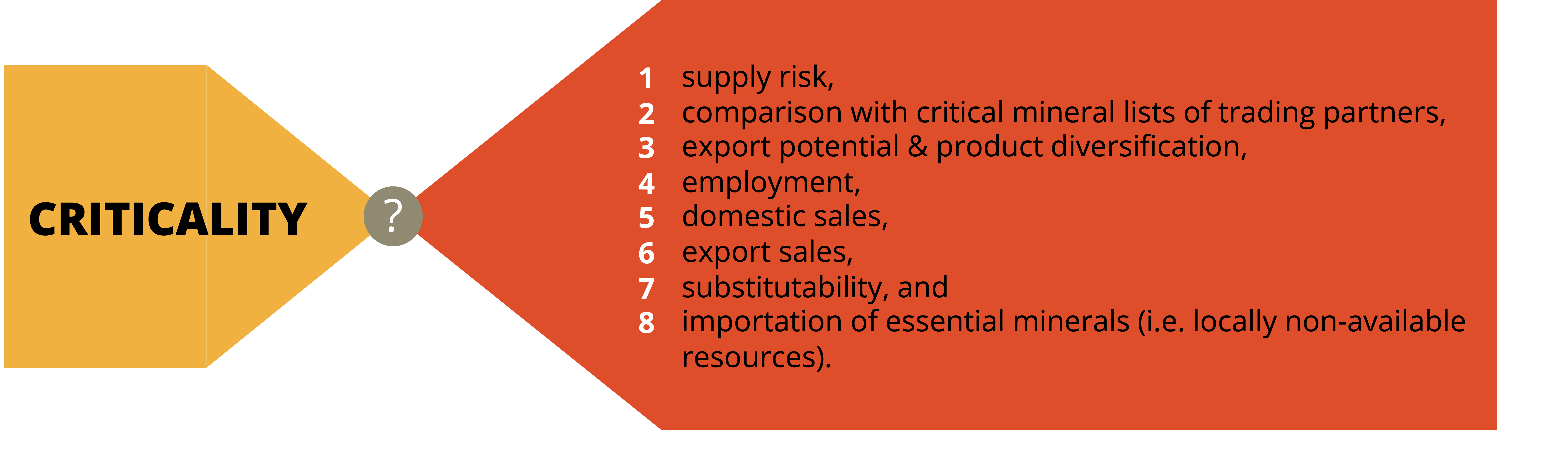
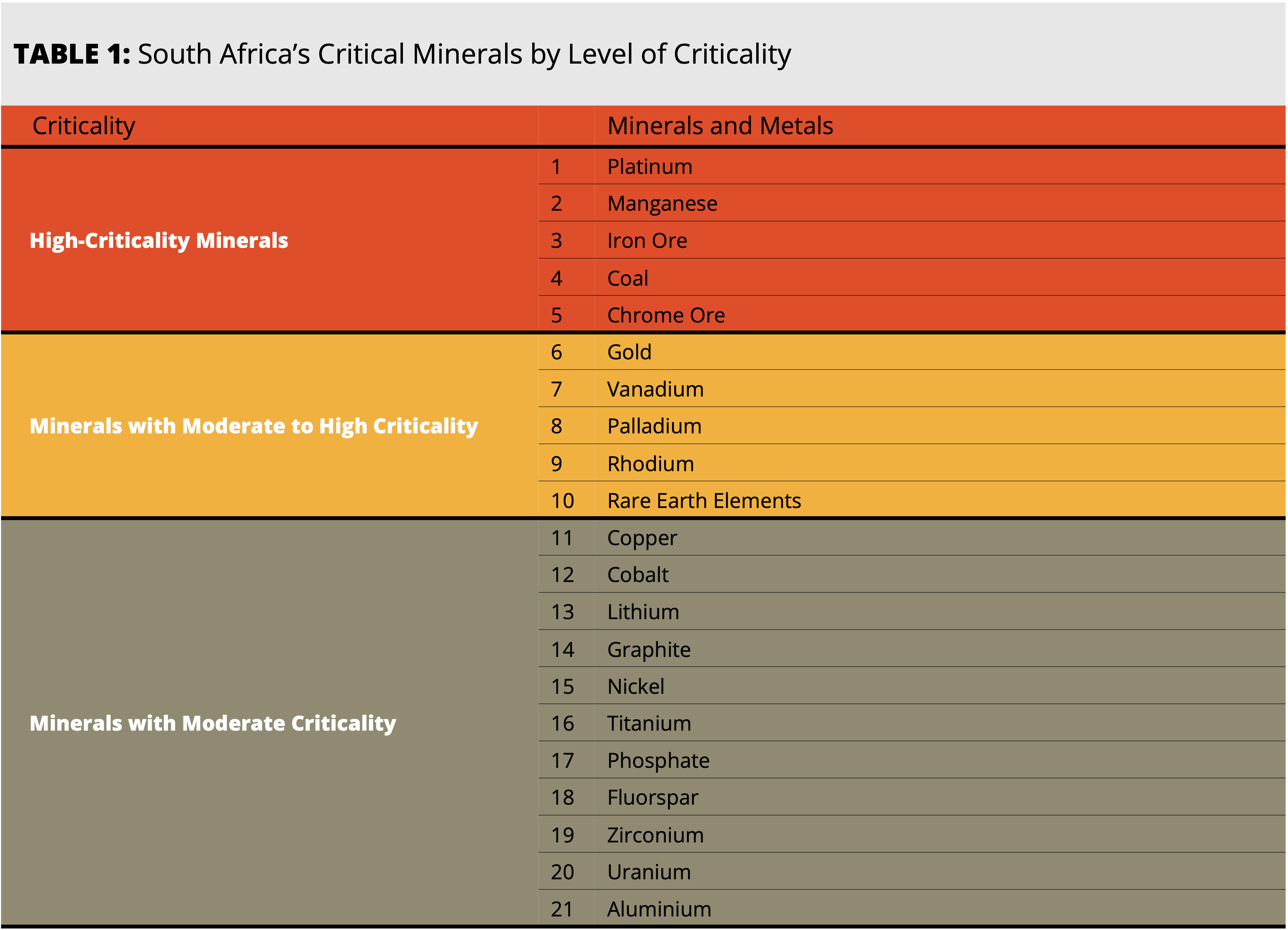
These indicators consider both the minerals South Africa produces and those it does not, acknowledging that strategic importance is driven not only by geological abundance but also by a mineral’s role in advanced technologies, its position in the value chain, and its potential to unlock broader socio-economic benefits. As a result, the document identifies platinum, manganese, iron ore, coal, and chrome ore as high-criticality commodities, and lists 16 others as either “moderate to high” or “moderate” criticality (see Table 1). In a statement by the Minister, it was mentioned that the list will “constantly be reviewed and updated” based on “underlying market conditions, exploration, technological advancement, substitutability, recycling, and geopolitics, among other factors”.
The second half of the CMMSSA contains a strategy section, described as “a gamut of cross-cutting, critical mining specific and sector specific interventions” (p. 22) (see Appendix for a summary). It outlines 9 strategic “pillars” (see below).
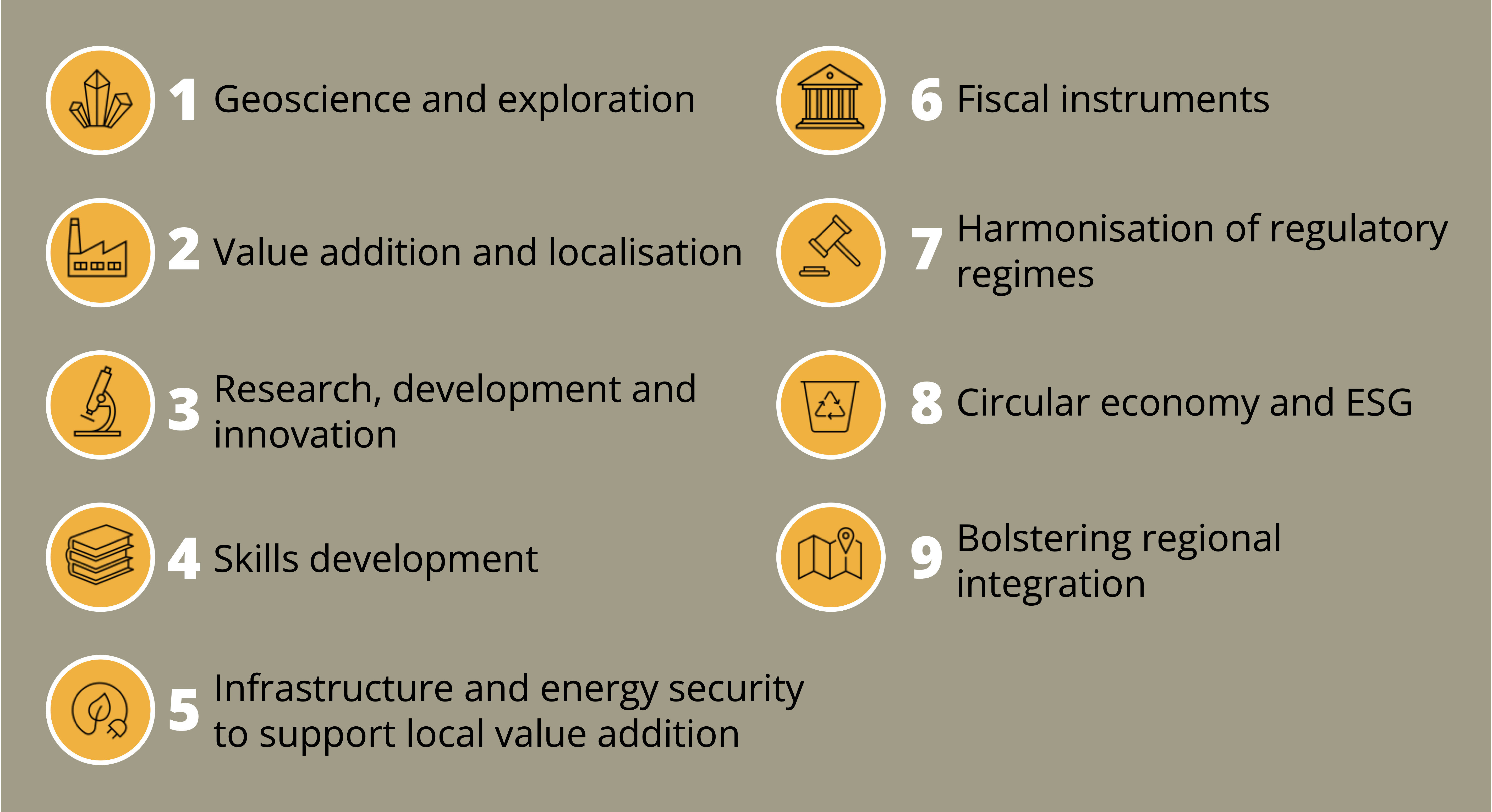
Together, the pillars reflect an ambitious and multi-dimensional effort to reposition South Africa within global critical minerals value chains.
Bold vision, uneven ground
The CMMSSA presents a timely and ambitious vision for repositioning South Africa within the global energy transition landscape. It recognises the country’s rich mineral endowment not as an end in itself, but as a platform for industrialisation, technological innovation, and regional collaboration. Its integrated approach – linking geoscience, beneficiation, skills development, infrastructure, and trade – signals a departure from fragmented policymaking and demonstrates a clear commitment to capturing greater value domestically. The emphasis on battery and hydrogen value chains, strategic use of fiscal incentives, and support for junior miners reflects responsiveness to global market trends and domestic structural gaps. Importantly, the strategy embraces the circular economy, regional integration, and just transition principles, suggesting a broader developmental vision that balances economic competitiveness with environmental and social imperatives. Yet, the picture is not without complications, a few of which are discussed below.
- Overextension vs. capacity
The Strategy touches on wide-ranging areas for intervention, from battery manufacturing hubs and hydrogen corridors to titanium-based medical technologies and artificial intelligence (AI) in mining. Yet South Africa’s longstanding difficulties with policy implementation, including delayed licensing, limited institutional capacity, critical skill limitations, inadequate monitoring, and recurring bureaucratic inefficiencies, prompt a fundamental question about how the management of critical minerals will depart from past patterns. Many of the proposed measures rely on coordination across multiple departments such as the Department of Mineral Resources and Energy (DMRE), the Department of Trade, Industry and Competition (DTIC), the Department of Science and Innovation (DSI), the Department of Higher Education and Training (DHET), and the Treasury. However, previous attempts at cross-departmental alignment have been weak and fragmented, undermining the policy coherence the Strategy seeks to establish.1
Furthermore, the regional integration envisioned by the Strategy depends on shared standards, infrastructure, and trust. Yet practical barriers remain, including weak border coordination, poor transport and energy links, overlapping regional commitments, and limited information sharing. Furthermore, divergent governance frameworks and persistent elite capture in certain jurisdictions present significant political obstacles to regional coordination. These factors raise questions about South Africa’s readiness to lead a cohesive critical minerals compact.
- Political economy blind spots
The Strategy underplays the political and institutional dynamics that will ultimately determine its success. It puts forward a rational economic vision centred on industrial upgrading and investor incentives, but pays insufficient attention to the underlying distribution of power and interests that shape outcomes in practice. These dynamics include tensions between departments and a regulatory environment often characterised by discretionary enforcement and opacity. For private investors, the key risks lie not only in technical constraints but in the political environment, where policy volatility and regulatory discretion are purported to create uncertainty.
These domestic challenges are compounded by a global playing field shaped by strategic state intervention, where countries like China use subsidies and industrial policy to dominate mineral value chains. Without coordinated regional strategies and stronger state capacity at home, South Africa will struggle to compete on fair or stable terms.2 Furthermore, the Strategy gestures towards regionalism but does not address the deeper question of how South Africa will manage power asymmetries within the region to foster a more inclusive critical minerals ecosystem, whether through benefit-sharing, technology transfer, or co-investment frameworks.
- Justice as an afterthought
The CMMSSA is likely to be praised by those who favour rapid implementation and fewer barriers for private investors to extract more, produce more, and expand their presence in South Africa. What remains underexplored, however, is the justice dimension of this agenda. Scaling up extraction and industrialisation will inevitably lead to increased land occupation, loss of biodiversity, pollution, and deeper impacts on communities situated near these developments. Despite the government’s repeated commitment to balance both growth and justice ideals, this commitment is not meaningfully reflected in the structure or priorities of the Strategy. While certain sectors such as mining are governed by regulatory frameworks that aim to balance the interests of workers, communities, and operators, this is not the case across the board. In particular, the manufacturing sector, which is central to the Strategy’s value addition ambitions, lacks comparable safeguards. Furthermore, the Strategy makes no attempt to integrate or address the justice principles espoused in the country's JETP commitments or its Just Transition Framework which should, in theory, underscore all transition-related plans.
Key concerns such as how fast-tracked approvals or financial incentives to private actors might affect people living near operations are not fully explored. It is unclear how existing legal provisions that emphasise community consultation and consent in land-intensive sectors like mining will interact with proposed measures to expedite licensing and rapidly expand industrial capacity. And, while the Strategy briefly refers to community benefits and inclusion, these ideas are marginal. Moreover, there is no engagement with the deep trust deficit between mining companies and affected communities, nor with the structures needed to resolve disputes or ensure fair distribution of benefits. Most importantly, the document fails to acknowledge that meaningful inclusion requires time, resources, and deliberate planning. If justice is truly a priority, it must be incorporated into project design, implementation budgets, and timelines.
Prioritising social justice is not a question of mere ideology. South Africa’s recent history has shown that there are real consequences when these considerations are ignored. The country has a deep and checkered history of activism and political struggle. Its dynamic civil society, bolstered by the country’s globally-renowned constitution and human rights protection, has led to significant push back in the form of legal action, protest, and media coverage. If consultation and co-creation are not built into project design, it can lead to significant project delays or costs down the road.
- Regular regulatory tension
One of the defining tensions of South Africa’s democratic era has been the clash between two competing development ‘ethics’. One relies on integration into global markets and investor confidence. The other seeks to correct structural inequalities and extend the promise of dignity and opportunity to those historically excluded. South Africa’s transformation agenda reflects this tension, as seen in efforts to expand ownership, promote equity, and link economic growth with social redress.
This tension is visible in South Africa’s continuous negotiation and social compacting efforts over its mining legislation. In fact, on the same day the CMMSSA was released, draft amendments to the Mineral and Petroleum Resources Development Act (MPRDA), the country’s primary mining legislation, were also published for public comment. The draft received a more cautious reception, however, with some stakeholders criticising it for directly contradicting the provisions of the CMMSSA. This is because it includes provisions that would significantly shift the regulatory landscape, intensifying racial transformation requirements in ways that some say may deter the investment sought by the Strategy. For instance, it removes a rule that let companies keep their empowerment status after Black shareholders exited, requiring ongoing Black ownership. It sets racial ownership targets at the exploration stage (a move that has since been reversed), reserves some licences for Black South Africans, and extends ministerial control over ownership changes, including abroad. It also expands obligations around local beneficiation, mine closure, and environmental liability, and reclassifies historic mine dumps as requiring full mining rights.
These two parallel policy formulations reflect a clear tension between the country’s ambition to position its mining industry as a vehicle for transformation and distributional justice, as reflected in its just transition commitments, and its parallel goal of accelerating investment and innovation in the critical mineral space. It remains uncertain whether the investor community views these justice-oriented provisions in the MPRDA as a meaningful framework to contribute to, or as a regulatory risk to be managed or avoided.
Lessons beyond South Africa
South Africa’s attempt to strategically manage its critical minerals endowment holds important lessons for other African countries navigating the energy transition. The Strategy represents an important first step, though its real impact will depend on how it is implemented. Nevertheless, the document itself offers valuable insights. First, it demonstrates the value of developing national definitions of criticality that are grounded in local industrial needs, supply risks, and development goals. This departs from frameworks used in developed countries, and supports policy autonomy. Second, the Strategy reflects the importance of integrating mineral policy with infrastructure planning, research and innovation systems, skills development, and regional trade objectives. Fragmentation has long undermined industrial policy on the continent, and South Africa’s multi-pillar approach offers a potential model. Finally, while the Strategy has notable blind spots, it highlights the necessity of confronting tensions between growth, justice, and investor confidence head-on. African countries seeking to scale critical mineral extraction will need to anticipate similar tensions, and should invest early in the governance, dispute resolution, and participatory mechanisms required to manage them.
Conclusion
In closing, it has to be underlined that the CMMSSA offers a bold and wide-ranging blueprint for leveraging South Africa’s mineral wealth to drive industrialisation, regional leadership, and sustainable development. It outlines a cohesive and forward-looking vision that responds to global energy transitions and seeks to embed economic competitiveness within a broader developmental agenda. Yet, its success will depend less on vision than on implementation. The Strategy’s impact will ultimately be determined by the state’s ability to overcome entrenched institutional weaknesses, manage the trade-offs between growth and justice, and navigate competing policy signals that risk undermining investor confidence. Without attention to these underlying dynamics, even the most ambitious strategy may struggle to deliver meaningful and inclusive transformation.
There are nonetheless reasons for optimism. If South Africa has honed any particular craft in its democratic era, it is the ability to negotiate complex social compacts. These processes often unfold quietly, and the compromises they produce can leave all sides somewhat dissatisfied. Yet it is precisely this capacity for inclusive dialogue and iterative consensus-building that has allowed the country to navigate deep divisions and competing priorities. This political culture is once again on display in the current formation of a coalition government of national unity. And it is this same spirit of negotiated progress that will be essential in reconciling the ambitions of the Strategy with the imperatives of a just and equitable transition.
Endnotes
[1] Cross-departmental collaboration has, in recent years, been prioritised by the Presidency through initiatives such as Operation Vulindlela, a joint initiative of the Presidency and National Treasury aimed at accelerating the implementation of structural reforms and supporting economic recovery, and the Project Management Office (PMO), which supports the delivery of key strategic priorities from the centre of government. The PMO works across departments to enhance coordination on issues such as energy security, infrastructure delivery, and youth employment.
[2] While the CMMSSA makes a vague reference to state support under its export pillar, South Africa's trade and industrial policy remains constrained by its commitment to World Trade Organisation (WTO) rules and global trade norms, limiting its ability to deploy the kinds of interventionist subsidies and protective measures used by countries like China.
About the Author

Judy Hofmeyr
Judy Hofmeyr is a Green Transition Minerals Fellow at APRI and a University of Manchester PhD candidate leveraging extensive experience in Southern Africa's mining sector to research natural resource governance, human rights, and the socio-legal impacts of the energy transition in Africa.

This commentary is funded by the Stiftung Mercator Foundation as part of the Geopolitics and Geoeconomics of Africa-Europe Relations Project.