

Executive Summary
Context
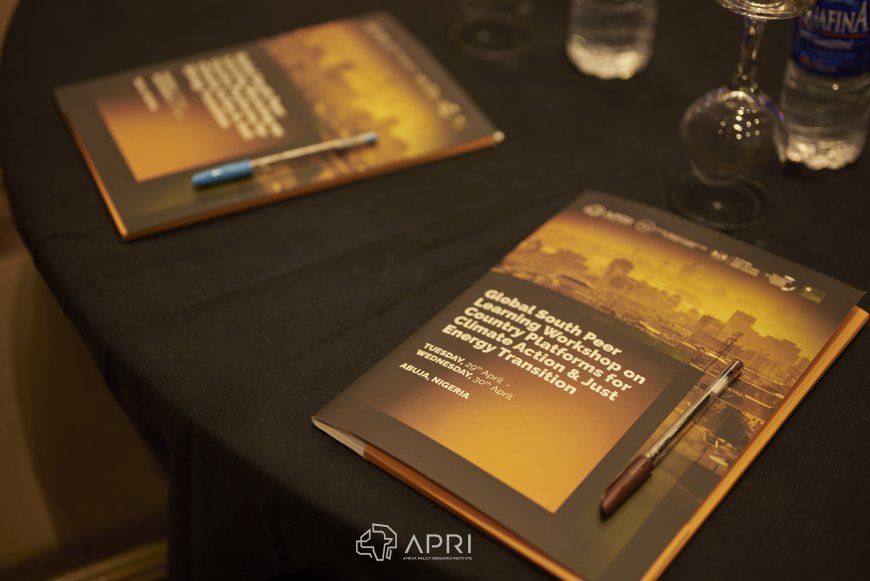
APRI - Africa Policy Research Institute and key partners convened more than 150 participants from Global South peer countries in Abuja on April 29 and 30th, 2025, to explore Just Energy Transition Partnerships (JETPs) and co-design a fit-for-purpose Country Platform for Climate Action and Just Energy Transition.
Recent reforms, including the Electricity Act 2023, Petroleum Industry Act, Energy Transition Plan (ETP), and Climate Change Act, have created a complex and fragmented policy environment that requires harmonization. Without clear leadership, effective institutional coordination, and strong stakeholder engagement, overlapping strategies may undermine private sector investment, donor confidence, and coherent climate action.
Designing a Reflective Country Platform
- Beyond JETP Emulation: Nigeria needs a development-rooted, multi-stakeholder platform, not simply a donor-driven replica of other JETPs.
- State‐Owned & Deliberative: The platform must be politically anchored (preferably under presidential mandate) yet open to subnational, private, and civil society inputs.
- Alignment & Flexibility: Climate objectives should align with economic growth, job creation, and energy access. Modularity allows for attention to be given to energy, agriculture, transportation, industrialisation, and finance.
- Formal Governance: Drawing lessons from South Africa’s Presidential Climate Commission, the platform needs clear accountability, social compacting mechanisms, and real-time linkage between vision and implementation.
Political Settlements
- Presidential Leadership: High-level political buy-in (President or NEC) is critical to issue clear mandates across MDAs and reconcile competing interests.
- Federal Dynamics: Nigeria’s federal structure requires vertical coordination, ensuring states, especially oil-producing ones, have incentives and a voice.
- Oil-Region Bargains: Given dependency on fossil revenues, transitions must be negotiated with oil-producing states, labour unions, and political elites to build legitimacy.
- “Elite Bargain” for Development: Climate agendas should be reframed as part of a new national development compact that balances winners/losers and secures social license.
- Government-Led Mobilization: Experiences from Indonesia and Vietnam show domestic leadership, rather than external partners, drives cohesive, national action.
Finance & More Financing
- Coherence Over Abundance: Nigeria’s challenge is not a lack of funds but weak coordination and institutional readiness to deploy them effectively.
- Commitments vs Disbursements: Even well-funded JETPs (e.g., South Africa’s $8.5 billion) struggle to translate pledges into on-the-ground projects; Nigeria must avoid similar pitfalls.
- Access & Capacity Bottlenecks: No single “front door” exists to interface with climate funds, carbon markets, development finance, and blended instruments, creating fragmentation.
- De-Risking & Clarity: Private investors demand clear return profiles, streamlined regulations, and project pipelines with high readiness; a national financing strategy must crowd in local capital (pensions, banks, green bonds) and align macroeconomic policy (exchange rate stability) with climate signals.
- Integrated Solution: “Finance is part of the solution,” but must be coupled with institutional readiness, political credibility, and market confidence to unlock transformative impact.
Development Approach
- Reframe Climate as Development: The transition must prioritize co-benefits such as job creation, industrial growth, energy access, food security, and social protection, rather than focusing solely on emissions.
- Balance Adaptation & Mitigation: Address Nigeria’s underlying development deficits by integrating adaptation measures (e.g., resilience in vulnerable communities) with mitigation targets.
- Align with National Plans: Country Platform design must dovetail with Nigeria’s National Development Plan, ETP, and sectoral roadmaps, ensuring climate and development converge.
- National Ownership: Donors must align behind Nigeria’s defined priorities, while Nigerian institutions assert leadership, ensuring climate policy feels indigenous rather than imposed.
Inclusivity & Justice
- People-Centred Transition: Local communities, particularly those in oil-producing areas, must be meaningfully included in decision-making rather than merely consulted.
- Youth, Women, Marginalized: Embed these groups in governance structures (e.g., youth councils, women’s representation) rather than relegating them to token roles.
- Reskilling & Social Protection: Design reskilling programs and safety nets for workers displaced by the transition, ensuring no one is left behind.
- Geographic Fairness: Prevent deepening North-South or urban-rural divides by ensuring equitable resource allocation and program delivery.
- Multi-Stakeholder Governance: Draw on South Africa’s social compact model to institutionalize conflict resolution, grievance redress, and long-term accountability.
Private Sector & Labour
- Fragmented Engagement: Private sector stakeholders often feel excluded from decision-making processes or remain unclear about available incentives. Lessons from JETPs highlight the importance of consistent policy signals, including tax reforms, subsidy realignment, and regulatory coherence, to attract and sustain investments in decarbonization.
- Labour Concerns: Workers in oil-dependent jobs worry about lack of transition planning; labour unions call for structured reskilling and social safety nets.
- Structured Engagement: The country platform should create formal engagement windows (e.g., sectoral roundtables, labour seats on governance boards) to reconcile private-sector ambitions and labour interests.
Geopolitics & Global Realities
- Global Fragmentation: Nigeria must carefully navigate shifting global dynamics, including political uncertainty in the United States, the European Union’s Carbon Border Adjustment Mechanism (CBAM), and China’s green diplomacy, while avoiding “hypocrisy traps” in which major polluters continue to expand fossil fuel activities.
- Interest-Based Cooperation: Define Nigeria’s interests for climate cooperation across blocs (West, BRICS, Gulf) to attract partnerships aligned with national development goals.
- Continental & Regional Leverage: Leverage a unified position in AU, ECOWAS, and OPEC negotiations to secure fairer terms for financing, technology transfer, and market access.
An Ideal vs. Practical Scenario
- Ideal Platform: The framework should be fully institutionalized under a presidential mandate, cross-sectoral in scope, legally grounded, adequately resourced, and inclusive, ensuring a strong link between long-term vision and real-time implementation.
- Realistic Pathway: Start with a lean secretariat housed in an existing structure (e.g., Ministry of Planning or ETP Office), secure clear political support (President and NEC), and coordinate donors/private sector via technical working groups.
- Phased Implementation: Pilot key sectors or state platforms while building capacity, refining institutional arrangements, and demonstrating early wins to build momentum.
Conclusion
- Tailored Design: Nigeria’s country platform must reflect its unique political economy, development priorities, and socio-economic realities rather than replicate existing models.
- Core Requirements: Secure genuine political buy-in; bridge funding commitments with project readiness; frame climate action as an enabler of inclusive development and social justice.
- Operational Principles: Foster transparent coordination, equitable participation, and pragmatic, phased implementation. Balance ambition with political pragmatism to avoid stalling.
- Adaptive & Sovereign: The platform should remain adaptive to evolving global geopolitical dynamics and domestic conditions, strategically leveraging international partnerships while safeguarding national sovereignty, equality and resilience.