The Iran Conflict and Africa’s Food Security: Policy Pathways Beyond Emergency Response
The crisis underscores how concentrated control over strategic maritime corridors and fertilizer supply chains continues to shape food security outcomes far beyond the immediate conflict zone.

Key Takeaways
-
The Iran-US conflict has disrupted the critical Strait of Hormuz maritime corridor, creating a severe global fertilizer shock. Africa is uniquely vulnerable because this supply limitation directly coincides with major regional planting seasons, threatening immediate crop yields and food security.
-
Fertilizer markets are absorbing damage across multiple channels simultaneously, including soaring raw material prices, spiked maritime insurance premiums and widespread speculative behavior.
-
The crisis has once again exposed deep-seated flaws in Africa’s agricultural infrastructure: heavy reliance on external imports, fragmented regional markets and limited strategic reserves.
-
Standard emergency subsidies are fiscally unsustainable and insufficient on their own. Governments must pivot toward coordinated regional market stabilization, targeted farmer support, and expanded local blending and production capacities.
-
Instead of relying on reactive crisis management, African leadership should leverage the AfCFTA and Regional Economic Communities (RECs) to build an integrated continental market, accelerate regional production hubs, and secure long-term food system resilience.
Introduction: A Geopolitical Shock Reaches Africa’s Fields
The escalating confrontation involving Iran and the United States has rapidly evolved beyond a regional security crisis into a global economic and food systems shock. At the center of the disruption lies the Strait of Hormuz, one of the world’s most strategic maritime chokepoints through which significant volumes of oil, natural gas (liquefied natural gas), and fertilizer products (and raw materials) transit every day. For Africa, the consequences have been immediate and profound.
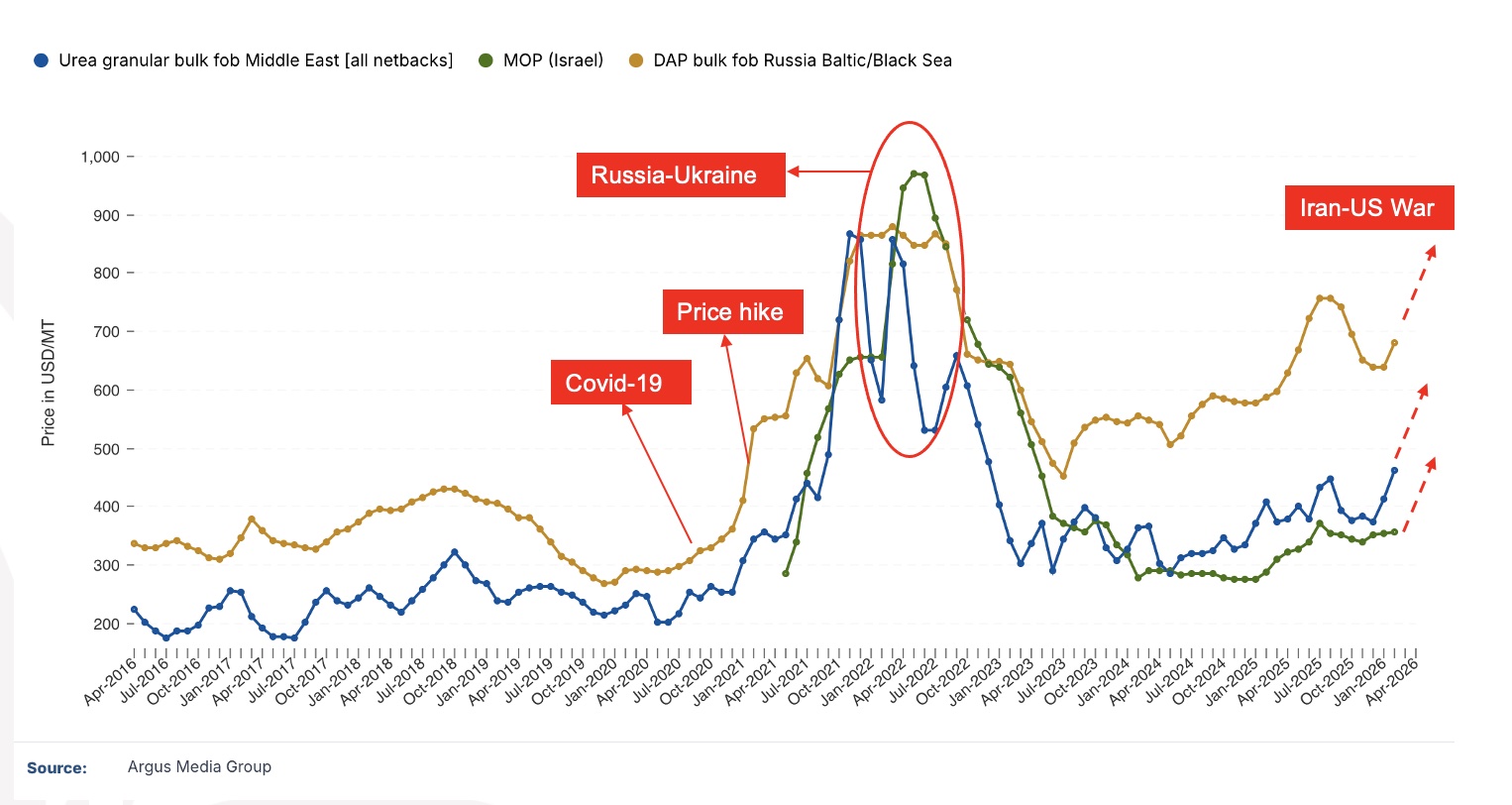
According to the International Fertilizer Association (IFA), the Middle East accounts for a substantial share of globally traded fertilizers. Countries in the Arab Gulf, directly exposed to disruptions around the Strait of Hormuz, account for approximately 34% of global urea exports, 18% of global MAP/DAP (monoammonium phosphate and diammonium phosphate) trade, 23% of global ammonia exports, and 50% of global sulfur trade. Within weeks of the conflict's escalation, urea prices surged by nearly 58% (according to Argus Media), while freight and insurance costs rose sharply as shipping routes became increasingly risky.
Figure 1: Historical Fertilizer Price trends to date
Africa enters this crisis from a structurally vulnerable position. The continent imports more than 80% of the fertilizer it consumes, while fertilizer application rates remain among the lowest globally. Yet timing matters as much as dependency. Many African countries are entering or preparing for critical planting seasons, meaning even temporary supply disruptions may translate into reduced fertilizer application, lower yields, rising food prices, and heightened fiscal stress. This, coupled with the procurement of smaller batches of fertilizer in readiness for the planting season, means that most countries in Africa have been caught in the crosshairs.
The crisis therefore extends beyond fertilizer availability. It raises deeper questions regarding Africa’s strategic dependence on external supply chains, the resilience of regional markets, and the continent’s ability to coordinate policy responses in a fragmented geopolitical environment. This paper delves into what options, policy and otherwise, Africa could explore to mitigate these far-reaching consequences now and for future crises.
The current crisis is not an isolated event but part of a recurring pattern of external shocks exposing structural weaknesses in Africa’s food and fertilizer systems. From COVID-19 to the Russia-Ukraine conflict and now the Strait of Hormuz disruption, Africa repeatedly absorbs external volatility generated elsewhere. This raises broader questions about strategic dependency, economic sovereignty, and the resilience of Africa’s integration into global commodity systems.
Why the Strait of Hormuz Matters for Global Fertilizer Markets
The current fertilizer shock continues to demonstrate how deeply interconnected global energy, shipping, and agricultural systems have become. Nitrogen fertilizer production depends heavily on natural gas, phosphate-based planting fertilizers depend on sulfur, while global fertilizer trade relies on stable maritime logistics and affordable freight.
The Strait of Hormuz is central to this system. Major fertilizer exporters such as Iran, Qatar, Saudi Arabia, Bahrain, and the United Arab Emirates depend on this corridor to move products into global markets. As tensions escalated, fertilizer producers in the region reportedly reduced operations while traders reacted rapidly to supply uncertainty. For instance, at the height of the conflict in March, the Qatar Fertilizer Company (QAFCO) shut down its urea production, and Bahrain’s BAPCO declared force majeure on its sulfur production.
The disruption has affected markets through three principal transmission channels.
-
First, fertilizer prices have risen sharply due to fears of supply shortages and export disruptions. Urea prices increased from approximately $493/ton before the conflict to above $780/ton within weeks. MAP, DAP, and potash prices have also increased significantly.
-
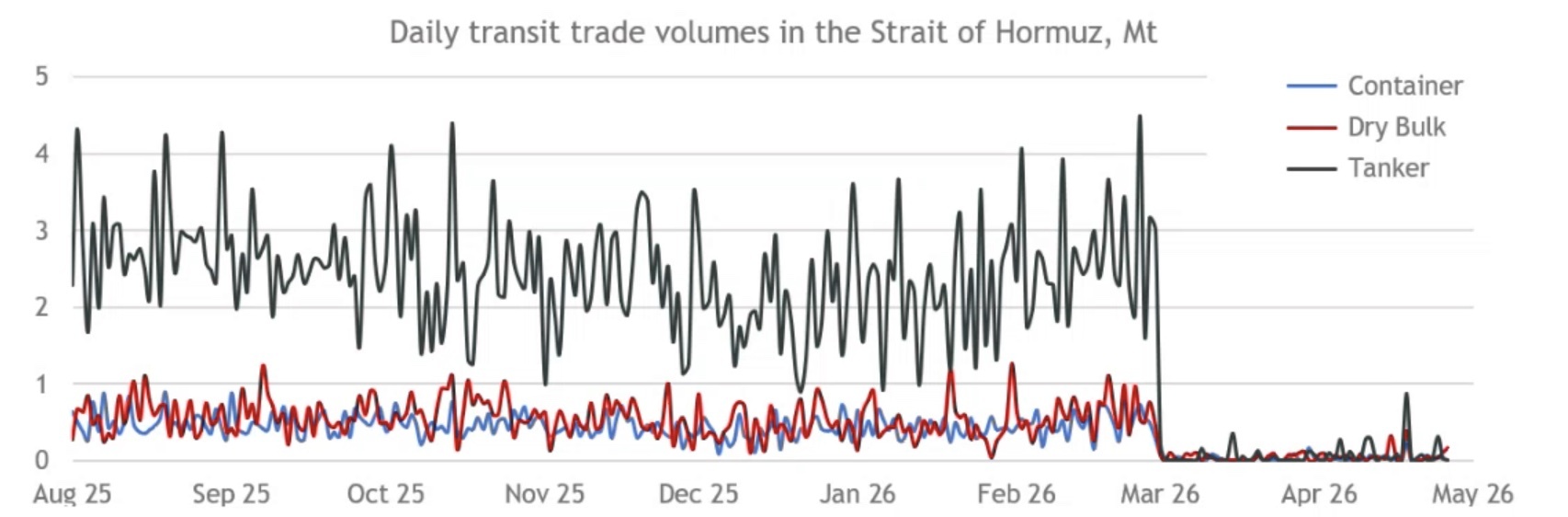
Second, freight and insurance costs have surged. Shipping through the Gulf has become substantially more expensive due to elevated war-risk premiums and declining insurer appetite for regional exposure. These costs are transmitted directly into fertilizer landed prices, particularly for import-dependent countries in Africa and Asia. A direct consequence has also been significant reduction in vessel traffic through the Strait, leaving fertilizer volumes destined for export markets stranded.
Figure 2: Transit trade volumes through the Strait of Hormuz
-
Third, market uncertainty itself is tightening supply conditions. Traders and importers are becoming increasingly cautious, procurement decisions are delayed, and speculative behavior is contributing to additional volatility.
The fertilizer market is experiencing not only a physical supply disruption but also a crisis of confidence and predictability. Recent tender results and awards in India through Indian Potash Limited (IPL) have acted as a barometer for stable urea and phosphate (DAP/ TSP) fertilizers in the short- to medium- term.
Africa’s Structural Vulnerability: Import Dependence Versus the Planting Season
Africa’s exposure to the current shock is rooted in longstanding structural weaknesses within its fertilizer systems. A fundamental reality is that Africa’s fertilizer vulnerability is not only about import dependence but also about timing, coordination, and weak shock-absorption capacity.
The continent accounts for only a small share of global fertilizer consumption (4%) despite having one of the world’s fastest-growing populations and largest agricultural labor forces. Average fertilizer application rates in sub-Saharan Africa remain significantly below global averages (23 kg/ha against a global average of 135 kg/ha), contributing to low yields and declining soil fertility.
At the same time, Africa remains heavily dependent on imported finished fertilizers and raw materials. This dependence extends beyond product supply to financing, shipping, insurance, and foreign exchange availability. As a result, global disruptions are in most cases transmitted rapidly into local agricultural markets.
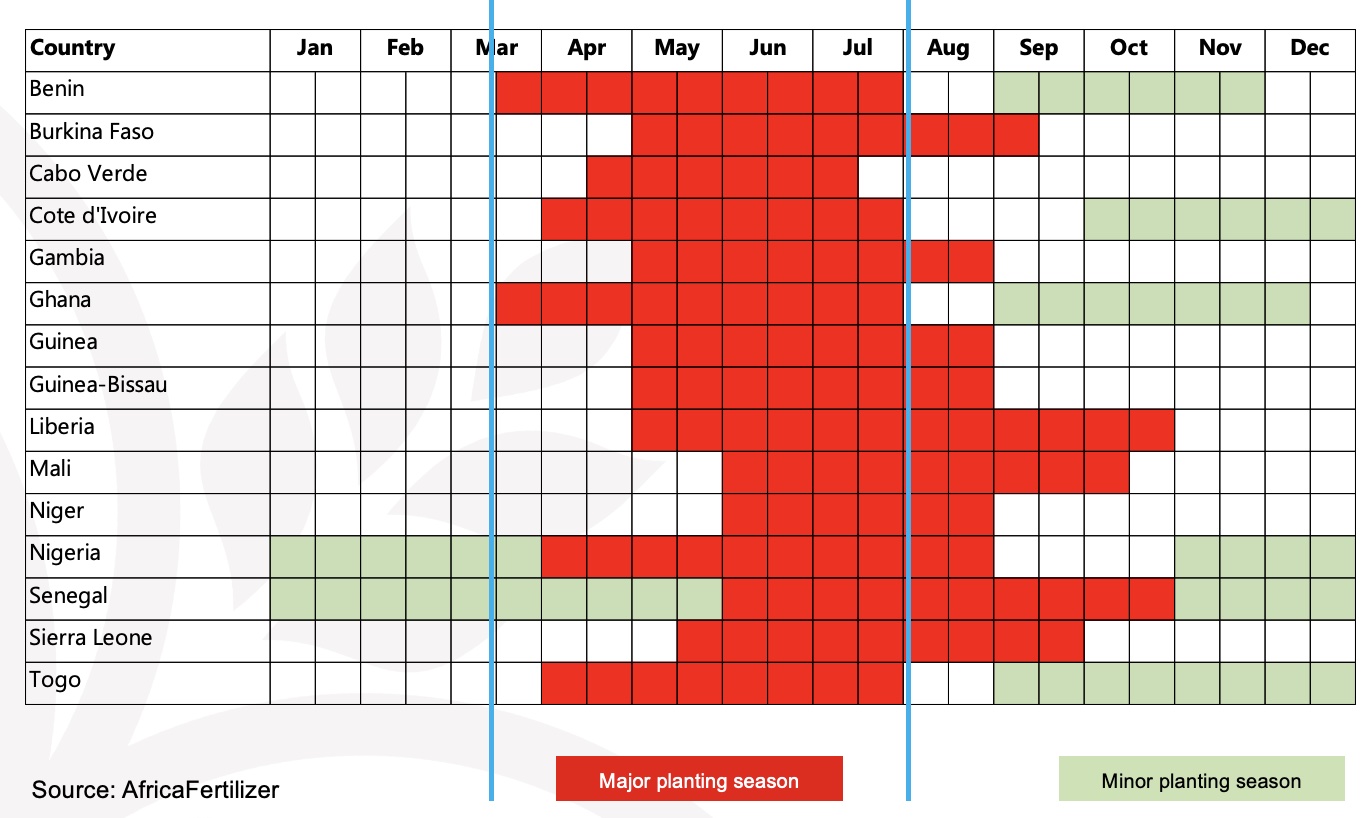
The timing of the current crisis makes the situation especially severe. West Africa faces immediate exposure because many countries are in the middle of peak fertilizer demand periods ahead of planting seasons. Countries such as Ghana, Côte d’Ivoire, Burkina Faso, and Mali already report significant supply gaps and procurement uncertainties. Landlocked Sahelian countries face additional risks linked to corridor disruptions and rising logistics costs.
Figure 3: Crop calendar for countries in West Africa
East Africa presents a mixed picture. Kenya has already experienced retail fertilizer price increases of approximately 27%, reflecting the rapid pass-through from global markets. Countries with ongoing planting seasons are particularly vulnerable because new imports will arrive at substantially higher prices than existing stocks.
Southern Africa currently benefits from a temporary buffer due to post-harvest timing. However, procurement cycles for the 2026–2027 season are likely to occur under structurally tighter market conditions.
Likely Scenarios and Consequences for African Agriculture
Several plausible scenarios are emerging. These are supported by a recent assessment by the IFA on the extent of the exposure of fertilizer markets globally and in Africa. It is important to note that these scenarios are underpinned by the complex geopolitical intricacies of this conflict and, as such, might change quite quickly.
Scenario 1: Short-term disruption and market stabilization (Best-case scenario)
This posits that there is a robust ceasefire agreement between the warring parties and a return to normalcy is seen within 120 days with a rapid recovery in market conditions. The effect of this would be firm price levels as currently being witnessed, and these will be sustained through 2026. Countries that had front-loaded inventory will be affected minimally in the first two quarters and only exposed to price spikes in newer procurements later in the year.
Scenario 2: Longer-term disruption of 6-12 months with continued conflict and blockades at the Strait with intermittent vessel flows. The impacts of high prices and constrained availability persist into 2027. This raises the risk that Africa will face high costs for fresh imports and subsequently depressed crop yields and food security issues.
Scenario 3: A minimum of 12 months of disruption that results in multi-season impacts into 2028. This would account for a longer return to normalcy due to restarts required for production facilities. Essentially, disruptions to availability and affordability would continue, leading to yield declines and fiscal crises.
Scenario 4: (Worst case scenario). A complete breakdown of systems resulting in longer-term impacts, and prolonged disruption periods with no return to normal trade flows as we know them. This would lead to a rebalancing of global flows of energy, fertilizer, and food.
The impact on Africa would be more severe in all the scenarios above due to import dependency, expensive logistical costs involved in sourcing from alternative markets, and weak structural barriers to fertilizer trade within the continent. As the IFA notes, “...even short disruptions can trigger disproportionately large market reactions because fertilizer demand is synchronized with global planting calendars...”
For many African economies, the fertilizer shock risks evolving into broader, far-reaching ramifications around inflation, depressed yields, and political-economy crises, particularly in highly import-dependent countries already facing debt distress and currency pressures.
Policy Options for African Governments
African governments face difficult policy choices. Blanket subsidies alone are unlikely to provide sustainable solutions given fiscal constraints and rising international prices.
Instead, responses should focus on strategic stabilization and resilience building.
Immediate Policy Measures: Governments should prioritize rapid market intelligence and coordinated procurement. Timely information on stocks, import gaps, and cropping calendars is essential to avoid panic-driven decisions. ECOWAS has already initiated regional coordination efforts to assess fertilizer availability and synchronize responses among member states. Immediate actions could include prioritizing fertilizer imports within foreign exchange allocation systems, temporarily reducing trade and customs bottlenecks, facilitating private sector import financing, avoiding abrupt export restrictions or distortionary market interventions, and, where subsidies exist, targeting support toward vulnerable farmers rather than generalized subsidies.
Medium-Term Measures: Beyond immediate crisis management, governments should invest in systems that improve resilience to future shocks. These could include establishing strategic fertilizer reserves, expanding local blending capacity, supporting organo-mineral fertilizer systems, promoting integrated soil fertility management, and strengthening extension services and fertilizer efficiency programs.
Importantly, fertilizer profitability at the farm level must improve. Historically, many farmers have reduced fertilizer use not only because prices increased but because crop prices and soil productivity did not justify the investment.
Long-Term Structural Transformation: The current crisis reinforces the need for Africa to treat fertilizer as a strategic food security asset rather than simply a tradable commodity.
Long-term policy priorities should therefore include regional fertilizer production hubs as resolved by the African Union. They should also include gas-to-fertilizer investments in countries like Ethiopia, Nigeria, and Angola, nutrient recycling and use efficiency systems, the expansion of domestic phosphate and organic fertilizer industries, and coordinated continental fertilizer strategies under the African Union framework.
Policy options will differ significantly depending on fiscal space, domestic production capacity, and market structure. While countries such as Nigeria, Morocco, and Egypt may leverage domestic production and regional exports, highly import-dependent and fiscally constrained states in other parts of Africa face narrower policy space and may require coordinated regional support.
So, What Next? Is the AfCFTA a Solution?
A few emerging solutions could be considered going forward. The AfCFTA, as a policy framework, has been touted as a possible solution to some of the ills bedeviling Africa’s trade. Africa’s fertilizer markets still remain fragmented, with inconsistent regulations and limited cross-border coordination. As a result, countries often compete against each other during global supply disruptions, as is currently the case, driving prices even higher. Recent AU-led frameworks that have been proposed, down to the Regional Economic Communities (RECs), would result in a strategic shock-absorbing mechanism capable of enabling faster cross-border fertilizer movement from producing countries such as Nigeria, Morocco, and Senegal to neighboring countries, harmonized standards, reduced tariff and non-tariff barriers, regional procurement coordination, and the expansion of intra-African fertilizer trade in the long term.
RECs are particularly important in operationalizing these efforts. ECOWAS has emerged as a leading example through technical and ministerial convenings in West Africa to develop a coordinated response to the current fertilizer crisis. Some of the proposed interventions include securing strategic reserves via framework agreements with regional producers; financing at scale through liquidity swap lines, credit guarantees, freight/insurance co-financing, and working capital for importers and agro-dealers; establishing fertilizer buffer stocks either at the national or ECOWAS level; waiving all tariffs, including the recently introduced 9% VAT in Côte d'Ivoire; and helping governments build stronger strategic relationships with regional producers and suppliers by supporting them during regular seasons to enable them to better respond in the future.
Beyond financing and coordination, the current crisis also highlights how policy and trade rules can either stabilize or destabilize fertilizer markets. On the African side, enabling measures include harmonized fertilizer regulations, reduced non-tariff barriers, coordinated regional procurement, fast-tracked customs clearance, strategic reserve frameworks, and stronger implementation of AfCFTA protocols to facilitate cross-border fertilizer movement. Conversely, fragmented subsidy regimes, ad hoc export restrictions, foreign exchange controls, inconsistent tariffs, and delayed border procedures risk amplifying supply disruptions and increasing intra-African competition for limited fertilizer volumes.
Non-African actors, international financial institutions, development partners, and multilateral agencies also play a decisive role in shaping market outcomes. Stable export policies, trade finance support, investment in African fertilizer production, and the maintenance of open shipping and insurance corridors can help stabilize supply chains during periods of crisis. However, protectionist export measures/restrictions as seen in Asia and the Baltic regions, sanctions spillovers, speculative trading behavior, and the withdrawal of maritime insurance coverage can intensify market volatility and disproportionately affect import-dependent African economies.
Private sector actors remain central. Traders, producers, and logistics firms will continue to shape market outcomes through investment decisions, risk management, and the allocation of supply to Africa, which has long been viewed as a high-risk market. The challenge therefore is not simply increasing fertilizer availability but ensuring that coordination mechanisms reduce uncertainty, particularly from a policy perspective.
The current disruption highlights that Africa’s fertilizer challenge is not merely agricultural but industrial. Fertilizer systems sit at the intersection of energy policy, industrialization, mining, logistics, and regional integration. Ultimately, the crisis demonstrates that fertilizer security is increasingly shaped not only by production capacity, but also by the governance rules, trade systems, and geopolitical decisions that determine how supply flows during periods of global disruption and their interconnectedness with other sectors.
Conclusion: From Crisis Response to Strategic Fertilizer Sovereignty
The current Iran-US related fertilizer shock is not an isolated disruption. It is the latest reminder of how vulnerable African food systems remain to external geopolitical events.
The crisis demonstrates that fertilizer security cannot be separated from energy security, trade logistics, industrial policy, or regional integration. Africa’s dependence on imported fertilizer systems leaves the continent repeatedly exposed to shocks originating far beyond its borders.
Paradoxically, the crisis may accelerate reforms and investments that Africa has long postponed, including regional fertilizer integration, local production, strategic reserves, and coordinated continental market governance.
Rather than relying solely on emergency responses and short-term subsidies, African governments and regional institutions have an opportunity to build more integrated, resilient, and strategically coordinated fertilizer systems. The AfCFTA, AU-led coordination mechanisms, regional production investments, and stronger market intelligence systems could collectively reduce Africa’s exposure to future disruptions.
Ultimately, the issue is not only about fertilizer availability. It is about whether Africa can transition from reactive crisis management toward long-term strategic resilience.
The current disruption may therefore become more than a geopolitical shock. It may become the catalyst for a new continental approach to fertilizer security, food systems resilience, and economic sovereignty.
About the Author

Sebastian Nduva
Sebastian Nduva is a Fertilizer Market Specialist and the current AfricaFertilizer Lead at the International Fertilizer Development Center (IFDC).