
Foto von Ross Sneddon auf Unsplash
Wohin geht die Reise? Kann Nigeria seine Wirtschafts- und Klimaziele gleichzeitig erreichen? (EN)
Kann Nigeria zu einer 1-Billionen-Dollar-Wirtschaft heranwachsen und gleichzeitig seine Emissionen senken? Diese Analyse beleuchtet die Zielkonflikte, Risiken und Wege, die die Zukunft des Landes in Bezug auf Klima und Wirtschaft prägen.
Summary
- Nigeria is pursuing dual objectives of achieving a USD 1 trillion economy by 2030 while committing to a 29% absolute emissions reduction, creating a complex climate-economy balancing challenge.
- The current economic model remains highly carbon-intensive, with evidence showing that every 1% GDP growth leads to a 3.11% increase in emissions, highlighting structural misalignment between growth and climate goals.
- Institutional coordination between the Federal Ministry of Budget and Economic Planning (FMBEP), National Council on Climate Change (NCCC), and Energy Transition Office (ETO) is central but constrained by weak KPI alignment and implementation gaps.
- Key trade-offs shape policy decisions, including growth vs. emissions, energy access vs. clean sources, and fiscal stability vs. transition speed, with natural gas positioned as a transitional but contested solution.
- Despite challenges, opportunities exist through job creation, climate-resilient infrastructure, decentralized renewable energy, and multilateral initiatives like Mission 300, though these require significant financing and policy coherence to scale.
Executive summary
Nigeria is currently in a decisive phase of national development, attempting to solve the dual equation of rapid economic prosperity and global environmental responsibility. This analysis explores the coordination between the "Renewed Hope" National Development Plan (NDP) 2026-2030, which targets a USD1 trillion GDP by 2030, and the updated Nationally Determined Contribution (NDC 3.0), which commits to an absolute emission reduction of 29% by 2030. The institutional framework is anchored by the Federal Ministry of Budget and Economic Planning (FMBEP), the National Council on Climate Change (NCCC) and the Energy Transition Office (ETO).
Despite a staggering USD27.2 billion annual climate finance gap, vital pathways are emerging through multilateral partnerships like Mission 300. While primarily an electricity access initiative, Mission 300 acts as a climate action by prioritizing renewable energy to avoid future emissions and displace over 250,000 polluting generators. However, a technical paradox remains: Nigeria's growth model is historically carbon-intensive, meaning economic expansion has been fundamentally coupled with rising pollution levels. According to research published in MDPI Sustainability (2025), every 1% rise in GDP has resulted in a 3.11% unit increase in carbon emissions, indicating that prospective growth is currently locked into high-emission pathways. Achieving simultaneous success requires moving beyond aspirational pledges to a rigorous, absolute framework where every unit of emission reduction translates into sustainable economic growth.
Introduction
Nigeria's development path is defined by two primary goals: rapid economic expansion and the global imperative for climate action. This situation calls for national blueprints to coordinate efforts and achieve a sustainable outcome for the future. The National Council on Climate Change (NCCC) and the Federal Ministry of Budget and Economic Planning (FMBEP) have different mandates and targets for the development of Nigeria. The NCCC focuses on climate governance/coordination and the Nationally Determined Contribution (NDC 3.0), while the FMBEP is the economic architect coordinating the "Renewed Hope" National Development Plan (NDP) 2026-2030 (Clark, 2025). While the NDP targets a USD1 trillion GDP by 2030 to reduce poverty and create jobs, the NDC 3.0 commits the nation to an absolute reduction in greenhouse gas (GHG) emissions of 29% by 2030 and 32% by 2035, relative to 2018 levels (NCCC, 2025). Balancing the tradeoffs that exist between achieving climate goals and meeting the economic target requires a shift beyond climate pledges, which are often based on reductions against a hypothetical scenario, to a rigorous absolute framework showing how a unit of reduction in emissions will translate into an increase in GDP, and not the other way around, for Nigeria.
Institutional architectures for a harmonized climate-economy nexus
While several organizations and institutions in Nigeria support the simultaneous drive to achieve climate action and economic growth, this paper highlights the three major entities that set the strategic mandates and targets, as shown below. The governance of Nigeria's climate-economy nexus relies mainly on the NCCC, the FMBEP and the Energy Transition Office (ETO). The NCCC has the mandate to integrate climate action across all federal policies, serving as the primary enforcer of the Climate Change Act of 2021 (Federal Republic of Nigeria, 2021). Simultaneously, the FMBEP manages the national economy through medium-term plans and the national budget, aiming to grow the economy to USD1 trillion while creating over 21 million jobs and lifting 35 million people out of poverty (Clark, 2025).
The Energy Transition Office (ETO), resourced by Sustainable Energy for All (SEforALL), is responsible for implementing the Nigeria Energy Transition Plan (ETP) (ETP, 2024). It is vital to note that although the ETP was developed by SEforALL and functions through the ETO, it is strategically harmonized with the NCCC's governance framework and is now integrated under the Nationally Determined Contribution (NDC) to ensure a unified approach to decarbonization.
The primary challenge in this arrangement involves coordinating key performance indicators (KPIs) to ensure that GDP growth to ensure that GDP growth does not translate into a commensurate escalation of the national carbon budget. The USD1 trillion economy vision requires development in sectors such as steel, cement, and transport, which are traditionally carbon-intensive. Integration efforts focus on creating a unified dashboard where "GDP growth" and "CO2 reduction" are monitored simultaneously. The separation of the Ministry of Budget and Economic Planning from the Ministry of Finance in 2023 established an entity capable of prioritizing climate-resilient budgeting without being solely focused on immediate fiscal pressures (NCCC, 2025).
Table 1: The Institutions and their mandates
| Institutional Body | Primary Mandate | Strategic Document | Key Target (2030/Long-term) |
|---|---|---|---|
|
National Council on Climate Change (NCCC) |
Chief coordinator, mainstreaming climate action and enforcing the Climate Change Act 2021 |
Climate Change Act, NDC 3.0 (NCCC, 2025), Net-Zero 2060 Target |
29% Absolute GHG reduction by 2030; 32% by 2035 (relative to 2018 baseline of 573.5 MtCO2eq) |
|
Ministry of Budget & Economic Planning (FMBEP) |
Coordinate national development plans, manage the economy, and lead budget formulation |
NDP 2026-2030 (Renewed Hope)/ Agenda 2050 |
USD1 Trillion GDP by 2030; 21 Million Jobs; 35 Million lifted out of poverty |
|
Energy Transition Office (ETO/ SEforALL) |
Implement Energy Transition Plan (ETP); achieve SDG 7 (universal energy access) |
Nigeria Energy Transition Plan (ETP) |
100% Electricity access by 2030 (9% annual growth in connections); create 340,000 jobs |
|
Table: Developed by David O. Omata; Sources: NCCC, FMBEP, and SEforALL/ETP |
|||
Macroeconomics and the USD1 trillion target
The Nigeria Agenda 2050 serves as the long-term blueprint for economic transformation, aiming for an average real GDP growth rate of 7% (National Economic Council, 2023). However, achieving a USD1 trillion economy by 2030 presents a fundamental paradox in that the current model of economic growth in Nigeria remains highly carbon-intensive. As previously noted, every 1% rise in GDP has resulted in a 3.11% unit increase in emissions (MDPI, 2025). The GHG intensity of the Nigerian economy was recently estimated at 893.88 tCO2eq per million dollars of GDP, showing that prospective growth is currently locked into high-emission pathways (MDPI, 2025). While the non-oil sector contributed 96.03% to GDP in early 2025, the industrial expansion required for the USD1 trillion target relies heavily on "hard-to-abate" sectors, such as steel and cement (Ministry of Steel Development, 2025).
According to reports by industrial sector experts at the International Energy Agency (IEA), Nigerian industrial activities are energy-intensive and remain heavily reliant on non-renewable sources to maintain baseload stability. The government's target of producing 10 million tonnes of liquid steel by 2030 is essential for infrastructure but relies on processes that renewables alone cannot power (African Development Bank, 2025; The Reforms, 2025). Heavy industries require constant, high-temperature heat, a demand that current renewable technologies, such as solar, cannot meet on a 24/7 basis given the massive, currently unavailable storage capacity needed (ETO, 2022). Consequently, these industries are expected to remain reliant on fossil fuels, specifically natural gas, well beyond 2030. This creates a direct conflict with the NDC 3.0 target of an absolute 29% emission reduction, as the industrial surge could drive emissions up to 452.7 MMTCO2e by 2030 without radical intervention (African Development Bank, 2025). Furthermore, industrial assets such as blast furnaces have lifespans of up to 50 years, meaning that new investments made today could result in "carbon lock-in" or stranded assets (ETO, 2022).
Trade-offs in the climate-economy nexus
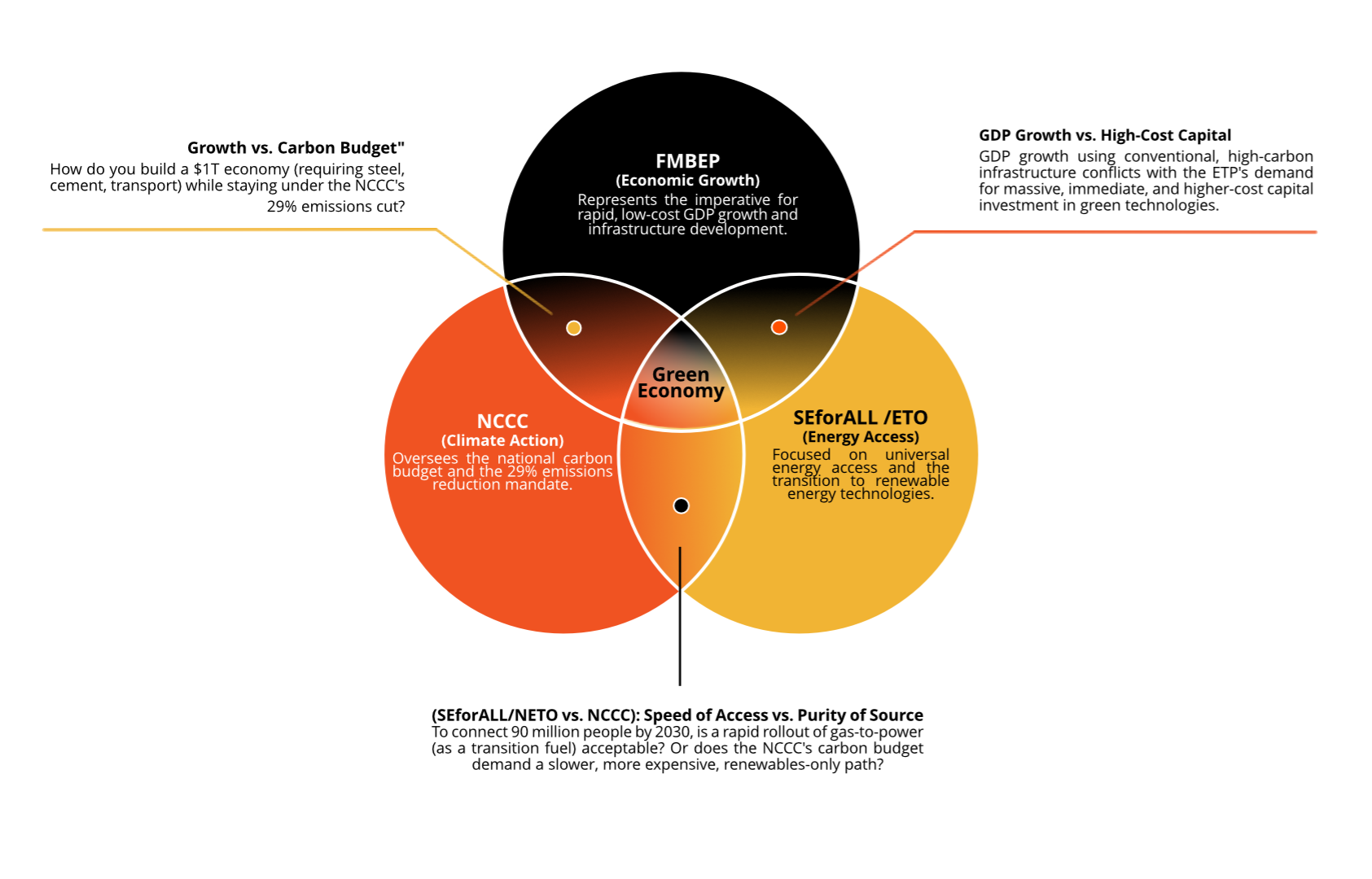
Steering through the path toward a USD1 trillion economy involves addressing three fundamental trade-offs that represent the "hard questions" for Nigerian policymakers:
- Growth vs. carbon budget: Building the industrial base required for a USD1 trillion GDP necessitates substantial inputs of steel, cement and transport services. The FMBEP's imperative for rapid, low-cost growth often favors conventional high-carbon infrastructure, which directly conflicts with the NCCC's requirement for absolute emission cuts. Decoupling growth from CO2 emissions is a vital necessity, but it requires a technical leapfrogging that is currently underfunded (CPI, 2025).
- Speed of access vs. purity of source: To connect 90 million people by 2030, a rapid rollout of gas-to-power is technically the fastest and most affordable route. However, international climate financiers often demand a "renewables-only" path. Nigeria maintains that using natural gas as a transition fuel is a sovereign right to development, but this approach carries the risk of stranded assets and a larger methane footprint (ETO, 2022).
- Fiscal stability vs. immediate transition: The removal of fossil fuel subsidies and the floating of the naira were necessary to create fiscal space for climate-resilient growth. However, these measures have triggered substantial inflationary pressures that increase energy poverty and reduce public acceptance of the energy transition (Clark, 2025).
- Job losses in fossil fuel-dependent sectors: While the Energy Transition Plan (ETP) projects significant net employment gains, 340,000 direct jobs by 2030 and 840,000 by 2060, there is credible evidence that substantial job losses in fossil fuel-dependent sectors could occur as part of the same transition. Analysis by the World Resources Institute, drawing on data from the International Energy Agency and related studies, indicates that fossil fuel employment could contract dramatically; for instance, fossil fuel jobs globally may decline from approximately 12.6 million to 3.1 million by 2050, with the most substantial losses in the coal, oil, and gas extraction industries. Workers displaced from these sectors may not automatically transition into clean energy roles without deliberate reskilling and support measures, underscoring the importance of "just transition" planning to mitigate the social and economic impacts of job displacement (World Resources Institute, 2023).
Figure 1: Facing the Trade-Offs (The Hard Questions)
Synergies and collaborative wins
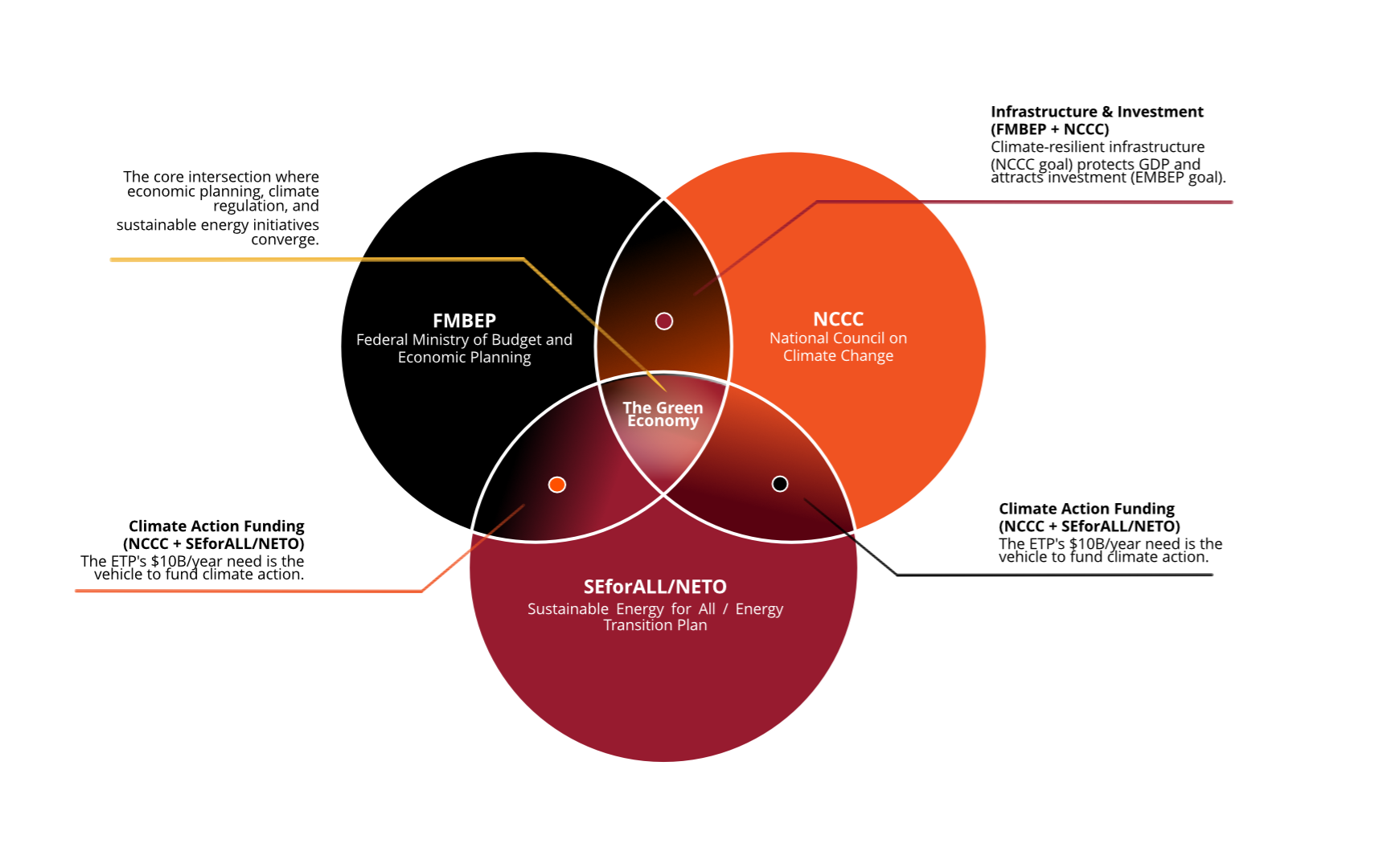
Despite these challenges, achieving strategic alignment between NDC 3.0 and the NDP 2026-2030 offers powerful synergies that can accelerate national prosperity:
- Job creation alignment: The Energy Transition Plan (ETP) aims to create 340,000 new direct jobs by 2030, increasing to 840,000 by 2060 (ETO, 2022). These jobs directly support the FMBEP's mandate for generating massive employment, particularly for Nigeria's growing youth population (Clark, 2025).
- GDP protection through resilience: Climate-resilient infrastructure protects the economy from devastating future losses. Climate change is projected to cause a loss of up to 30% of national GDP by 2050 (estimated at USD460 billion) (CPI, 2025). Meeting climate targets is therefore a substantial synergy for long-term GDP stability (CPI, 2025).
- Bottom-up economic productivity: Partnerships like Mission 300 and the DARES project drive economic growth at the community level. Every 1% reduction in power outages is estimated to prevent a 3.5% loss in business productivity across the region (World Bank Group, 2025). Distributed renewable energy serves as a multiplier for educational opportunities and enhances the reliability of clinical services.
Figure 2: Synergies (The "Win-wins")
Multilateral partnerships and Mission 300
The acceleration of Nigeria's energy transition is supported by the Mission 300 Initiative, a massive partnership led by the World Bank and the African Development Bank (World Bank Group, 2025). According to the African Development Bank (2025), while Mission 300 is primarily an electricity access initiative, its specific focus on achieving that access through renewable energy, thereby displacing polluting fuels such as kerosene and diesel, justifies its classification as a climate action (African Development Bank, 2025). This strategic focus advances climate and health goals simultaneously while meeting the urgent needs of underserved regions.
In Nigeria, this framework is activated under the aegis of the Distributed Access through Renewable Energy Scale-Up (DARES) project, a USD750 million facility designed to provide over 17.5 million Nigerians—roughly 20% of the currently unserved population—with access to electricity through solar home systems and mini-grids (World Bank Group, 2025). However, while this initiative drives economic activities at the household and small enterprise level, it must be balanced with the reality that Nigerian industrial activities remain heavily reliant on non-renewable sources. According to the manufacturing sector analysis (2025), large-scale industrial operations are extremely energy-demanding and currently depend on fossil fuels like natural gas and coal to maintain the baseload stability required for continuous production.
The Strategic role and risks of natural gas
The "Decade of Gas" Initiative (2021-2030), supported by the National Gas Policy (NGP) of 2017 and the National Gas Expansion Programme (NGEP), serves as the official framework positioning natural gas as Nigeria's primary transition fuel (ETO, 2022). This policy aims to leverage the nation's 210 trillion cubic feet of reserves to diversify the economy and reduce dependence on more carbon-intensive hydrocarbons (Clark, 2025). According to the report by Clark (2025), the role of gas as a transition fuel is a pragmatic reality that allows Nigeria to diversify its economy away from oil dependency while meeting the needs of a booming population.
However, continued investment in gas infrastructure faces scrutiny from climate analysts. The Climate Action Tracker (CAT) suggests that expanding centralized gas capacity from 4 GW in 2020 to 14 GW by 2030 does not align with the 1.5°C goal (Climate Action Tracker, 2025). Critics warn of potential "carbon lock-in," where gas assets become stranded as the global economy shifts toward cheaper renewables. To address these concerns, the government points out the need for eliminating routine gas flaring by 2030 and reducing fugitive methane emissions from the oil and gas industry by 60% to 95% (NCCC, 2025).
Financing the green transformation
Meeting Nigeria's climate and development goals requires massive capital mobilization. Nigeria estimates that full implementation of NDC 3.0 will cost approximately USD337 billion by 2035, with about 80% of this amount dependent on international support (based on Nigeria's climate finance needs and gap estimates). Tracked public and private climate finance flows in 2021/22 amounted to roughly USD2.5 billion, leaving an annual climate finance gap in the tens of billions of dollars relative to estimated needs (Climate Policy Initiative, 2024).
To help address this gap, the government is activating mechanisms to de-risk green investments and attract capital at scale. The National Council on Climate Change and Federal agencies are moving to operationalize the National Climate Change Fund, with plans to raise significant capital to support low-emission and climate-resilient infrastructure (Reuters, 2026). In support of broader mobilization efforts, the Federal Government launched the Nigerian Climate Investment Platform (NCIP) in partnership with the Nigeria Sovereign Investment Authority (NSIA), National Council on Climate Change (NCCC) and the Green Climate Fund (GCF) to mobilize climate finance for infrastructure and resilience projects (Federal Ministry of Finance, 2025). At the same time, institutions such as the Ministry of Finance are enhancing their roles in mainstreaming climate considerations and green investment strategies into government planning and fiscal coordination frameworks. Domestic instruments such as credit enhancement (e.g., guarantees mobilized by InfraCredit) are also being used to unlock institutional capital for renewable energy and related projects.
Monitoring, Reporting, and Verification: The JGIT MRV framework
Successful implementation of the climate-economy nexus depends on the ability to track progress and ensure transparency. The Nigeria Just and Gender Inclusive Transition (JGIT) Monitoring, Reporting, and Verification (MRV) Framework was developed in 2024 to systematically collect and analyze data related to the transition. This framework aligns with the Climate Change Law and the Long-Term Low Emission Development Strategy (LT-LEDS), tracking indicators across economic, social, and environmental dimensions (ICAT, 2024).
The JGIT MRV Framework emphasizes social equity, ensuring that the benefits of the energy transition are distributed among vulnerable populations, including women, youth and persons with disabilities. It tracks specific KPIs such as green job creation, gender-disaggregated employment rates, and the impact of the transition on local livelihoods in the oil and gas and agricultural sectors. The National Bureau of Statistics (NBS) coordinates this data collection to ensure standardization, while independent third-party auditors verify results to enhance accountability and build investor confidence.
Conclusion
Nigeria's path toward a USD1 trillion economy while adhering to the rigorous absolute carbon budget of NDC 3.0 represents one of the most complex policy challenges in its history. This report features the technical and financial hurdles that impede a seamless transition, most notably the USD27.2 billion annual climate finance gap and the carbon intensity of heavy industrial expansion. However, the synchronization of mandates between the FMBEP, NCCC and ETO—supported by multilateral projects like Mission 300—provides a viable framework for success. The ultimate outcome depends on the government's ability to decouple GDP growth from emissions through innovative financing, policy consistency and the deep integration of climate considerations into the national budget cycle.
Recommendations
Based on the strategic analysis of Nigeria's current progress and the mandates established by NDC 3.0 and NDP 2026-2030, the following actions are recommended to bridge remaining implementation gaps:
- Establish transparent NCCF investment windows: While the National Climate Change Fund (NCCF) has been approved, the government must now establish formal "catalytic" and "innovation" windows managed by independent boards to use public seed funding to de-risk high-impact green projects for private capital.
- Institutionalize climate budget tagging in the IFMIS: The FMBEP should implement a formal "Climate Budget Tagging" (CBT) module within the Integrated Financial Management Information System (IFMIS). This will enable the real-time tracking of every naira allocated to climate mitigation and adaptation across all MDAs.
- Expand the capital base of local currency guarantors: To support the USD750 million DARES project, the government should galvanise the Nigeria Sovereign Investment Authority (NSIA) to further expand the capital base of local currency guarantors, such as InfraCredit, thereby unlocking domestic pension fund assets for renewable energy.
- Legislate mandatory industrial energy standards: Enact mandatory CO2 performance regulations for new industrial facilities to prevent carbon lock-in, requiring the adoption of best-available-technology for high-heat processes, such as waste-to-heat recovery.
- Integrate carbon tonnage into MDA performance dashboards: Update digital performance dashboards to include "Absolute Carbon Tonnage" as a primary KPI for economic MDAs. This ensures that the pursuit of GDP targets is analytically bound by the national carbon budget.
- Execute pilot debt-for-climate swaps: Negotiate a pilot debt-for-climate swap with major creditors, ring-fencing the savings specifically for the HOPE-GOV Program to ensure healthcare facilities are climate-resilient by 2030.
- Harmonize gas expansion with methane enforcement: Strictly enforce the 2023 Methane Guidelines through the NUPRC, including mandatory Leak Detection and Repair (LDAR) for all operators, to ensure that gas remains a lower-carbon transition fuel.
Acknowledgement
This study was funded by the Alexander von Humboldt Foundation under the supervision of the APRI - Africa Policy Research Institute.
References
African Development Bank (AfDB) (2025). Mission 300: Roadmap for African Prosperity. 5 June. Available at: View source
African Development Bank (AfDB) (2025). Nigeria Green Investment (Decarbonisation) Program Strategy. May. Available at: View source
Argus Media (2025). Nigeria releases 2035 sector-wide climate target. 22 September. Available at: View source
Clark, E.K. (2025). Moving from plans to action: Mainstreaming climate action into Nigeria's budget and economic planning. APRI - Africa Policy Research Institute. 16 June. Available at: View source
Climate Action Tracker (CAT) (2025). Nigeria - Policies & Action. Available at: View source
Climate Policy Initiative (CPI) (2025). Landscape of Climate Finance in Nigeria 2025 Report. 7 May. Available at: View source
Climate Policy Initiative (CPI) (2024). Landscape of Climate Finance in Nigeria 2024 Report. October. Available at: View source
Ebipere, K.C. (2025). The Foreign Exchange Constraint at the Heart of Development Finance. APRI. 5 November. Available at: View source
Energy Transition Office (ETO) (2022). Nigeria Energy Transition Plan (ETP): Strategy and Implementation. August. Available at: View source
Federal Ministry of Budget and Economic Planning (FMBEP) (2025). Mandate and Strategic Framework for National Development. Available at: View source
Federal Ministry of Finance (2025). FG unveils climate investment platform to unlock $500m in green finance. Available at: View source
Federal Republic of Nigeria (2021). Climate Change Act of 2021. November. Available at: View source
ICAT (2024). Nigeria Just and Gender Inclusive Transition (JGIT) MRV Framework Report. August. Available at: View source
InfraCredit (2025). InfraCredit Impact Report. Available at: View source
MDPI (2025). Linking Economic Growth to Carbon Emissions in Nigeria. Sustainability, 17(9). Available at: View source
Ministry of Steel Development (2025). National Steel Summit: Rebuilding and Consolidating Nigeria's Steel Industry. August. Available at: View source
National Council on Climate Change (NCCC) (2025). Nigeria's Third Nationally Determined Contribution (NDC 3.0). 22 September. Available at: View source
National Economic Council (NEC) (2023). Nigeria Agenda 2050 Perspective Plan. February. Available at: View source
Reuters (2026). Nigeria bets on $2 billion fund to boost energy transition. Available at: View source
Sustainable Stories for Africa (2025). Strategic climate finance could shield Nigeria from $100 billion yearly economic losses. Available at: View source
The Reforms (2025). FG sets 2030 target for 10m tonnes liquid steel production. 19 August. Available at: View source
World Bank Group (2025). National Energy Compact for the Federal Republic of Nigeria (Mission 300). January. Available at: View source
World Resources Institute (WRI) (2025). Energy transition implications for workers supported by oil and gas. Available at: View source
About the Author

Omata David Omakoji
Omata David Omakoji is an energy and climate researcher, driving policy innovation and sustainable development, and a 2025 Alexander von Humboldt Climate Protection Fellow at APRI.