
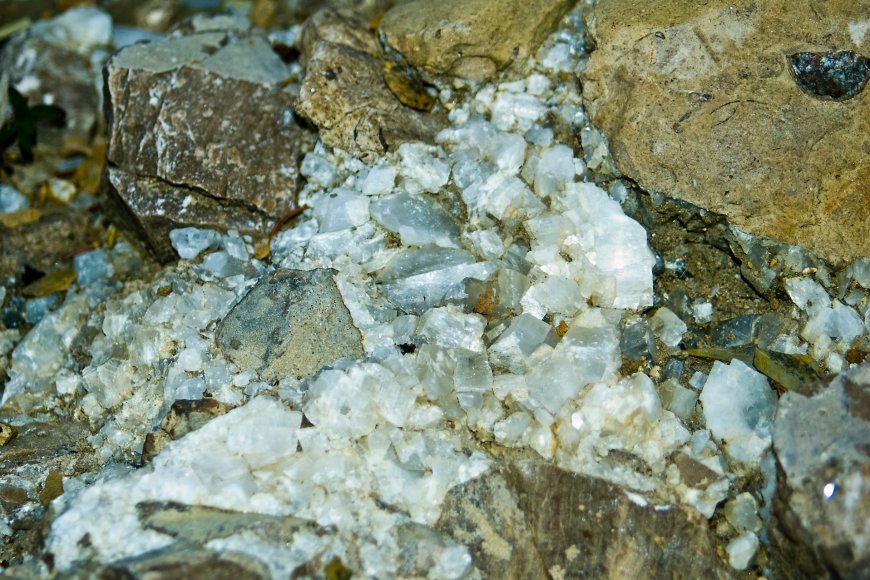
Foto von Alan Emery auf Unsplash
Vom Kompromiss zur Synergie: Mineralien mit Mehrwert als Brücke zwischen Klimafinanzierung und Wirtschaftswachstum in Nigeria (EN)
Dieses Papier zeigt, wie Nigeria die wertschöpfende Verarbeitung von Übergangsmetallen nutzen kann, um das industrielle Wachstum voranzutreiben, Arbeitsplätze zu schaffen und Klimaschutzmaßnahmen durch eine stärkere Regierungsführung zu finanzieren.

Summary
- The paper argues that Nigeria should move from exporting raw transition minerals to processing them domestically in order to capture significantly greater economic value and deepen industrialization.
- It demonstrates that mineral beneficiation can multiply the value of resources such as lithium, create skilled employment, and reduce the billions of dollars lost annually through raw exports.
- The study explains that domestic value addition can align with climate goals by enabling cleaner processing standards and directing higher revenues toward funding Nigeria’s Nationally Determined Contribution and energy transition.
- It identifies governance weaknesses, including smuggling, weak institutional enforcement, and policy instability, as the main obstacles preventing Nigeria from realizing this opportunity.
- The paper proposes a phased industrial policy, the creation of Special Processing Zones, and a mine-to-port digital traceability system to improve transparency, attract investment, and ensure implementation.
Introduction
The historical political economy of Nigeria’s extractive sector, dominated by crude oil since the 1970s, established a powerful, centralized rentier state. This model, characterized by limited economic diversification and industrial capacity, prioritized quick, high-volume export revenue over long-term industrial planning, resulting in institutional neglect of the solid minerals sector and creating a governance framework prone to opacity and illicit flows, which ultimately facilitated the persistence of the raw “extract-and-export” approach (OAL Law, 2025). As the world transitions to a green energy future, relying on the export of raw commodities is no longer a viable long-term growth strategy. Global demand for transition minerals, the essential materials for electric vehicles (EVs), wind turbines and grid-scale batteries, is growing at an unprecedented rate, increasing from about USD121 billion in 2015 to ~USD243 billion in 2020, and is projected to reach around USD358 billion in 2025 (IEA, 2024; IEA, 2025).
Nigeria possesses significant deposits of some of these minerals, including lithium, nickel, cobalt and rare earth elements (Nigerian Geological Survey Agency, 2022; OAL Law, 2025). Without a deliberate strategy for domestic value addition, the country risks repeating the extractive model of the oil sector: exporting low-value raw materials while losing the immense economic and industrial benefits of downstream processing. This approach provides short-term revenue but fails to build a resilient, modern economy. At the same time, Nigeria faces growing pressure to address climate change, as reflected in its commitments under the Paris Agreement and its national goal of achieving net-zero emissions by 2060 (Federal Republic of Nigeria, 2021).
This article argues that local value addition in the transition minerals sector is one of the most effective and sustainable strategies for Nigeria to align its economic growth objectives with its climate commitments. Nigeria can convert its mineral deposits into high-value products by developing domestic processing and manufacturing capabilities. This will stimulate industrialization, create skilled jobs, and support the development of cleaner, more secure supply chains. The analysis undertaken in this paper examines global demand trends, assesses Nigeria’s resource base and policy framework, quantifies the economics of beneficiation and proposes a strategic plan to position Nigeria as a key participant in the global green economy.
The global demand for transition minerals
The shift to a net-zero global economy is fundamentally a shift in materials, making transition minerals the foundation of this change. The International Energy Agency (IEA) projects that demand for these minerals will increase substantially. In its Stated Policies Scenario, the total mineral demand for clean energy technologies is expected to double by 2040. In a scenario consistent with achieving global climate goals (Net Zero by 2050), this demand would be six times greater than current levels (IEA, 2021).
The growth is most pronounced for minerals vital to battery production (IEA, 2024). The IEA projects that by 2040, demand for lithium could increase by over 40 times, while demand for graphite, cobalt and nickel could see 20 to 25-fold increases (IEA, 2021). This rapid demand growth is creating a significant demand-supply gap. The World Bank has warned of potential deficits in key minerals, such as copper and lithium, emerging by the end of this decade (World Bank, 2020).
Furthermore, the current supply chain carries significant geopolitical risk due to its extreme geographic concentration in regard to processing (Musa and Isa, 2025; IEA, 2022). Globally, China does not hold the majority of transition-mineral reserves, but its dominance stems from its control of midstream processing. It possesses roughly 13% of global lithium reserves, around 1.5% of cobalt reserves and about 5% of nickel reserves, meaning most critical-mineral deposits lie outside its borders. However, China refines around 60–65% of the world’s lithium, 65–75% of cobalt, about 68% of nickel and nearly all natural graphite and rare-earth elements, giving it unmatched leverage over the processing stage that converts raw minerals into battery-grade materials essential for clean-energy technologies (IEA, 2022). This concentration makes global supply chains vulnerable, prompting nations, such as the United States and member states of the European Union, to seek diverse sources for processed minerals. This global effort to de-risk supply chains presents a significant opportunity for resource-rich countries, such as Nigeria, to attract investment into their processing sectors.
Table 1: The development challenge and value addition opportunity
| Nigeria's Development Challenge | Current Extractive Model | Value Addition Opportunity |
| Economic Structure | Dependence on raw mineral exports creates economic vulnerability and inhibits industrial growth | Build a diversified, high-value industrial base through domestic processing & manufacturing |
| Climate & Environment | Mining causes local environmental degradation, while economic value & emissions are exported | Manage emissions with modern, renewables-powered technology; use new revenues to fund climate initiatives. |
| Global Positioning | Positioned as a price-taker at the first-step of the supply chain. | Become a strategic partner in the midstream and downstream segments of the green technology value chain. |
Source: Author - Omata David O., informed by diverse scholarly sources
Table 2: Projected demand growth for key clean energy minerals (NZE scenario, 2040)
| Mineral | Projected Demand Growth by 2040 (NZE Scenario) | Primary Clean Energy Use |
| Lithium | ~42x | Electric vehicle batteries, grid storage |
| Graphite | ~25x | Battery anodes |
| Cobalt | ~21x | Battery cathodes |
| Nickel | ~19x | Battery cathodes, specialized alloys |
| Rare Earths | ~7x | Permanent magnets for wind turbines and EV motors |
Source: Adapted from International Energy Agency (IEA). Developed by Omata David O.
Nigeria’s resource endowment and existing policies
Nigeria's geology contains a wide variety of transition minerals. High-grade lithium deposits have been confirmed in a region now known as the "Nigerian Lithium Belt," which encompasses states such as Nasarawa, Kogi, Kwara, Ekiti and Oyo (Nigerian Geological Survey, 2022). In 2023, the Minister of Mines and Steel Development confirmed discoveries of lithium ore with grades as high as 13%, indicating world-class commercial potential (Ministry of Mines and Steel Development, Nigeria, 2023). In addition to lithium, Nigeria has known deposits of nickel, manganese and cobalt, all of which are at various stages of exploration and development.
Despite these resources, the solid minerals sector contributes a very small amount to the national economy (NEITI, 2019). While mining accounted for over 4% of Nigeria's GDP in the 1960s, its contribution today is approximately 0.3%, according to recent figures from the National Bureau of Statistics (NBS) and NEITI (Anyanwu, 2024). The contribution of mining to Nigeria's GDP is significantly lower than in other resource-rich African nations, such as Botswana (40%), the Democratic Republic of Congo (25%) and South Africa (18%).
On the policy side, Nigeria has taken some positive steps to ramp up its value-addition agenda for transition minerals: President Tinubu has mandated that all new mining licenses be explicitly tied to local processing and beneficiation (Anyanwu, 2024). The Federal Ministry of Solid Minerals now grants licences only to firms demonstrating concrete plans for domestic processing, offering incentives such as tax waivers, simplified power licensing and full profit repatriation (Anyaogu, 2024). To clear the way for real development, over 900 dormant licenses were revoked under a “use it or lose it” policy, and more than 1,200 additional licenses have since been cancelled for non-payment of annual fees (Ewepu, 2024). NEITI has welcomed the clean-up, underscoring how revocation boosts transparency and discourages speculative hoarding of titles [Lawal, 2025]. Meanwhile, the issuance of 867 new licenses in Q1 2025 (raising NGN6.95 billion in revenue) signals growing investor confidence aligned with these reforms (Kareem, 2025). Strategic institutions, such as the Mining Cadastral Office (MCO) and NEITI, play a significant role in enforcing compliance and enhancing governance. At the same time, the Nigerian Geological Survey Agency (NGSA) is also crucial for geological mapping (Eboh, 2025). Bilateral cooperation, for instance, with South Africa on geological mapping, is underway to support local beneficiation capacity (National Bureau of Statistics, 2023).
Nigeria's efforts toward genuine local value addition are severely hampered because the necessary processing infrastructure lags far behind its policy ambitions. The primary reason for this underperformance has been an "extract-and-export" model, sustained by weak policy enforcement and the absence of an integrated industrial plan (National Bureau of Statistis, 2023; Brickstone, 2020). Foundational laws, such as the Nigerian Minerals and Mining Act of 2007 and the Roadmap for the Growth and Development of the Nigerian Mining Industry (2016), exist and, in principle, encourage local processing (Eboh, 2025; OAL Law, 2025). However, their implementation has been inconsistent. Despite these steps, the broader policy has not yet successfully created the necessary investment conditions, such as reliable energy and transport infrastructure and targeted fiscal incentives to attract large-scale mineral processing companies. Consequently, most raw ores are still exported with minimal value being captured in Nigeria (NES Group, 2025).
Table 3: Nigeria’s mineral endowment and value addition potential
| Mineral/Framework | Current Status | Value Addition Opportunity |
| Lithium (multiple states) | High-grade deposits are confirmed; exports consist mainly of unprocessed ore. | Domestic conversion to battery-grade lithium hydroxide or carbonate. |
| Nickel & Cobalt | Deposits are identified in several states; exploration is in early stages. | Processing into intermediate products (e.g., nickel sulfate) for battery precursors |
| Mining Sector GDP | ~0.% of total GDP. | Increase contribution to over 5% of GDP through a value-chain-focused strategy. |
| Policy Frameworks | Established but lack effective implementation for local processing mandates | Strengthen policy wIth clear incentives, infrastructure guarantees, & enforcement. |
Source: Developed by the author, informed by diverse scholarly sources.
The economic case for value addition
The economic argument for local mineral processing (beneficiation) is compelling. The increase in value from a raw mineral to a processed, high-purity product is substantial. For example, a tonne of raw lithium ore (spodumene concentrate) might sell for USD800 to USD1,200. Once processed into battery-grade lithium hydroxide, its value can increase to over USD20,000 to USD30,000 per tonne. This represents a 20 to 30-fold increase in value that is currently lost when unprocessed minerals are exported (Brickstone, 2020).
International examples confirm the success of this approach. Indonesia implemented a ban on the export of unprocessed nickel ore in 2020 (National Bureau of Statistics, 2023; Brickstone, 2020). This policy compelled companies to invest in domestic smelting and refining, transforming the nation into the world’s leading producer of battery-grade nickel. This move has attracted over USd15 billion in foreign direct investment into its processing industry (Musa and Isa, 2024). One factor believed to be a major driver of success is that Indonesia is improving governance and traceability by implementing a digital tracking system (SIMBARA) for minerals such as nickel and tin, which tracks ore from mines to smelters. This will boost accountability, increase tax revenue and prevent illegal mining (Musa and Isa, 2024).
Furthermore, employment from value-adding activities is far greater than from mining alone (NES Group, 2025). While extraction is capital-intensive, processing and manufacturing create more high-skilled, better-paying jobs in fields such as metallurgy, chemical engineering and logistics. These industrial centres have a powerful multiplier effect, stimulating local economies and building technical expertise.
Table 4: Illustrative economic multiplier of mineral beneficiation
Prices are illustrative and subject to high market volatility
| Mineral | Illustrative Raw Price (per tonne) | Illustrative Processed Price (per tonne) | Value Multiplier |
| Lithium Ore | ~$1,000 (Spodumene Concentrate) | ~$25,000 (Lithium Hydroxide) | ~25x |
| Cobalt Ore | ~$32,000 (Metal) | ~$65,000 (Cobalt Sulfate) | ~2x |
| Manganese Ore | ~$170 (Ore) | ~$1,600 (High-Purity Manganese Sulfate) | ~9x |
Source: Author, based on data from Benchmark Mineral Intelligence and S&P Global Commodity Insights.
While the multipliers above are illustrative, applying a conservative blended multiplier to Nigeria's recent export figures reveals a staggering opportunity cost. Using official data for solid mineral exports, which NEITI reports suggest are significantly underestimated due to smuggling, the forgone revenue amounts to billions of dollars annually.
Table 5: Estimated opportunity cost of raw mineral exports (2021-2023)
Declared export values are based on National Bureau of Statistics (NBS) Foreign Trade Reports. “Potential Processed Value” is a conservative estimate using a blended 10× value-addition multiplier. The actual figure could be significantly higher
| Year | Declared Export Value (Raw Minerals) | Potential Processed Value (Estimate) | Estimated Opportunity Cost | Declared Export Value (Raw Minerals) | Potential Processed Value (Estimate) | Estimated Annual Opportunity Cost |
| ₦ (Naira) | ₦ (Naira) | ₦ (Naira) | $ (USD) | $ (USD) | $ (USD) | |
| 2021 | ₦36.85 billion | ₦368.5 billion | ₦332.41 billion | ~$89 million | ~$890 million | ~$801 million |
| 2022 | ₦59.84 billion | ₦598.4 billion | ₦536.8 billion | ~$136 million | ~$1.36 billion | ~$1.22 billion |
| 2023 | ₦128.7 billion | ₦1.287 trillion | ₦1.154 trillion | ~$165 million | ~$1.65 billion | ~$1.48 billion |
Figures represent full-year estimates compiled from NBS data and other sources. Conversions are based on average official exchange rates: ~$1 = ₦415 (2021), ₦440 (2022), ₦780 (2023).
Source: National Bureau of Statistics.
Balancing Economic Activity with Climate Goals
The extractive sector presents inherent environmental and social challenges, including habitat loss, water contamination, and carbon emissions (Brickstone, 2020). This creates an apparent conflict between economic development and climate objectives. However, a strategy focused on domestic value addition provides a clear path to reconcile these goals.
When Nigeria exports raw ore, it bears the full local environmental impact of mining, but exports the economic value, jobs, and associated processing emissions to other nations. Nigeria will gain direct authority over the environmental standards of the value chain by building domestic processing facilities. This allows the country to require the use of modern, low-emission technologies. Processing plants can be powered by Nigeria’s natural gas reserves as a transitional energy source or by co-located renewable energy projects, thereby lowering the carbon footprint of the final products.
Additionally, the significant revenues from selling high-value processed minerals can be directed into a national climate fund. This income can be used to finance Nigeria’s Nationally Determined Contribution (NDC) under the Paris Agreement, supporting investments in renewable energy, climate adaptation, and community resilience projects (Federal Republic of Nigeria, 2021). Within this framework, transition minerals serve as a direct financing tool for Nigeria's transition to a green economy.
Table 6: Comparative outcomes of export models on climate and economic strategy
| Tradeoff | Raw Export Model | Domestic Processing Model |
| Emissions Control | Emissions are generated abroad and are not controlled by Nigeria. | Emissions are managed under domestic laws; cleaner technology can be required. |
| Climate Finance | Low royalties provide limited funds for national climate action. | High revenues from processed goods can directly fund Nigeria's climate strategy. |
| Global Positioning | A simple resource supplier, exposed to external policy changes. | A strategic green economy partner, offering low-carbon processed materials. |
Source: Developed by the author, informed by diverse scholarly sources.
A Strategic Plan Built on Governance and Implementation
Achieving value addition requires moving beyond policy statements to address the core governance deficits that have long hindered the mining sector (NES Group, 2025). The findings of the Nigeria Extractive Industries Transparency Initiative (NEITI) provide a precise diagnosis of these gaps. NEITI's audits consistently reveal significant discrepancies between mineral production, export records and revenue remittances, indicating widespread illegal mining, smuggling and a weak institutional capacity (NEITI, 2023; Akinrinade,2025; Routray et al., 2024). A credible strategic plan must be designed to close these specific gaps, as outlined in the following.
- Enforce a phased and incentivized industrial policy: Rather than relying on sudden export bans, which can deter investment, Nigeria should implement a phased industrial strategy (Zadeh, 2025). This involves linking mining licenses to time-bound, contractual commitments for downstream investment. Phase 1 could incentivize the production of intermediate products (e.g., spodumene concentrate), while Phase 2 mandates investment in higher-value refining (e.g., lithium hydroxide). This provides the policy predictability that serious investors require for capital-intensive projects.
- Establish clustered infrastructure in Special Processing Zones (SPZs): The national infrastructure deficit is too large to be addressed all at once. A more targeted approach is to establish dedicated SPZs in mineral-rich regions (Brickstone, 2020). These zones must be equipped with reliable, embedded power generation (via public-private partnerships for gas or solar plants) and dedicated logistics corridors to ports (NES Group, 2025). This de-risks investment by creating a functional and competitive operating environment.
- Implement a mine-to-port digital traceability system: A primary gap identified by NEITI is the inability to accurately track and measure what is extracted and exported (NEITI, 2023). Nigeria must implement a mandatory digital traceability system, utilizing technologies such as blockchain and satellite monitoring [Routray et al., 2024; National Risk Assessment Forum, 2022). This system would create an immutable record of minerals from the point of extraction to the port of export, drastically improving royalty collection, curbing illegal exports and providing verifiable proof of provenance for international markets.
Governance risks that perpetuate raw material exports
The greatest obstacle to Nigeria’s value-addition strategy is a set of governance risks that actively sustain the chaotic and unprofitable "extract-and-export" model. Addressing these is a prerequisite for attracting the large-scale investment needed for domestic processing.
- Risk: Illicit economies and institutional resistance: The poorly monitored export of raw minerals has fostered a lucrative illicit economy. As NEITI reports indicate, the significant disparity between official production and actual export volumes suggests widespread smuggling and under-declaration, involving a network of illicit miners, corrupt officials and their sponsors. This network has a strong vested interest in maintaining the status quo, as a formalized and transparent processing industry would eliminate their source of illicit income. This creates powerful internal resistance to any meaningful policy change, including the enforcement of export bans or beneficiation mandates.
Mitigation: Mandate action on NEITI audits: To dismantle this resistance, transparency must be paired with accountability. The government must legally require that agencies like the Ministry of Mines and the Nigeria Customs Service publicly to respond to NEITI's audit findings and demonstrate concrete actions taken to close revenue and monitoring gaps. This makes transparency an active tool against institutional capture rather than a passive reporting exercise. - Risk: Policy instability and investor distrust: The government's inability to enforce its own laws, ranging from Community Development Agreements (CDAs) to announced bans on raw ore exports, signals deep-seated policy instability. For a global company considering a USD500 million investment in a processing plant, the sight of unchecked trucks of raw lithium being illegally exported is a major red flag. It demonstrates that government decrees are not consistently enforced, making the investment climate unpredictable and prone to high risk. This chaos directly deters the type of long-term, capital-intensive partners Nigeria needs for value addition.
Mitigation: Legislate a binding national minerals strategy: To build investor confidence, Nigeria needs to move beyond discretionary policies and legislate a binding, long-term national minerals strategy. This strategy should clearly outline the phased requirements for value addition, establish stable fiscal terms and overhaul the CDA framework to make it transparent and enforceable. A legislated strategy is harder for future administrations to change arbitrarily, providing the predictability that investors require
Conclusion: from transparency to transformation
Nigeria's transition mineral endowment presents a historic opportunity to build a diversified, industrial economy. However, this potential will not be realized by simply replicating the extractive models of the past. The country's primary challenge is not a lack of resources or policy ideas, but a deep and persistent deficit in governance and implementation.
The extensive work of NEITI has already laid bare the fault lines: revenue leakages, illicit mineral flows and institutional weaknesses that prevent the nation from capturing the true value of its resources. Therefore, the path forward is not just about attracting investment, but about first building a foundation of transparency and accountability worthy of that investment. The choice for Nigeria is no longer between exporting rocks or exporting products; it is between tolerating opacity or committing to transformation.
References
Akinrinade, K.(2025). Expert Proffers Solution to Illegal Mining in Northern Region.
Anyanwu, S. (2024). President Tinubu: All New Mining Licenses Must Have Local Value.
Anyaogu, I. (2024). Nigeria to grant mining licences only to companies that process locally.
Arsalan, A., and Merwin, M. (2022). Indonesia's Nickel Export Ban: Impacts on Supply Chains and the Energy Transition.
Benchmark Mineral Intelligence (2024). Lithium Price Assessment Data. 2024.
Brickstone (2020). Challenges to Mineral Beneficiation in Nigeria.
CSM Tech (2024). Addressing Nigeria's Billion-Dollar Challenge: The Impact of Illegal Mining on National Revenue.
Eboh, C. (2025). Nigeria signs minerals pact with South Africa in diversification push.
Ewepu, G. (2024). Alake revokes 924 dormant mineral licences.
Federal Republic of Nigeria (2021). Nigeria's Updated Nationally Determined Contribution.
International Energy Agency (2021). The Role of Critical Minerals in Clean Energy Transitions.
International Energy Agency (2022). Global Supply Chains of Critical Minerals.
International Energy Agency (2024). IEA Critical Minerals and Clean Energy.
International Energy Agency (2025). IEA reports. Critical mineral supply concentration, export restrictions may cause disruptions.
Kareem, A. (2025). FG issues 867 mining licences in Q1, generates ₦6.95b.
Lawal, R. (2025). NEITI backs revocation of mining licences, says it'll promote transparency.
Ministry of Mines and Steel Development, Nigeria (2023). Press Briefings and Sectoral Updates.
Musa A.Y. and Isa, M. (2025). Harnessing Nigeria's Critical Mineral Wealth: Navigating Global Geopolitics in the Energy Transition Era.
National Bureau of Statistics (2023). Nigerian Gross Domestic Product Report (Q2 2023). 2023.
National Risk Assessment Forum (2022). EXTRACTIVE SECTOR REPORT - October 2022.
NES Group (2025). Towards Effective Resources Federalism in Nigeria's Mining Sector.
Nigeria Extractive Industries Transparency Initiative (2023). Solid Minerals Industry Report 2021.
Nigeria Extractive Industry Transparency Initiative (2019). Improving Transparency and Governance in Mining Report.
Nigerian Geological Survey Agency (2022). Geological and Mineral Resources Information. 2022.
OAL Law (2025). The Case for Critical Minerals Legal and Policy Reform in Nigeria.
Rossouw, Andries et al. (2025). Mine 2023: Concentrating on the future.
Routray, B.B. (2024). Addressing Nigeria's Billion-Dollar Challenge: The Impact of Illegal Mining on National Revenue.
S&P Global Commodity Insights (2024). Metals & Mining Price Assessments.
Pintar, S. (2025). How African Countries Combat Poverty by Banning Mineral Exports.
World Bank (2020). Minerals for Climate Action: The Mineral Intensity of the Clean Energy Transition.
Zadeh, J. (2025). Understanding Zimbabwe's 2027 Lithium Concentrate Export Ban.
About the author

David Omata
David Omata is an energy and climate researcher, driving policy innovation and sustainable development, and a 2025 Alexander von Humboldt Climate Protection Fellow at the Africa Policy Research Institute (APRI).