Perspektiven und Herausforderungen bei der Einführung von Bus-Rapid-Transit-Systemen (BRT) in Ghana (EN)
Die Wiederbelebung des BRT-Systems in Ghana kann die städtische Mobilität grundlegend verändern, vorausgesetzt, sie wird durch institutionelle Reformen, eigene Fahrspuren und eine nachhaltige Finanzierung durch Steuern und Instrumente zur Erschließung von Bodenwertgewinnen unterstützt.

Summary
-
Bus Rapid Transit (BRT) promises a high-capacity, reliable public transport system that can improve mobility, reduce travel times and foster sustainable urban development.
-
Poor planning and implementation, as well as institutional and financial issues, continue to hamper the successful deployment of the BRT system in Accra and other cities.
-
To ensure the success and sustainability of future BRT initiatives in Ghana, there is a need for institutional reform, integrated planning and stakeholder management.
-
There is also a need for sustainable funding through taxation, property development from the private sector and land value capture instruments.
Introduction
Ghana is experiencing rapid urbanisation, with an increasing proportion of its population living in cities. In 2020, 50.4 % of the population resided in urban areas, a significant rise from 38.4 % in 2000 (Korah et al., 2025). Rapid and unplanned urbanisation has outpaced the ability of governments to establish an efficient urban transport system, exerting pressure on transport systems in sub-Saharan African cities (Gutu Sakketa, 2023). In the case of Ghana, urbanisation continues to overwhelm existing transport systems, leading to congestion, limited accessibility and reliance on inefficient, informal paratransit services (Adom-Asamoah et al., 2021). Making access to employment particularly constrained. In Accra, only 48 % of the residents can reach half of the city’s jobs within one hour by public transport. In Kumasi, the figure is even lower, at just 38 %.
Additionally, urban transport in Accra, Kumasi, and other cities is marked by a fundamental paradox: demand far exceeds supply. This gap is exacerbated by chronic underinvestment in public transport, reflecting weak urban policy and planning amid rapid urbanisation and poor integration between land use and transport planning (Agyemang, 2015; Asimeng, 2021; Poku-Boansi & Marsden, 2018; Teko & Lah, 2025).
Several urban mobility options are currently available across the country, including light rail, metro systems, informal paratransit reforms, non-motorised transport (NMT) and traffic demand management. These have been evaluated in existing national and city-level transport studies and plans. However, many of them encounter significant challenges in Ghanaian cities, including high capital and maintenance costs for rail-based systems, lengthy implementation timelines, land acquisition difficulties and limited capacity to serve high-volume corridors.
A lack of union management of transport services is also a significant obstacle. For example, as a result of their informal nature, flexibility and affordability, paratransit operators using taxis and minibuses, known locally as trotros, have become the dominant service providers. However, a significant portion of these services operate outside union management. In the Ghanaian urban transport context, union management involves the organisation and regulation of paratransit operations through established transport unions, primarily the Ghana Private Road Transport Union (GPRTU) and the Progressive Transport Owners Association (PROTOA). These unions oversee route allocation, vehicle dispatching, fare collection and terminal management, and ensure that their members comply with fundamental operational rules. While paratransit is crucial for mobility, particularly in underserved areas, it is often associated with frequent accidents, unreliable scheduling and non-compliance with regulations (Poku-Boansi & Marsden, 2018).
In this context, Bus Rapid Transport (BRT) systems offer significant economic benefits, including job creation, improved productivity and reduced travel times through efficient, high-capacity transportation (Asimeng, 2021; Fan & Beukes, 2021). BRT can also alleviate traffic congestion, lower emissions, enhance road safety and improve mobility for vulnerable populations, contributing to a more sustainable and liveable urban environment. Furthermore, BRT corridors create opportunities for Transit-Oriented Development (TOD), facilitating better land-use planning and revenue generation to support long-term urban growth.
Ghana first attempted to introduce a BRT system in 2005, but the initiative did not achieve the same level of implementation success seen in countries such as Senegal, South Africa and Tanzania. These countries offer important lessons. The Senegal model for low-emission BRT development illustrates effective strategies for integrating electric buses and charging infrastructure while fostering cross-sectoral coordination. The South African BRT highlights the essential role of government support and land policy for transformative changes in public transport operations. Similarly, the Tanzanian experience showcases the potential of BRT to tackle mobility challenges such as congestion and the unreliability of public transport (Joseph et al., 2021).
Ghana’s BRT system struggled to meet its objectives due to a disconnect between the BRT’s design and the country’s broader policies on land use, housing, economic development and transportation. This stems from challenges related to planning and implementing institutional decoupling. Urban transport planning in Ghana has evolved in silos, with limited coordination among agencies. Consequently, the BRT was designed primarily as a transport project, with little integration into land-use plans, transit-oriented development strategies or housing policies that could support ridership and system viability.
Fragmented and informally organised paratransit services have also complicated BRT integration. Inadequate mechanisms for transitioning existing operators into the BRT system have led to parallel operations along BRT corridors, undermining demand, operational efficiency and service reliability. Additionally, limited and unstable financing arrangements have constrained phased implementation, complementary investments and long-term system maintenance, weakening the BRT's ability to deliver broader environmental and urban development benefits beyond mobility improvements. As a result, the BRT has not achieved the expected improvements in mobility, environmental sustainability and urban development.
This policy brief draws on a combination of document analysis and expert interviews related to Ghana’s urban transport sector. Reports from Ghana’s Ministry of Transport, the Department of Urban Roads, the World Bank and other partners were examined to highlight the prospects and challenges concerning the implementation of BRT systems and make recommendations for their improvement in Ghanaian cities. Participants for the interviews were selected based on experience with BRT planning and urban transportation. The brief aims to inform urban policies that will facilitate the successful implementation of BRT to address transportation and mobility issues that have proven to be a wicked urban problem in sub-Saharan cities.
The case of BRT implementation in Accra, Ghana
To address the declining efficiency and reliability of public transport services in Accra and other major cities, Ghana attempted to implement a BRT system in 2005. The initial pilot, launched by Metro Mass Transit Limited on Accra's 20 km Kinbu–Adenta corridor, utilised 12 buses along a dedicated lane. Despite early gains in ridership, the project faced significant setbacks, including weak enforcement, insufficient infrastructure and opposition from informal transport operators. It was suspended in 2007 (Poku-Boansi & Marsden, 2018).
Subsequently, the Ghana Urban Transport Project (GUTP), which included the development of a BRT system, was established to create the necessary institutional structures and capacity to plan and regulate public transport (Fan & Beukes, 2021). Later in 2007, a national BRT policy was drafted under the GUTP. This was later supported by the National Transport Policy and development plans. Although there were intentions to expand dedicated lanes, only 3.5 km were constructed in the most congested areas of Accra (Teko & Lah, 2025). The inability to provide the dedicated infrastructure prevented the system from achieving full BRT benchmarks (Asimeng, 2021).
In 2016, following years of delay and an inability to introduce a true BRT system, a downgraded system known as the Quality Bus Service (QBS), or ‘Aayalolo’, was introduced. The QBS was implemented to offer an alternative service to what was perceived as a failing, unsafe and poorly regulated informal transit system. Although the QBS provided the benefits of lower costs, comfort and environmental gains, it struggled with low patronage and insufficient financing. It collapsed in 2018 (Asimeng, 2021; Teko & Lah, 2025). While operations resumed on a new route in 2019, core challenges persist.
Ongoing initiatives bolstered by the World Bank continue to focus on improving BRT systems in both Kumasi and Accra. Here, we present the key issues identified with the design and implementation of BRT in Ghana.
Lack of integrated planning and inadequate stakeholder engagement
Within the governance system of Ghana, urban development and transport planning are handled in isolation, with minimal coordination between agencies responsible for spatial planning, road infrastructure and public transport. Recognising this, Ghanaian BRT policy has designed a cross-institutional collaboration for operating and regulating the BRT system (Fig. 1).
Figure 1: Organisational structure of BRT planning and implementation in Ghana
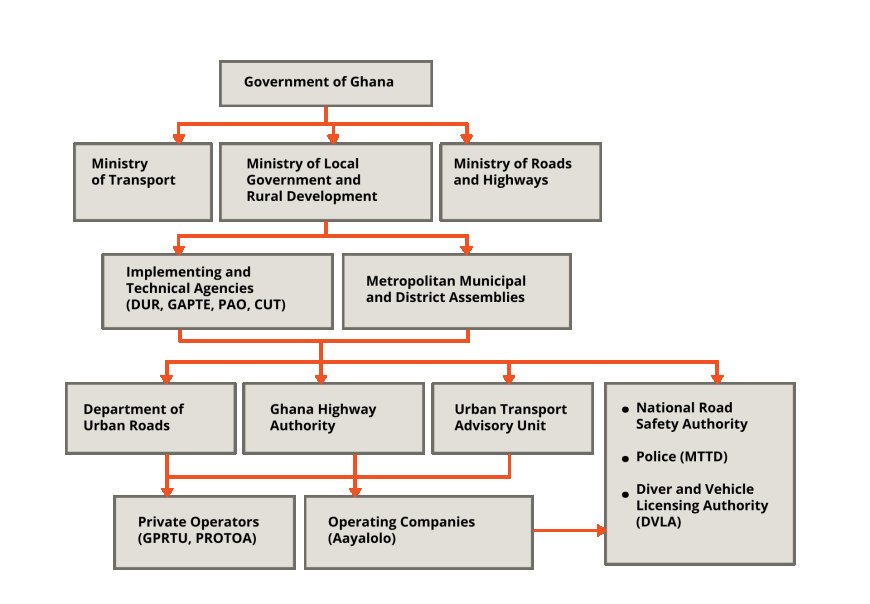
As Figure 1 describes, the project was to be led by the Ministry of Transport (MoT) and the Ministry of Local Government and Rural Development (MLGRD). The MoT was to provide overall policy direction and oversight for the transport sector, including BRT initiatives, and work closely with the MLGRD to integrate BRT within broader urban development plans.
Under the guidance of MLGRD, local government authorities, such as the Accra Metropolitan Assembly (AMA), are responsible for planning, implementing and managing BRT systems within their respective Metropolitan, Municipal and District Assemblies (MMDAs) (Poku-Boansi & Marsden, 2018).
As mentioned above, coordination of the planning and implementation of the BRT was formalised under the Ghana Urban Transport Project (GUTP). This was jointly funded by the Government of Ghana, the World Bank, Agence Française de Développement (AFD) and the Global Environment Facility (GEF). The framework was supposed to ensure that national ministries provide policy direction, urban transport and road agencies handle technical planning and implementation, the Metropolitan Transport Authority oversees operations, and private or restructured operator1 companies deliver services.
In terms of stakeholder and project coordination, the BRT governance framework adopted a multi-stakeholder, collaborative and inclusive approach to facilitate the effective development and operation of the system (Government of Ghana, 2020). The Project Advisory Office (PAO) was expected to bring together representatives from the MoT, the MLGRD and the AMA. The PAO primarily served as a coordinating and implementation unit (World Bank, 2007), lacking the statutory authority to align mandates, plans or budgets across institutions. While the PAO’s project- and donor-supported mandate allowed it to bring together key stakeholders and facilitate coordination through technical committees, joint planning meetings and information sharing, these efforts depended heavily on voluntary cooperation. As a result, the office faced challenges in achieving its goals, as it struggled to break down entrenched institutional silos in critical areas such as budget alignment, land-use control, enforcement, long-term planning and inter-agency coordination.
This institutional fragmentation undermined the BRT’s design and implementation. For example, overlapping mandates between the MoT and the MLGRD, and weak coordination mechanisms between the AMA and the Department of Urban Roads, led to conflicting decisions during the design phase of the project. Resistance from transport unions also heightened tensions. According to an expert who was involved in several stakeholder engagements during the initial design phase of the project, local assemblies frequently clashed over operational control of bus terminals and revenue management systems. This is because, despite having designed an organogram and ensuring the support of the PAO, the institutional arrangement failed to define clear roles, reporting structures and coordination mechanisms, reflecting the absence of a centralised governance and accountability framework.
The PAO was established to bridge institutional gaps. However, it was blighted by inadequate technical capacity and competing institutional interests. As such, the office could not coordinate effectively among agencies during the design and implementation phases, and different actors were unclear about reporting lines and priorities. For example, conflicting priorities emerged when local authorities sought to strengthen their regulatory influence in urban transport management. This was fiercely resisted by private transport unions, particularly the GPRTU, who felt their long-standing, though informal, dominance was threatened.
Key informants involved in the project’s planning and appraisal stages reported that development partners prioritised importing international BRT models. These were seen as more efficient and better aligned with global BRT standards. In doing so, less attention was given to developing a model tailored to Ghana’s urban transport system – one that could have protected the livelihoods and market position of existing paratransit operators and transport unions in the short to medium term. This approach created a significant policy and operational divide. The resulting lack of alignment and institutional cohesion weakened collaboration, delayed implementation and diluted the transformative potential of the BRT system.
Additionally, some local stakeholders, especially transport unions, accused external funding institutions of exerting significant influence over key decision-making processes, particularly in the planning and implementation of the QBS/Aayalolo system. In some instances, this resulted in the imposition of priorities, conditions and operational models that did not fully align with the city’s transport strategies, priorities and long-term mobility goals. It is worth noting that externally driven agendas can undermine local ownership, limit the adaptability of the system to Accra’s unique socio-economic and infrastructural context and potentially compromise the sustainability and effectiveness of the service (Asimeng & Jauregui-Fung, 2025).
Stakeholder resistance from paratransit transport unions and affected community actors was a critical barrier. One expert noted that limited consultations and negotiations with paratransit operators, particularly members of the GPRTU and the Progressive Transport Owners Association (PROTOA), contributed to conflicting opinions and perceptions, creating uncertainty among paratransit operators and property owners along the corridor. At the design phase, the PAO and the AMA were supposed to consult the property owners along the proposed BRT corridor to agree on the acquisition arrangement and compensation package. This would have enabled the timely relocation of properties and utilities. However, many property owners disputed the compensation packages and negotiations quickly broke down. This affected the construction schedule at the implementation phase of the project. The result was significant delays, an inability to deliver infrastructure, misunderstanding and tension among the community and stakeholders, and reduced public trust and confidence in the project.
Frequent changes in the project coordinating unit posed a further challenge to BRT implementation in Ghana. Responsibility for the project shifted from the PAO within the Department of Urban Roads to the Centre for Urban Transportation (CUT) and finally, in 2014, to the Greater Accra Passenger Transport Executive (GAPTE). This was to realign institutional responsibilities and create a dedicated agency with the technical and managerial capacity to oversee urban transport reforms and operations. Eventually, the PAO, which had limited institutional authority and insufficient capacity to enforce decisions, was replaced with the CUT. According to the 2013 Draft Audit Report, these transitions resulted in management changes and a loss of institutional knowledge, which disrupted project continuity and weakened overall coordination (Teko & Lah, 2025).
This brief’s findings also suggest that stakeholder engagement in the planning phase of the project was largely tokenistic and oversimplified. According to key informants, several experts felt they were being asked to participate for participation's sake simply to meet the stakeholder engagement requirements of the project. One expert lamented that their opinions were ‘frequently ignored’, suggesting that their engagement was a box-ticking exercise rather than a genuine consultative process.
Although the BRT project was designed around an integrated planning approach, this did not materialise in practice. Key sectors – land use, transport planning and institutional governance – remained siloed, undermining implementation. Key informants noted that coordination challenges emerged early in the design phase, despite assurances from technical experts at the planning and feasibility stages. Practical issues, such as relocating pipelines and electricity infrastructure, proved more complex and costly than experts anticipated.
These difficulties reflect a broader structural issue. In Ghana, urban development and transport planning are typically managed in isolation, with limited coordination between agencies responsible for spatial planning, road infrastructure and public transport. While the BRT policy formally provided for cross-institutional collaboration (Fig. 1), implementation fell short of this ambition. Agencies prioritised sector-specific mandates, leading to delays, cost overruns and the failure to deliver a fully integrated BRT system in Accra.
Lack of dedicated lanes
BRT systems are designed to provide fast and reliable public transportation using dedicated lanes that allow buses to bypass traffic congestion. Accordingly, Ghana’s BRT policy aims to enhance urban mobility by constructing dedicated lanes and supporting infrastructure (Agyemang, 2015). However, due to the high costs of acquiring land and demolishing structures, as well as limited financial commitment from the government, this did not go ahead as planned (Asimeng, 2021; Poku-Boansi & Marsden, 2018). Consequently, the Quality Bus Service (QBS/Aayalolo), implemented as a BRT, operated in regular traffic, which reduced its effectiveness. As a result, it struggled to attract sustained ridership, and conventional paratransit services continued to dominate. Many commuters tend to prefer trotro due to their affordability, accessibility and cultural integration. Building public trust in BRT will require a high-quality BRT system that offers reliable schedules, enhanced customer service and reduced travel times.
Financial constraints
Capital cost
Infrastructure accounts for 85-90 % of the capital cost of BRT development, while procurement of vehicles and other equipment amounts to 10-15 %. BRT systems in Tanzania and Senegal are generally financed through a combination of public and private funding, with significant support from international development finance institutions (IDFs), including the World Bank, the European Investment Bank (EIB) and Agence Française de Développement (AFD). The countries secured loans, grants and credit enhancements to facilitate the development of these transit systems.
Similarly, the funding model for Ghana’s BRT system was designed to leverage multiple sources, including grants and concessional loans from IDFs like the World Bank and the African Development Bank (AfDB). These institutions were expected to provide financial support for infrastructure development, technical assistance and capacity building. However, Ghana’s BRT funding model was externally driven, capital-intensive and poorly integrated with domestic revenue sources. Delays in disbursement of counterpart funds by government, limited private sector engagement by the Project Administrative Office (PAO) and later the Greater Accra Passenger Transport Executive (GAPTE), and challenges in securing consistent government funding to offset capital cost hindered the financial sustainability of the BRT project (Poku-Boansi & Marsden, 2018). The setbacks led to the downgrading of the original BRT design to the less effective QBS in 2006. The downgrade reflects both technical and political compromises, resulting in little-to-no impact on traffic congestion and commuter experience.
Operational cost
The primary objective of the BRT system was to provide affordable, efficient and reliable public transportation for urban residents, especially those in lower-income brackets. Fare revenue was anticipated to cover a substantial portion of daily operating costs, while substantial government subsidies were anticipated to address funding gaps and support the system as its ridership grew.
As previously mentioned, following years of delay the BRT ambition was downgraded to the Quality Bus Service (QBS/Aayalolo). However, even this service encountered significant financial challenges. The failure to provide dedicated lanes, combined with low ridership and competition from informal trotro minibuses, derailed the project. Operational inefficiencies further eroded public trust; for example, the lack of a streamlined ticketing and payment system created significant delays, discouraging potential commuters (Asimeng, 2021).
Conclusion and Policy Recommendations
In the light of the above findings, this brief recommends:
- Integrated urban planning: The findings from the document review and expert interviews reveal that poor coordination among land use, transport, housing and economic development planning has undermined the effectiveness of previous BRT initiatives. To address these shortcomings, it is essential to embed transport (including BRT) and mobility planning within a broader urban development framework that aligns transport corridors with residential and commercial growth patterns. This integration would enhance connectivity and accessibility, strengthen institutional coordination, optimise resource utilisation and promote the long-term sustainability and efficiency of BRT systems across Ghanaian cities.
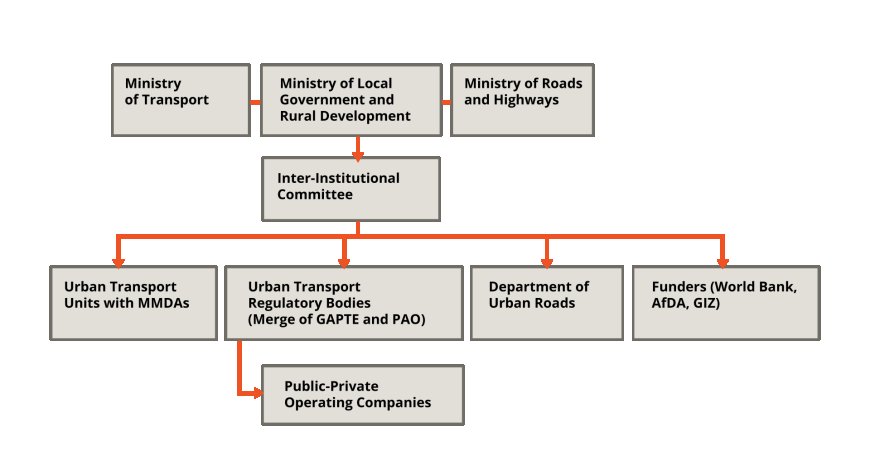
- Institutional reform: The BRT policy assigned roles to multiple implementing agencies. However, overlapping mandates, weak coordination and conflicts of interest hindered execution. To address these challenges, the institutional framework must be reformed to (a) redefine responsibilities, hierarchies and decision-making lines among the Ministry of Transport (MoT), the Ministry of Roads and Highways, the Department of Urban Roads, Metropolitan, Municipal and District Assemblies (MMDAs) and transport unions; (b) strengthen oversight by equipping the MoT with the necessary legal authority and technical capacity to coordinate the system; (c) tackle governance fragmentation by creating an inter-institutional committee to coordinate planning and institutional efforts; and (d) develop regulations to govern BRT implementation (Fig. 2).
The move will enhance collaboration across local government areas and planning units to enable integrated citywide planning. The reforms will also improve accountability, streamline coordination and build institutional capacity for the successful implementation of BRT systems in Ghana. The recommendation is directed primarily at the national level of government, particularly the MoT. It should be implemented in close collaboration with the Ministry of Local Government, Decentralisation and Rural Development. The study recognises that resistance from existing agencies poses a significant risk to the reform. To mitigate this, it is essential to implement changes in phases, promote coordination through incentives (such as conditional funding and shared performance targets) and maintain a strong political commitment. This approach will help prevent reforms from being hindered by institutional protectionism.
Figure 2: Recommended organisational structure for BRT planning and implementation in Ghana
- Successful countries and cities have adopted diverse funding instruments to support BRT systems that Ghana can learn from. General tax revenue is a common source for both capital and operational costs, particularly in high-income nations such as those in Europe and the United States, where mass transit is considered a public good. These revenues typically come from sales and value-added taxes and, less frequently, from payroll taxes. Motor-related revenues such as fuel levies represent another significant funding source for BRT and other forms of public transportation. This approach has been effectively implemented in countries such as Colombia, Australia, the United States, Singapore, Brazil and Mexico, where governments impose charges on motorists to generate funds for public transport and broader economic benefits.
In some cases, property development mechanisms are employed, allowing BRT systems to lease or sell development rights at key stations or terminals to private developers. In return, developers finance all or part of the construction costs for the station or terminal. The mechanism provides the framework for private sector investment in BRT. These examples illustrate viable funding instruments that can be adapted to the Ghanaian context to enhance the financial sustainability of BRT implementation. The assessment and adoption of new revenue proposals primarily rest with the Ministry of Finance, which has constitutional responsibility for fiscal policy, taxation and public expenditure management. The impetus for change could originate from strong policy leadership within the transport sector through evidence-based proposals that emphasise fiscal sustainability, economic returns and social benefits.
Additionally, land value capture (LVC) instruments such as betterment tax, accessibility increment contribution and joint development can provide sustainable funding to the system (Medda, 2012). Countries and cities across the world, including Columbia, Brazil, Ethiopia, Egypt, India, China and the United Kingdom, have adopted LVC strategies to finance infrastructure projects (Suzuki et al., 2015). The goal of LVC is to ensure that a portion of the increased land value benefits the community instead of solely enriching private landowners. This concept encompasses policies that enable public authorities to reclaim the value added to land due to government actions, such as land development, infrastructure improvements, service deployments and changes in land use regulations. By capturing value increases from BRT investments, governments can address inequality by reinvesting in the BRT system, affordable housing, social services and infrastructure in underserved or economically disadvantaged areas. The Ministry of Finance should take the lead in developing an LVC policy, working in collaboration with the Ministry of Local Government, Decentralisation and Rural Development, the Ministry of Lands and Natural Resources, and the MoT. - To integrate the BRT system in Ghanaian cities, capacity building and awareness programmes, based on a strong change management strategy, are needed to build the competencies of MMDAs, planners and unions. This approach will ensure a strong institutional base for the planning and implementation of the BRT system. There is also a need for targeted public awareness campaigns to build ridership trust and support. These campaigns should clearly communicate the benefits of the BRT system to targeted users and the public.
Endnotes
[1] A previously informal, privately run public transport provider, like a trotro operator, which has been formally integrated into the BRT system.
References
Adom-Asamoah, G., Asibey, M. O., & Nyarko, S. (2021). Rethinking or affirming the ‘affordability’ debate on the efficiency of urban public transport usage: Case of Kumasi, Ghana. Transportation in Developing Economies, 7(2), 1–15. https://doi.org/10.1007/s40890-021-00131-6
Agyemang, E. (2015). The bus rapid transit system in the Greater Accra Metropolitan Area, Ghana: Looking back to look forward. Norsk Geografisk Tidsskrift, 69(1), 28–37. https://doi.org/10.1080/00291951.2014.992808
Asimeng, E. T. (2021). Bus rapid transit implementation with the inclusion of incumbent paratransit operators in African cities: Lessons from Accra. Urban, Planning and Transport Research, 9(1), 534–548. https://doi.org/10.1080/21650020.2021.2000485
Asimeng, E. T., & Jauregui-Fung, F. (2025). Tailoring bus rapid transit to the complex realities of African Cities: Critical issues and public policy planning approaches. Transportation Research Interdisciplinary Perspectives, 30, 101351. https://doi.org/10.1016/j.trip.2025.101351
BRTData. (2024). Global BRT Data. https://brtdata.org/
Fan, H., & Beukes, E. A. (2021). Enhancing financial sustainability and commercial viability of Bus Rapid Transits (BRTs) in sub-Saharan Africa (SSA): The factor analysis report. The World Bank. www.worldbank.org
Gutu Sakketa, T. (2023). Urbanisation and rural development in sub-Saharan Africa: A review of pathways and impacts. Research in Globalization, 6. https://doi.org/10.1016/j.resglo.2023.100133
Joseph, L., Neven, A., Martens, K., Kweka, O., Wets, G., & Janssens, D. (2021). Exploring changes in mobility experiences and perceptions after implementation of the bus rapid transit system in Dar es Salaam. Case Studies on Transport Policy, 9(2), 930–938. https://doi.org/10.1016/j.cstp.2021.04.012
Korah, A., Smith, L. C., & Wimberly, M. C. (2025). Understanding urban expansion across primary and secondary cities in Ghana. Habitat International, 158, 103339. https://doi.org/10.1016/j.habitatint.2025.103339
Medda, F. (2012). Land value capture finance for transport accessibility: A review. Journal of Transport Geography, 25, 154-161. https://doi.org/10.1016/j.jtrangeo.2012.07.013
Ministry of Transport. (2020, August). National transport policy. Government of Ghana. https://www.brr.gov.gh/acc/registry/docs/NATIONAL%20TRANSPORT%20POLICY.pdf
Poku-Boansi, M., & Marsden, G. (2018). Bus rapid transit systems as a governance reform project. Journal of Transport Geography, 70, 193–202. https://doi.org/10.1016/j.jtrangeo.2018.06.005
Suzuki, H., Murakami, J., Hong, Y.-H., & Tamayose, B. (2015). Financing transit-oriented development with land values: Adapting land value capture in developing countries. World Bank. https://openknowledge.worldbank.org/handle/10986/21286
Teko, E., & Lah, O. (2025). Institutional factors influencing transport innovation implementation: The case of Accra’s Bus Rapid Transit Project. Transportation Research Procedia, 89, 621–637. https://doi.org/10.1016/j.trpro.2025.05.086
World Bank. (2007). Ghana—Urban transport project. World Bank. http://documents.worldbank.org/curated/en/186371468036343928
About the Author

Emmanuel Amponsah
Emmanuel Amponsah is an Urban and Transport Researcher based at the Department of Planning at Kwame Nkrumah University of Science and Technology (KNUST) in Kumasi, Ghana. Emmanuel was a recipient of a SMUS-APRI Urban Africa Post-Doctoral Research Scholarship, which invited African scholars to address wicked urban problems. His research interests lie in sustainable transportation and urban studies. Emmanuel worked very closely with Dr. Nadine Appelhans, from the Habitat Unit, a globally networked research and teaching centre based at Technische Universität (TU Berlin).
The Global Center of Spatial Methods for Urban Sustainability (SMUS) is funded by the German Academic Exchange Service (DAAD) with funds from the German Federal Ministry for Economic Cooperation and Development (BMZ).