
Stärkung der Pandemieresilienz in der ECOWAS: Integration von Impfbescheinigungen in grundlegende Identitätssysteme (EN)
Jüngste Gesundheitskrisen wie Ebola und COVID-19 haben Schwachstellen im System offenbart – insbesondere im Bereich der digitalen Identität und der Überprüfung von Gesundheitsnachweisen. Mit Blick auf die Zukunft können die Interoperabilität digitaler Ausweise und einheitliche Impfzertifikate das Vertrauen und die Widerstandsfähigkeit im grenzüberschreitenden Verkehr wiederherstellen.

This paper is part of the ECOWAS Policy Analysis Series (EPAS) - an initiative spotlighting African thought leaders and researchers' take on ECOWAS. EPAS aims to critically examine ECOWAS’s evolution over the past five decades from the perspective of academics and citizens and contribute to a forward-looking vision for regional integration in West Africa. The EPAS series is coordinated by the Africa Policy Research Institute in the context of the ‘Support to the ECOWAS Commission on Organisational Development’ project. The project is implemented by the Deutsche Gesellschaft für Internationale Zusammenarbeit (GIZ) GmbH on behalf of the German Federal Ministry for Economic Cooperation and Development (BMZ).
Introduction
Since the establishment of ECOWAS in 1975, the free movement of people and goods across West African borders has been one of the regional bloc’s core objectives. Over the years, West African citizens have enjoyed visa-free travel within the region due to ECOWAS’ Protocol Relating to Free Movement of Persons, Residence and Establishment. However, public health crises like the 2010s Ebola virus epidemic and the coronavirus [COVID-19] pandemic exposed weaknesses within ECOWAS’ free movement regime, such as the lack of a harmonised digital identification system across the region.
While several ECOWAS members have taken steps to deploy digital foundational IDs under regional initiatives like the West Africa Unique Identification for Regional Integration and Inclusion (WURI) and the ECOWAS National Biometric Identity Card (ENBIC), these measures have not led to the establishment of a health information exchange system across the broader subregion.
This paper calls for the establishment of a region-wide vaccine certification and verification system, including a “health passport” linked to an individual’s digital ID. It urges the ECOWAS Commission to establish a framework for digital ID interoperability, which is the ability of information units to exchange data seamlessly in ways that would enable the implementation of measures like a digital vaccine certificate for the ECOWAS subregion. By aligning digital IDs with data infrastructure for public health, ECOWAS can strengthen West Africa’s public health resilience and pandemic preparedness by facilitating quicker response times, a streamlined process for border control and a reliable method of vaccine verification.
Freedom of Movement: A Boon for Ecowas
In 1979, ECOWAS adopted the Protocol on the Free Movement of Persons, Right of Residence and Establishment as one of its flagship tools for regional integration. Undoubtedly, free mobility across West Africa has delivered tangible benefits in intra-regional trade, economic development and social cohesion in West Africa. By removing barriers to mobility across the region, ECOWAS has made it easier for West African citizens to pursue income-generating opportunities anywhere in the ECOWAS subregion. Informal cross-border trade, which is a source of livelihood for many communities, has flourished since the adoption of the free movement protocol. Research by the Organisation for Economic Co-operation and Development (OECD) indicates that female traders in particular have benefitted from the free movement of goods across borders by gaining more access to commercial opportunities which have increased their earning potential.
However, despite the significant gains brought about by the ECOWAS Protocol on Free Movement of Persons, Residence, and Establishment, it has come under considerable strain on several occasions especially during public health crises. During the 2010s West African Ebola virus epidemic and the COVID-19 pandemic, West African governments resorted to nationalist measures such as mass deportations or border closures, which placed restrictions on economic activity and curtailed freedom of movement across the region.
COVID-19 and its Effects on Freedom of Movement
The COVID-19 pandemic negatively impacted free movement in West Africa. In response to the outbreak of COVID-19, West African governments imposed emergency restrictions on travel like flight bans, curtailing inter-city transport and the closure of land borders. These measures, which were ostensibly implemented to curb the spread of the disease, were poorly coordinated across the region and led to a conflicting patchwork of measures across different jurisdictions.
Border officials struggled to administer COVID-19 tests and other mandatory health measures while neighbouring countries sometimes had different curfew hours, which caused delays in the transport of perishable goods and other commodities across land borders. Some ECOWAS members lacked a unified system for validating COVID-19 test results or vaccinations, and generally implemented health security measures in isolation, due to lack of trust in the health certifications presented by travellers from neighbouring countries.
A Brief Overview of Digital IDs in West Africa
Long before the outbreak of the COVID-19 pandemic, ECOWAS recognised the need for a common digital identity that could accelerate regional integration. In 2014, the bloc adopted the ECOWAS National Biometric Identity Card (ENBIC) as a regional identification document for the bloc’s citizens. The ENBIC is a biometric smart card that is intended to serve multiple functions including a national ID card, a document to be used in lieu of a passport while traveling within the ECOWAS zone and as proof of the right to reside anywhere in the subregion. It is made up of an embedded electronic chip capable of storing the cardholder's biographical data. Senegal was the first country to adopt the ENBIC, having done so in 2016. Ghana followed suit in 2017, while Nigeria announced a plan to roll out ENBIC biometric IDs in 2024. However, the adoption of the ENBIC by all 12 ECOWAS members has not yet happened (see Figure 1). Nigeria has only partially distributed the new card due to budgetary constraints.
Complementing ECOWAS’s ENBIC initiative is the West Africa Unique Identification for Regional Integration and Inclusion (WURI) , a partnership between ECOWAS and the World Bank that was launched in 2018. WURI aims to work with West African governments to build robust ID forms that are machine-readable and valid for use by citizens in the ECOWAS subregion. WURI intends to develop a nationwide ID infrastructure buttressed by legal frameworks, databases and processes to create a form of identification for every ECOWAS citizen regardless of their nationality or residency status.
Figure 1 Overview of ID deployment programmes within the ECOWAS subregion (both planned and deployed).
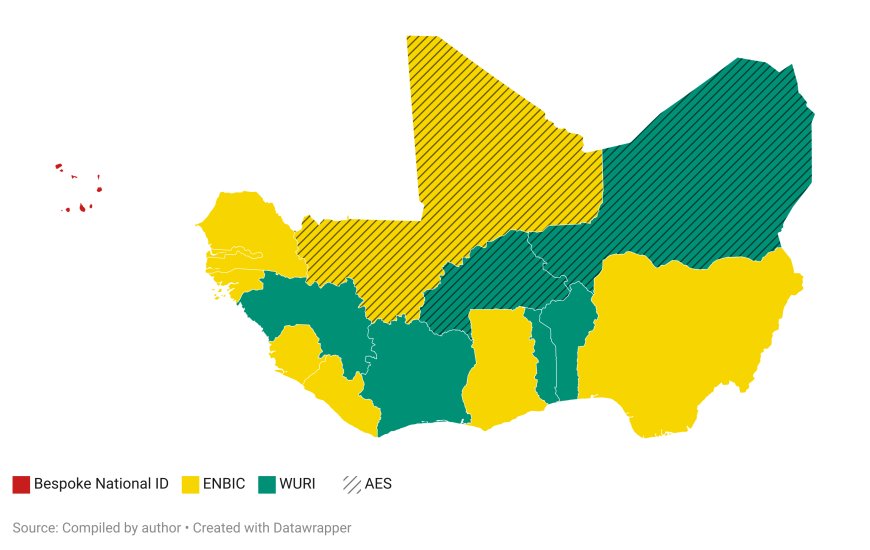
Some ECOWAS members like Benin, Burkina Faso, Niger and Togo are leveraging the support of WURI to roll out digital biometric IDs for all residents within their borders, create digital ID registries and issue identification credentials that are recognised across the ECOWAS subregion.
The Case for Interoperable Vaccine Certification
It is important for ECOWAS to build a robust digital ID system and an interoperable vaccine certification system. The experience of the COVID-19 pandemic shows that the ECOWAS Protocol on Free Movement must apply to health data as much as it does to people and goods. A shared digital platform that enables officials from any ECOWAS member state to securely verify a traveller’s health information would eliminate the need to close borders for an extended period in the event of a future public health emergency. An interoperable vaccine certificate would allow governments to screen travellers in an efficient, safe and timely manner. If adopted across the ECOWAS subregion, it would enable the bloc’s members to administer a standardised, digital immunization certificate that can be used anywhere in the subregion.
In order to eliminate bureaucratic bottlenecks arising from a disagreement or lack of trust among governments in the ECOWAS subregion, ECOWAS member states could adopt existing models like the World Health Organization’s (WHO) Global Digital Health Certification Network and adapt them to their countries. In the event of a health emergency, these measures will enable domestic governments to maintain the free movement of people and goods within a well-regulated regime, thereby ensuring continued economic activity and the safeguarding of public health at the same time. An interoperable ID framework anchored by a digital vaccine certification system would allow policymakers in the region to minimize disruptions to economic activities and free mobility during health crises. Equally, ECOWAS citizens who wish to travel across the region would be able to verify their health information without unnecessary delays or interference.
In Europe’s Schengen Area, which also administers free movement protocols among its members, its officials used technological measures to minimize disruptions to travel during the COVID-19 pandemic. The European Union (EU) launched a Digital COVID Certificate (DCC), a digital health certificate system that enables EU travellers to verify their COVID-19 vaccination or test status across the union’s borders through an EU trust network.
Over time, the EU granted access to its trust network to non-EU countries, effectively making the DCC interoperable across geographic regions. Some ECOWAS members like Benin, Togo and Cabo Verde established vaccine certifications that were interoperable with the EU system, allowing vaccinated travellers from these countries to travel easily to and within the EU even when borders in West Africa remained closed. The EU’s experience demonstrates the efficacy of a collective effort to develop a regional digital credential system that would minimize disruptions to trade and travel while safeguarding public health.
Similarly, the Association of Southeast Asian Nations (ASEAN) created a Travel Corridor Arrangement Framework in November 2020, which allowed the reopening of essential business travel in the region on the condition that officials in the region administered pre-departure testing and other health protocols. In addition, they implemented the use of digital measures such as contactless immigration and contact-tracing apps to assure the general public that the reopening of activities would not compromise public safety. By mid-2022, countries in the ASEAN zone adopted a Universal Verification Mechanism, a digital system created to authenticate vaccine certificates issued in the region using a secure QR code.
The African Union’s proposed digital vaccine passport and the AU Interoperability Framework for Digital IDs present an opportunity for African governments to adopt similar measures. African regional blocs like ECOWAS have a unique opportunity to establish a model that can be scaled across the continent.
Policy Recommendations
The EU’s DCC and ASEAN’s verification network demonstrate the value of synchronizing health data across borders in order to minimize disruptions to commerce and mobility during public health emergencies. ECOWAS should invest in the creation of interoperable digital ID and health certificate systems to enhance regional freedom of movement and boost resilience against public emergencies.
In addition, the bloc should include Burkina Faso, Mali and Niger — the three countries that withdrew from ECOWAS to form the Alliance of Sahel States (AES) — in these initiatives. The citizens of the three countries, whose collective population stands at more than 70 million, remain part of the broader West Africa region and will continue to interact with their ECOWAS neighbours. Health crises do not recognize borders or political associations, and neither should collaboration to boost health resilience. Thus, ECOWAS should ensure that it incorporates its neighbours from the AES into its certification network.
To achieve these objectives, ECOWAS should implement the following measures:
-
Establish a Regional Digital Health Certification Framework. ECOWAS should create and deploy a region-wide interoperable system to validate digital vaccines and test certificates. It should set up a special task force responsible for designing and implementing these measures. The certificate data, which would contain test results and vaccination statuses, should be linked to the digital IDs of individuals in order to ensure authenticity and prevent fraud.
-
Empower WAHO to Lead a Digital Health Trust Initiative: The West African Health Organization (WAHO), ECOWAS’ specialised health agency, should be tasked with the responsibility of coordinating the development of a regional health trust framework. WAHO is well-positioned to define health data standards, oversee interoperability, and ensure that the system aligns with international norms.
About the Author

Leslie Nii Lantey Mills
Leslie Nii Lantey Mills researches digital transformation and economic growth in developing countries with a focus on Africa and Asia. He holds an MPP from the Hertie School in Berlin.
Disclaimer: This publication was produced with support of the Organisational Development, Support to the ECOWAS Commission, commissioned by the German Federal Ministry for Economic Cooperation and Development (BMZ) and implemented by the Deutsche Gesellschaft für Internationale Zusammenarbeit (GIZ) GmbH (GIZ). The content of the publications does not necessarily reflect any official position of GIZ or the German government. GIZ and the BMZ assume no responsibility for external links and the content of external websites referenced in the publications.