Pillar 1
GROW
Agrifood & bio-industrials acceleration.


Foto von Golden Brown auf Shutterstock.
Das Papier fordert eine Neugestaltung der Beziehungen zwischen Ghana und Deutschland von einem begrenzten, auf Qualifikationen ausgerichteten Modell hin zu einer strategischen, avantgardistischen Partnerschaft, die auf Ghanas 24-Stunden-Wirtschaft und avantgardistischer Industrialisierung basiert.

Ghana and Germany share one of the longest and most technically textured development relationships in post-colonial Africa.1 Yet, in recent decades, the character of this relationship has shifted from a historically broad and industrially embedded partnership to one with a far narrower focus dominated by technical and vocational education and training (TVET), small-and-medium-enterprise (SME) support and scattered project-based cooperation.2 This narrowing has taken place just as Ghana has adopted one of the most ambitious structural transformation agendas in its post-independence history: the 24-Hour Economy initiative (24HE).
The core argument of this paper is that if the Ghana-Germany relationship is going to move with the times, it must be shaped to respond to the pace of Ghana's own framing of its ambitious structural transformation agenda. While TVET has a role to play in generating some of the essential skills needed in important dimensions of the industrialisation core of this transformation, it is far from sufficient. In fact, one may even argue that, bearing in mind Ghana's weak interlinkages between human capacity development and the employment-generation structure of the economy, TVET's failure to integrate into the fabric of Ghana's stop-start economic reform trajectory is determined by the logic of the system.3
Germany may thus not be able to upskill Ghana towards the vision set by the 24HE initiative. However, Germany can become a central partner in Ghana's industrial transformation, as long as it reorients its engagement from skills diffusion to a vanguardist, value-chain, industrial-integration logic. This shift will align more closely both with how late industrialisers in Asia have succeeded and with the internal strategic direction of Germany's own emerging global engagement doctrine.
Two pathways to structural transformation/oriented industrialisation are contrasted:
Ghana's structural conditions - e.g., a weak research and development (R&D) base, a fragmented training ecosystem, low domestic capital accumulation and weak industrial clustering - make platform-first strategies unrealistic in the near term. The country's development opportunity lies instead in selective value-chain acceleration: building deep, tight, highly networked industrial corridors in a few strategically chosen sectors, then diffusing capabilities outward after traction is achieved (the technical appraisal for this point follows Knez et al., 20216 ).
In this sense, the 24HE policy is not merely the single most determinative political-economy lens for economic diplomacy in Ghana today but also a genuine watershed moment in the country's longstanding reckoning with transformative reforms. Germany's current development-cooperation model in Ghana is not designed for this 'industrial-wedge' logic.
This paper therefore proposes a reframing of the bilateral partnership around four anchor propositions:
In light of the findings above, we conclude that the choice facing both countries is clear:
Either continue a donor-recipient, TVET-centric, low-impact cooperation model, or pivot to a vanguardist industrial compact built around selective, export-anchored, corridor-based industrialisation. Only the latter aligns with the urgency of Ghana's youth jobs crisis and the realities of Germany's own global repositioning.
The relationship between Ghana and Germany has always been more than a conventional donor-recipient interaction. It was born not in the era of NGO diplomacy or Sustainable Development Goal (SDG)-style development programming, but in a period when industrial strategy, geopolitical alignment and technological capability were the decisive currencies of global power.8 (See Appendix 3 for more information on the historic trajectory.)
The foundation of the partnership was productive infrastructure, industrial plant construction, technology transfer and state-to-state industrial diplomacy. That heritage matters, not for nostalgic reasons, but because Ghana has now re-entered a phase of development that once again requires industrial coordination capacity, not the incremental social programming that the long tail of technical and vocational education and training (TVET) diffusion and scattered interventions represents. Germany once participated meaningfully in such a phase.9 It no longer does. This is the core problem this paper seeks to address.
In the first decade after independence, both German states (East and West) left imprints on Ghana's manufacturing, logistics, processing capacity and engineering ecosystems. The Federal Republic of Germany (FRG) financed and supplied machinery, industrial installations, processing plants, energy infrastructure and logistics systems.10 The German Democratic Republic (GDR), though constrained by Hallstein Doctrine politics, still managed to export industrial equipment, modular plants and technical-scientific assistance.11 It bears emphasising that we are not here wading in peripheral add-ons to development policy. These German engagement activities were designed to anchor Ghana's industrialisation vision inside global technology and capital flows, in line with the grand ambitions of the government of the day.
For example, a sizable proportion of the USD 64 million committed by East Germany (GDR) to Ghana between 1955 and 1982 went to technical support services, including the acquisition of industrial equipment.12 A USD 20 million credit agreement targeted the timber, paper and pulp industries.13 Following a further USD 24 million trade and investment credit facility signed in 1965 to deploy modular industrial plants, Ghana became the second largest recipient of East German development assistance in Africa, after Egypt (then known as the United Arab Republic), whose distinction as the first African country to recognise the GDR via treaty in 1953 puts it in a special category.
By contrast, the contemporary Ghana-Germany relationship has gradually contracted into an over-specialisation around TVET, SME upgrading, micro-level employment schemes and scattered donor-programming cycles. Consequently, Germany is now the largest TVET donor in Ghana.
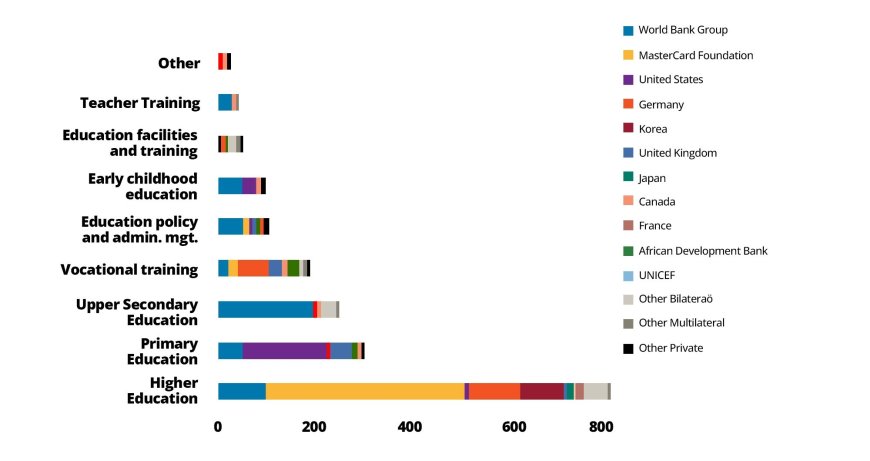
The trade-off is that Germany is no longer a major participant in industrial structuring, value-chain deepening, logistics systems, industrial corridor development, or capital-machinery ecosystem building. The result is a paradox: Germany remains visible in Ghana's development landscape, but structurally irrelevant to the country's most ambitious economic project in fifty years: the 24-Hour Economy (24HE).
This paper argues that the contraction of the relationship from industrial partner to skills donor is not a neutral outcome. It has produced a fundamental mismatch of development logics: Ghana has moved into a phase that demands selective, high-intensity, value-chain-anchored industrialisation, while Germany is still operating through models built for slow, diffuse, skills-first development. The result goes beyond mere tension. We are talking about mutual underperformance: Ghana does not get the kind of industrial scaffolding required for structural transformation, and Germany does not leverage its true strategic advantage (e.g., talk of industrial systems intelligence, supply-chain engineering and export-anchored cooperation models).
The key thesis of this paper is therefore simple, but decisive: Germany's upskilling emphasis will not make much of a difference to the quest to build a 24HE in Ghana. However, Germany can still pivot towards helping Ghana in this endeavour. But, first, it must abandon the diffusion-first mindset and re-engage through a vanguardist, value-chain, corridor-industrialisation partnership model.
This requires a new conceptual architecture for the partnership. The conventional assumption that industrialisation is what happens after skills formation must be inverted. History shows that late industrialisers who succeeded most rapidly (South Korea, Taiwan, Malaysia, China, Vietnam, among others) did not wait to diffuse broad technical capabilities before building globally competitive output sectors in narrow but tightly interwoven networks. Instead, they used spearhead-first strategies, where high-intensity production nodes generated the economic space, foreign exchange, institutional learning and political coalitions necessary for later capability diffusion.15 By contrast, the 'platform-first' approach, characterised by broad training, followed by hoped-for industrial uptake, worked only in countries with strong pre-existing institutional, technological and capital ecosystems (e.g., Italy, Japan, Ireland). Ghana is not in this category.
The inevitable inference for the 24HE initiative, then - considering the goals set for it - is that it is not tethered to a skills programme. It is, instead, heavily anchored in an industrial coordination doctrine. It is built around accelerating production through time-capacity optimisation (including, where appropriate, 24/7 operations), spatial clustering, logistics synchronisation, digital labour orchestration and selective value-chain anchoring. It cannot be delivered with TVET, entrepreneurship training, or SME support as the primary facilitators.
In saying so, the intent is not to downplay the value of German cooperation. Rather, it is to critique its sequencing logic. Germany has been supplying Ghana with technically sound solutions for a different development phase. Skills-first logic made sense when Ghana had a broader industrial base, or when it was entering the labour market reform era of the 1990s-2000s. But in 2026, Ghana is attempting what development economists call a late-stage industrial time-compression jump16: moving from shallow production to high-throughput industrial corridors through capacity maximisation of outputs, and not via the slow, if steady, diffusion of capabilities.
A serious Ghana-Germany strategy today must therefore return to the structural depth of the early partnership, while updating it for a world of AfCFTA regionalisation, supply-chain geopolitics, export-linked migration bargaining and EU carbon-border regulatory constraints.
This paper argues that the way forward is not revival of the past, but re-alignment around the vanguardist model,where Germany supports Ghana not by training the entire labour force, but by co-constructing the industrial spearheads that make large-scale labour absorption viable in the first place. Incentives-alignment, in the proposed model, comes from shifts in Germany's own global integration logic, which makes it imperative for all its relationships, even those on the semi-periphery, to be retooled as new sources of growth.17 18 Otherwise, Germany would only be vindicating the harshest critics of its development cooperation model.19
The rest of the paper proceeds as follows:
The conclusion argues that the choice before both countries is not between more or less aid, but between donor-logic and vanguard-logic. Only the latter aligns ambition with industrial reality.
The first phase of Ghana-Germany cooperation, spanning the late 1950s to the early 1970s, was defined by industrial diplomacy, and much less by aid-driven development. The Federal Republic of Germany (FRG), or 'West Germany' as it was often called, entered the Ghana Economic & Technical Cooperation Agreement of 1959. The Agreement established four interrelated compacts built around supplier credits, industrial equipment financing, technical advisory services and institutional support.
Backed by a bevy of supplier credit facilities, amounting to about USD 48 million,20 and technical education grants,21 economic historians rate the comprehensive pact as Ghana's first with a Western power. They ranged from Frukogold's logistical complexes in the industrial hubs of Tema and Takoradi, through the enduring water processing facilities of Kpong and Weija, all the way to Thyssen Stahlunion's multiple industrial plants spanning glassware to meat and cocoa processing.22
By the end of the First Republic, German industrial actors - among them Julius Berger, Hoesch and Maschinenfabrik Augsburg-Nürnberg - were not just exporters, but structural participants in Ghana's industrialisation strategy. West Germany financed sugar processing, machine parts fabrication, glassware production, meat processing, cocoa value-added facilities and critical logistics and energy assets. Tema and Takoradi port logistics operations still bear a German imprint.
By the end of 1969, World Bank records showed that only the United Kingdom had more industrial financing and capital aid projects in Ghana than West Germany.
Meanwhile, East Germany's role, though constrained, was not symbolically marginal. Industrial plant modules, agro-processing machinery and science-technology cooperation agreements were the core vehicles. Even scholarships were tied directly to productive domains: chemical engineering, agricultural equipment maintenance and industrial design.
The key point bears repeating: The Ghana-Germany relationship was born inside a shared industrial logic. The Germans partnered with Ghana not as a welfare subject, but as an industrialising state worthy of capital machinery, value-chain participation and technical exchange. It was a peer-to-peer development model, and not, as pronounced elsewhere, a donor-to-recipient model.
The 1970s-80s debt crises marked a structural rupture. As Ghana struggled through macroeconomic collapse, IMF stabilisation, political turnover and serial debt repudiations, German industrial credit became fiscally unworkable. Capital-formation instruments were displaced by humanitarian assistance, social development pilots and projectised aid logic.
The partnership shifted from industrial-system support to fragmented programmatic interventions:
German cooperation survived when others withdrew, but the logic regressed from productive capacity-building to donor humanitarianism.
Emblematic of this switch is the increased centering of what in the previous decade would have been considered marginal. For instance, programmes such as the so-called 'development villages' - developed by West German development actors in places like Biriwa and Peki at the instigation of social workers like Carl Hoffman - started to feature prominently in discourses on cooperation. Meant to demonstrate the integrated power of development aid and local agency, the projects have nonetheless been seen as spectacular failures by development sociology historians.23
The 1990s brought a pivot towards governance, scattered commitments to private sector development at a policy-rhetoric level and institutional capacity building - especially within certain technocratic functions in the national fiscus and tax institutions.
The 21st-century phase of cooperation is marked by technical assistance, skills upgrading and small and medium enterprise (SME) facilitation, largely shepherded by German institutions such as the Deutsche Gesellschaft für Internationale Zusammenarbeit (GIZ), the Physikalisch-Technische Bundesanstalt (PTB), the Kreditanstalt für Wiederaufbau (KfW) and Sequa. The EU also plays a key role in this area.
| Type of intervention | Instrument | Result |
|---|---|---|
| TVET reforms | Ghana Skills Development Initiative (GSDI), TVET Voucher Programme, BINA24, dual-apprenticeship pilots | Strong skills-output but weak industrial absorption |
| SME & agribusiness | Market-Oriented Agricultural Programme (MOAP), mechanisation centres | Upgrading but low scaling |
| Institutional support | AfCFTA Secretariat, metrology, standards, customs modernisation | Valuable but not industrialising |
| Development finance | KfW DEG (German Investment and Development Company) injections into banking, microfinance | Limited value-chain anchoring |
Interventions deserving mention include the BINA Ghana Project, a replica of a model implemented in many countries by the Beruflichen Fortbildungszentren der Bayerischen Wirtschaft gGmbH (BFZ).25 In Ghana, the Don Bosco School has been the key partner in training 'profilers', counsellors and instructors to identify and rate the skillsets of potential beneficiaries, typically young people that are yet to find a foothold in the job market. Selected beneficiaries are provided with tailored training to improve their chances of a successful work placement. The 2022 cohort was estimated at about 1500 beneficiaries.
The TVET Voucher Programme (TVET VP)26 mentioned above also deserves some elaboration. Designed in response to the high degree of informality in the Ghanaian labour market, with nearly 90% of the national workforce estimated to be locked in informal employment, the TVET VP targets traditional apprenticeships, a major skills development channel that has long been hobbled due to the lack of an accommodating national qualifications framework.
Following its launch in 2017 as one of the fixtures of the SME-focused Ghanaian-German cooperation landscape, the programme started to offer fully funded vocational training to selected youth and women. According to programme reporting, over 27,000 individuals have so far benefited. The initiative's strength is said to inhere in the blending of hands-on learning with structured, competency-based modules certified by the newly crafted consolidated national qualifications framework. If effective, the system should enable artisans to earn formal recognition for their skills nationwide.
Backers have included the German KfW and GIZ, the EU, and the Swiss development agency SECO (State Secretariat for Economic Affairs). The ambition of the TVET VP is to go beyond training and aim instead at a full-throttle modernisation of the deeply rooted informal ecosystem while preserving its community spirit and ethos.
Since the 2000s, the eclectic strategy of cooperation exemplified by the preceding has resembled a large collage of dot-matrix interventions in a broad array of areas, many driven by agencies such as the GIZ, with the occasional injection of funds from the KfW, among others, into microfinance-ecosystem-strengthening experiments and the setup of development banks in Ghana. However, the microfinance activity was judged to have failed to mobilise industrialisation, and the setup of the Development Bank Ghana (DBG) has recently become mired in scandal.27
Over time, the overall relationship, though highly active, has weakened. While Germany became Ghana's most committed TVET partner, it is no longer a consequential actor in industrial structure-building. While this shift has been somewhat variegated, it seems that the transition from industrial anchor to skills donor is the decisive inflection point.
The 2017 G20 Compact with Africa (CwA) raised expectations of a renewed strategic partnership. Ghana became a showcase country, but the CwA's design was fatally flawed, for it contained no sizable donor funding obligations.
Ghana's flurry of reforms following its inclusion, by Germany, in the CwA programme has been described as picking 'low-hanging fruits'.28 Analyst Dode Seidu, sums up the situation: '[a]longside little [sic] to no commitments from most G20 members, the level of interest and involvement at the country level is minimal'.29 Since the compact does not require those in the donor camp to commit new funds, precious little substance has come through the programme to date.30
Meanwhile, one cannot discuss the issue of capital and funding without bringing up the most pressing contemporary priority for the Ghanaian government in that realm. Without question, the issue of debt rationalisation to support the country's recovery from the worst fiscal crisis in nearly a generation by reducing the high debt-servicing burden is of the highest consequence for the Ghanaian state.31
Unfortunately, since the Highly-indebted Poor Country - Multilateral Debt Relief Initiative (HIPC-MDRI) initiatives, Germany's bilateral engagement with Ghana has featured very limited debt, rendering the issue of debt cancellation, one obvious potential leverage point for Germany, moot. Whilst there is some German-originated debt on the table, the lenders of note have come more from the private banks, like Deutsche Bank and Commerzbank, than policy banks, like KfW.32
Since the early 2000s, a considerable proportion of German support has been shifting toward private sector facilitation, with a particular focus on SMEs, agribusiness and vocational training. One of the key innovations of German cooperation during this period has been the promotion of the dual-track apprenticeship model, heavily inspired by Germany's own economic revitalisation experience within its domestic system, and adapted to the institutional realities of the host society.33
Several technical universities and polytechnics in Ghana have benefited from curriculum reform, equipment donation and industry linkages under this model. The transformation of Ghanaian polytechnics, long perceived as inferior to the mainstream universities, into a new cadre of 'technical universities' was heavily influenced by 'study tours' conducted by political decisionmakers from Ghana in Germany's techno-educational heartland.34
Other similarly themed programmes in the Ghanaian policy universe that have benefitted from German inspiration include:
On the technical-vocational skills acquisition front, the tie-up with job creation has been explicated by reference to the upgrading of cottage industries with stronger productivity-inducing capabilities and enhanced market-fit as the economy grows, buoyed by extraneous factors such as commodity booms. Yet these scattered bright spots have not coalesced into a promising picture of the contemporary relationship and its future direction. The next section explains why.
The CwA partnership narrowed because three structural linkages were lost:
The result is a relationship rich in programmes, but poor in structure.
Until recently, this narrowing might have been tolerable. But the 24-Hour Economy (24HE) initiative represents the first large-scale, state-led industrial coordination project in Ghana in a generation. Unlike the Presidential Special Initiatives of the 2000s and the 1 District 1 Factory initiative of the previous administration, the 24HE initiative encompasses a set of lateral and vertical integrations considerably deeper in scope than mere financial guarantees for existing manufacturing entities.
It demands:
These are historical German strengths, but they are not particularly associated with TVET outputs in the present Ghanaian context (see Appendix 2). That context is characterised by one crushing existential risk: Ghana's youth unemployment rate has hovered between 12% and 19% over the last decade, with underemployment and informal work affecting more than 40% of young people.
The new Ghanaian government strongly recognises the imperatives implied by the current spate of youth underemployment and, in some cases, unemployability, as the needs of the economy shift. Consequently, it has declared a 'national jobs emergency' and committed to the creation of a 24-Hour Economy.
Far exceeding the scope of the night economy with which it is routinely conflated, the 24HE initiative is best defined as a multi-sectoral transformation of production, distribution and service delivery structures across the entire economy. Its aim is capacity maximisation across all the economy's production frontiers. Carefully examined, 'scale' and 'speed' are the primary and overriding virtues and imperatives in the 24HE doctrine. Unless Germany re-enters as an industrial system co-builder, it will become marginal to Ghana's next development chapter.
The contraction of the Ghana-Germany relationship from industrial partnership to skills-oriented donor cooperation did not occur by accident. It emerged from the interaction of three reinforcing dynamics: (i) shifts in Ghana's macro-political economy; (ii) structural changes inside Germany's development and industrial policy architecture; and (iii) the global reconfiguration of North-South cooperation under post-Cold War liberalisation. Understanding this trajectory is critical because it explains why the current cooperation model is not merely inadequate but also structurally misaligned with Ghana's 24HE strategy.
Ghana's post-independence industrial strategy was anchored in import substitution, state-owned manufacturing and technology transfer via bilateral partners. It collapsed under external debt shocks, raw material price volatility and institutional fragility. By the mid-1980s, industrial policy as practised during the First Republic was delegitimised by the IMF-World Bank structural adjustment regime.35
As industrial policy retreated, 'private sector development' and 'skills upgrading' emerged as depoliticised substitutes. Donors favoured these because they:
German cooperation adapted accordingly. Instead of financing plants, machines and logistics systems, it funded micro-enterprise support, vocational centres and skills recognition frameworks. These interventions were not useless, but they certainly were decoupled from an industrial anchor.
By the mid-2010s, Ghana's developmental state capacity had weakened to the point where politically light-touch programmes like TVET became a safe arena for donor support because they did not interfere with macroeconomic conditionality, value-chain control, or trade structure. A premature 'graduation from aid' in the wake of post-HIPC36 donor fatigue, a mini oil-boom and the search for nominal success stories about development aid hastened these trends.37
The German side underwent an equally decisive transformation. In the 1960s to 1970s, development cooperation was a projection of German industrial strategy. Industrial firms, policy banks (KfW and its subsidiary DEG) and export credit agencies were the frontline actors. The model was transactional, supply-chain anchored and geoeconomically strategic. By the 1990s/2000s, German cooperation became professionalised, bureaucratised and NGO-agency-driven, with the GIZ emerging as the dominant implementing logic.38 39
Table 2 summarises – at a high level – how this shift has unfolded.
| Earlier model | Current model |
|---|---|
| German industry plus KfW plus state | GIZ plus thematic programming |
| Export-led industrial diplomacy | Social-sector, governance and skills projects |
| Risk-tolerant capital plus machinery | Risk-averse technical assistance |
| Co-invested plant building | Pilot interventions and policy advisory |
| Long-horizon industrialism | Short-cycle projectisation |
The result was a de-industrialisation of German cooperation abroad, even as Germany doubled down on recovering industrial competitiveness at home via hydrogen corridors, Industry 4.0 and logistics re-engineering in the face of deindustrialisation fears in Germany itself. Somehow, officials failed to make the link.
Germany now runs a dual operating system:
This contradiction is now exposed by Ghana's 24HE pivot.
The fall of the Soviet bloc, the rise of the Washington Consensus and the liberalisation of African economies produced a new norm: Industrialisation was treated as too risky, too political and too capital-intensive for development partners.
In its place, came:
This 'industrial bypass model' was adopted globally, not just in Ghana. It created the illusion of structural progress while leaving productive capacity shallow. This shift is extensively documented in Lall (1995), Toye (1993) and Whitfield & Therkildsen (2011), who show how donor agencies systematically replaced industrial policy with micro- and governance-centric interventions after the 1980s debt crisis and geopolitical realignment.40 Ghana is now exiting that era. Germany, however, is not, as reflected by its modes of cooperation.
| Ghana 2025 | Germany's current model |
|---|---|
| Capital needs: industrial corridors, logistics intelligence, production deepening, energy synchronisation, value-chain financing | De-anchored offers: TVET, SME support, technical assistance, pilot projects |
| Strategy: 24HE (selective capacity maximisation via continuous production) | Instrument: skills-first, diffusion-first cooperation |
| Logic: vanguardist, selective deepening | Logic: broad-based capability diffusion |
| Target: 2-3 million new industrial jobs | Output: <30,000 TVET beneficiaries so far |
The most important finding here is not that the German model is insufficient, but that it is sequenced for a different development phase.
Germany is behaving as though Ghana is in a platform-building era. Ghana, having failed to achieve platforming capacity, has moved decisively in the direction of a spearhead-scaling era.
This misalignment will not repair itself for three reasons:
With the 24HE initiative, Ghana has reintroduced industrial coordination as the organising principle of its development model. This reactivates the structural space that Germany once occupied, which is as an industrial system co-builder, not a skills donor.
The question is no longer whether Ghana needs Germany but whether Germany is willing to re-enter the partnership at the level of industrial depth required, and whether the entire apparatus of the development machine assembled over the last three decades for external economic development engagement can be reconfigured in an agile fashion to respond to the needs of countries like Ghana.
Section 4 below addresses this question directly.
The 24-Hour Economy (24HE) initiative is a doctrine of integration: time-integration (multi-shift operations), spatial integration (corridors and clusters), functional integration (power, logistics, standards, finance, labour) and regulatory integration (permitting, inspection, labour codes, customs windows). By contrast, TVET, within the structural constraints of Ghana, is a doctrine of diffusion: provision of portable skills to individuals who then seek insertion into heterogeneous labour markets. Diffusion presumes that downstream absorption capacity exists or will arise organically. Integration presumes the opposite: that capacity must be constructed, synchronised and governed.
In Ghana's structural conditions - thin supply networks, under-capitalised SMEs, unreliable industrial power quality, logistics frictions, metrology gaps, slow permitting, etc. - skills cannot substitute for missing system linkages. An incremental addition of trained technicians does not fix cycle-time variability, batch reject rates, or customs dwell-time. Only system engineering does. This is the core reason TVET-centric strategies, sequenced as prime, underperform. They are inclined to treat symptoms (skills) rather than the binding constraints (industrial organisation) of skills utilisation that led to the deprioritisation of technical skills in the economy in the first place.
When skills are expanded without throughput gains, two paradoxes emerge:
Both paradoxes have been observable in Ghana's artisanal and SME-heavy sectors when certification improves but value-chain anchoring is absent. The 24HE initiative seeks to break this cycle by hard-wiring throughput (longer machine-up-time, predictable logistics, shift staffing rules, energy quality guarantees, etc.) into targeted chains. However, this requires pre-committed buyers (whether through off-take mechanisms or structured market guarantees), logistics Service-Level Agreements (SLAs), energy scheduling, supplier development routines and metrology-certified processes, among others. This is a systems problem, and not, upon reflection, a training problem.
In late-industrialiser success cases, the role of skills policy is endogenous to spearheads:
In each case, absorption pathways existed or were created before skills provision was scaled.43 Ghana's present approach in much of TVET is the reverse - training first, ecosystem later - which is costlier and slower because institutions learn faster than markets can absorb when the latter are thin. A situation has thus been created whereby the cycle is always in laggard-mode.
The 24HE's promise is not merely more hours worked. That would not transform total factor productivity. Instead, it promises that the hours worked can be better organised. For example, the industrial literature shows that moving from one shift to two or three shifts reduces per-unit capital charges (more hours per asset), smooths maintenance windows and compresses order lead-times.44 But such a multi-shift operation also requires:
None of these are delivered by training volumes. They are delivered by industrial governance, which is precisely where Germany has comparative advantage (standards, energy systems integration, corridor logistics, industrial automation and maintenance regimes). Of course, Germany would not be able to port such capabilities over. Only a conscious effort to identify synergy points between certain segments of German industry and sockets within emerging 24HE corridors in Ghana stand any chance of fostering sound and effective integrations.
TVET does matter - but as a precision tooling of spearheads, not as a wide funnel for general capabilities diffusion. In a Ghana-Germany vanguardist partnership, skills policy should be co-designed inside value chains, with:
Put plainly: in the 24-Hour Economy, TVET is a control knob. It is not the engine. The engine is integrated value-chain design, which presently is seriously missing in the German-Ghanaian economic development engagement model.
Below, we list opportunities for a new handshake between Germany and Ghana based on Ghana's needs and areas in which Germany has both comparative strengths as well as a continuing interest in developing in light of its own re-industrialisation agenda. We have distilled the priorities from a large pool of technical reports and assessments carried out over the last decade in Ghana and Germany.45
Addressing these bottlenecks is a critical precondition for TVET to translate into jobs at scale. It is not surprising, in light of these findings, that a skills-centric partnership not connected to technical-productivity transformation chains, as exemplified by the above, shall underperform. Nor can one underplay why a systems-plus-skills partnership is the only one likely to meet 24HE ambitions, which is a massive opportunity for revitalising the German-Ghanaian economic relationship in the current political economy.
The grid-transformation opportunity alone shows how such an alignment will not only direct the kind of TVET skills accumulation to be prioritised but also open the door for a large number of mid-sized German engineering firms to win mutually beneficial contracts with major Ghanaian state-owned enterprises like GRIDCO (The Ghana Grid Company), VRA (The Volta River Authority) and ECG (The Electricity Company of Ghana), with the clear proviso that the contracts are coordinated to gather an assortment of Ghanaian SMEs best placed to absorb specialised TVET talents. Where the grid-transformation effort is strongly embedded into productive corridors that might produce goods suitable as intermediates for German high-end manufacturing, the circular and forward linkages in the constructed global value chain can only improve in resilience over time due to strong criss-crossing incentive alignments.
The failure of TVET-first strategies to generate structural transformation is not an indictment of skills accumulation or technical training. Rather, it is an indictment of sequencing, compositing and integration strategy.
The 24HE initiative will succeed only if Ghana and Germany design spearhead ecosystems where TVET is instrumented to measurable productivity levers (OEE, OTIF, reject rates, certification cycle times, etc.), embedded in governed corridors and financed by chain-linked instruments. This logic is operationalised in Section 5 below.
Overview
This section restructures German engagement around the eight pillars of Ghana's 24HE initiative, converting a fragmented programme portfolio into a chain-first, corridor-governed architecture. Each pillar specifies: (i) Ghana's imperative; (ii) German contributions (institutions, firms and instruments); (iii) priority value chains; (iv) near-term deliverables; and (v) metrics. The following recommendations are framed in scenario-modelling terms to affirm the practical context of this paper. (Archetypal German actors and key decisive actions ands benchmarks are underlined for emphasis.)
Agrifood & bio-industrials acceleration.
Light manufacturing & process industries.
Energy & plant uptime for multi-shift operations.
Logistics, customs, inland terminals.
Blended finance & de-risking aligned to batch cycles.
Standards, metrology, certification, mutual recognition.
Labour market engineering for shifts.
AfCFTA regionalisation & export enablement.
The strategic basis for investing in the delivery platform is to move the partnership from discrete projects to programmed industrial governance. This is the very essence of the 24HE.
In this section, we present a scenario-based proposal as a unifying framework for some of the key recommendations in this paper. This proposal is known as the Ghana-Germany Youth Employment & Value-Chain Compact (hereafter: the Compact).
The Compact converts Germany's existing instruments (such as the GIZ, PTB, KfW/DEG, Hermes, DIHK and Mittelstand networks) into chain-anchored job absorption engines. It targets 200,000 youth placements across five priority value chains over three years, with retention and productivity metrics hard-wired into financing and accreditation.
| Dimension | Year 1 | Year 2 | Year 3 |
|---|---|---|---|
| Youth placed in chain jobs | 40,000 | 70,000 | 190,000 |
| SMEs qualified at Tier-2/3 | 120 | 250 | 600 |
| OEE (pilot clusters, averages) | 55% | 63% | 70% |
| Export-grade pass rate | 85% | 90% | 94% |
| Certification cycle time (days) | 28 | 18 | 14 |
| OTIF ≥ 95% (firms %) | 30% | 55% | 75% |
Germany's emerging doctrine emphasises co-benefit: export competitiveness, supply-chain diversification, climate alignment and regulated mobility. The Ghana-Germany Youth Employment & Value-Chain Compact (the Compact) makes this operational by linking German industrial strengths - such as standards, automation, logistics and context-sensitive financing - to Ghana's emerging corridor-industrialisation blueprint. Done effectively, the outcome should be measurable in German terms (exports, supplier ecosystems and reputational leadership) and Ghanaian terms (jobs, productivity and exports).
The EU Global Gateway provides the macro-envelope (transport, energy, digital) for resourcing analysis. The Compact can become a flagship within that envelope, using EU instruments to scale corridor infrastructure while German assets structure chain-level absorption. This prevents the common failure mode where large infrastructure lacks industrial tenants.
Labour mobility should be circular and strategic, and not a leak from priority chains as it frequently is nowadays. Germany can open limited, shortage-occupation channels tied to skills ladders that culminate in return roles (supervisory/maintenance) inside Ghanaian corridors. This aligns German demographics with Ghana's industrialisation ambitions rather than competing against them.
The Compact should deliver German-African buyer clubs for specific chains (e.g., packaging, textiles finishing, OSD pharma inputs), enabling Ghanaian firms to graduate into Tier-n suppliers. DIHK and industry associations can convene framework sourcing agreements with performance gates to sustain partnership credibility.
Germany's hydrogen strategy, industrial energy retrofits and building-efficiency programmes can be mirrored in Ghanaian parks via combined heat and power (CHP), waste-heat recovery and demand-response pilots. It would be best that the framing not adopt the generic 'climate project' labels but instead position them as uptime projects that enable multi-shift production. Such positioning avoids unnecessary category errors and mission-creep.
Legacy pitfalls in Ghana's stop-start transformation journey have centred around fragmentation, low absorption and private-sector hesitancy. Many of these missteps stem from projectisation and a policy-politics dis-continuum this author has termed 'katanomics'.50 The Compact replaces this with programmed corridor governance: chain boards, a delivery unit and the one-plan/one-budget per chain model. Results are measured in broad-based industrial KPIs to encapsulate the multidimensional intervention strategy.
The Compact is proposed as a 3-year accelerator, aligning with the political economy cycle in Ghana. Its legacy should be the institutionalisation of chain boards, labs with mutual recognition arrangements (MRAs), supplier-development routines and finance windows recycled through local development finance institutions (DFIs). Success is measured by irreversibility: Corridors keep running long after grants and engagement sprints have ended.
Ghana and Germany once collaborated at the level that matters most for structural transformation: industrial integration. Over time, the partnership devolved into skills-first projectisation.Germany's contributions have been helpful to significant populations within Ghana, but at this point they are generally mismatched to Ghana's elevated ambition.
The political will in Ghana to re-engineer its economy for jobs at an unprecedented level represents an urgent call for a massive retooling of the relationship. Germany's own initiatives to navigate the choppy waters of the global innovation frontier and sustain its economic edge - in the face of intense geopolitical uncertainties and competition - counsel a global pivot towards strategic partnerships with a serious drive to go deep or go home.
Only tight-knit transnational networks connecting the existential problem-solving vanguard of the two countries can generate the thrust and momentum to develop a partnership balanced on the bleeding-edge and poised for a true take-off.
The 24-Hour Economy (24HE) compels a return to integration logic: organising time, space, power, logistics, standards, finance and labour into governed value chains capable of absorbing hundreds of thousands of workers. Technical and vocational education (TVET) cannot deliver this outcome alone. But TVET inside industrial corridors buoyed by co-accredited, buyer-validated, performance-linked instruments can deliver it at scale.
Germany is uniquely positioned to help Ghana build those corridors: PTB for metrology and MRAs; Siemens/ABB-class partners for power quality and automation; KfW/DEG/Hermes for chain-linked finance; DIHK and Mittelstand for supplier development; the GIZ for diagnostics and institutional twinning; and a whole sea of export-primed SMEs that are looking for new zones of flourishing.
The Ghana-Germany Youth Employment & Value-Chain Compact provides the architecture to combine these assets under one-plan/one-budget per chain, governed by measurable KPIs rather than activity counts.
This paper presents the trade-off as stark and brutal. Ghana and Germany can continue with the diffusionist cooperation approach and accept marginal impact, or they can pivot to a vanguardist partnership and build the selective, export-credible spearheads that make the 24HE a reality. The latter aligns Ghana's employment imperative with Germany's geoeconomic interests. It revives the structural intelligence of the early partnership while modernising it for AfCFTA regionalisation, climate-aligned industrial energy and standards-driven global markets.
Germany cannot upskill Ghana into a 24-Hour Economy, but it can certainly help to construct one. The smarter path is clear: from skills-first projects to chain-first compacts; from donor metrics to industrial KPIs; from incrementalism to governed scale.
If both countries choose this path, the next chapter of the Ghana-Germany relationship will be more than inspirational. It will be transformative for youth, workers, firms and the shared strategic future they are all working so hard to build.
[1] White, J. (1965). German aid: A survey of the sources, policy, and structure of German aid. Overseas Development Institute (ODI).
[2] Landricina, M. (2018). Nkrumah and the West: The Ghana experiment in the British, American and German archives (Vol. 7). LIT Verlag Münster.
[3] Card, D., Kluve, J., & Weber, A. (2018). What works? A meta-analysis of recent active labor market program evaluations. Journal of the European Economic Association, 16(3), 894–931.
[4] Abramovitz, M., & David, P. A. (1996). Convergence and deferred catch-up: Productivity leadership and the waning of American exceptionalism. In The mosaic of economic growth (pp. 21–62). Stanford University Press.
Johnson, C. (1982). MITI and the Japanese miracle: The growth of industrial policy, 1925–1975. Stanford University Press.
O’Riain, S. (2004). The politics of high tech growth: Developmental network states in the global economy. Cambridge University Press.
[5] Wade, R. (2018). Governing the market: Economic theory and the role of government in East Asian industrialization. Princeton University Press.
Amsden, A. H. (1989). Asia’s next giant: South Korea and late industrialization. Oxford University Press.
[6] Knez, K., Jaklič, A., & Stare, M. (2021). An extended approach to value chain analysis. Journal of Economic Structures, 10(1), Article 13.
[7] Global Perspectives Initiative. (2025). A changing world – Germany and the Global South. Final report of the expert commission.
[8] Weigel, J. W. (2022). Image under fire: West German development aid and the Ghana press war, 1960–1966. Contemporary European History, 31(2), 259–270.
[9] Grayson, L. E. (1973). The role of suppliers’ credits in the industrialization of Ghana. Economic Development and Cultural Change, 21(3), 477–499.
[10] Ansong, K. (1968). Ghana’s economic relations with the Soviet-bloc countries: A study of the critical period 1959–1965 (Master’s thesis). University of Rhode Island.
[11] Central Intelligence Agency. (1983). East Germany: Soviet partner in the LDCs. Directorate of Intelligence (declassified).
[12] Central Intelligence Agency. (1983). East Germany: Soviet partner in the LDCs. Directorate of Intelligence (declassified).
[13] Ansong, K. (1968). Ghana’s economic relations with the Soviet-bloc countries: A study of the critical period 1959–1965 (Master’s thesis). University of Rhode Island.
[14] World Bank. (2024). World Bank Group support to Ghana, fiscal years 2013–23: Approach paper.
[15] Monga, C., & Lin, J. Y. (2010). Growth identification and facilitation: The role of the state in structural change. World Bank Policy Research Working Paper No. 5313.
[16] Whittaker, D. H., Sturgeon, T. J., Okita, T., & Zhu, T. (2020). Compressed development: Time and timing in economic and social development. Oxford University Press.
Srikanth, K., Anand, J., & Stan, M. (2021). The origins of time compression diseconomies. Strategic Management Journal, 42(9), 1573–1599.
[17] Boysen-Hogrefe, J., Groll, D., Hoffmann, T., Jannsen, N., Kooths, S., Krohn, J., & Schröder, C. (2025). German economy in autumn 2025: Economy yet to gain momentum. Kiel Institute.
OECD. (2025). OECD Economic Surveys: Germany 2025. OECD Publishing.
International Monetary Fund, European Department. (2024). Germany: 2024 Article IV consultation (IMF Country Report No. 24/229).
[18] A recent German Council of Economic Experts report highlights adverse structural changes in the German economy that strongly counsels a post-industrial vanguardist model suited to Germany itself.;German Council of Economic Experts. (2025). Structural change in Germany: Productivity, regional aspects and the labour market (Chapter 4). Spring Report 2025.
The ifo Institute. (2024, September 5). ifo economic forecast autumn 2024: German economy is stuck in crisis. In any case, it is evident that Germany itself cannot continue to scatter its aid resources unstrategically. Deep and selective joint venturing is a long overdue mindset.
[19] Janus, H., & von Schiller, A. (2025). Last chance for a fundamental reform of German development policy? German Institute of Development and Sustainability.
[20] GBP 17 million equivalent.
[21] Landricina, M. (2018). Nkrumah and the West: The Ghana experiment in the British, American and German archives (Vol. 7). LIT Verlag Münster.
[22] Hartmetz, A. (2023). Between factory and fiction – planning and implementation of agro-industrial development projects in Ghana, 1960–1966. In C. Bernhardt, A. Butter & M. Motylinska (Eds.), Between solidarity and economic constraints (pp. 123–142). De Gruyter Oldenbourg.
Landricina, M. (2018). Nkrumah and the West: The Ghana experiment in the British, American and German archives (Vol. 7). LIT Verlag Münster.;
Grayson, L. E. (1973). The role of suppliers’ credits in the industrialization of Ghana. Economic Development and Cultural Change, 21(3), 477–499.
[23] Weigel, J. W. (2016). Dramatizing development: The celebration and reality of West German village projects in West Africa, 1962–1977 (Doctoral dissertation, Carnegie Mellon University).
[24] BBW International. (2019, November 11). Ghana: Successful launch of the new BINA project in Ashaiman.
[25] Reinhardt, A. (2021). Germany’s development cooperation with Africa – Projects in development cooperation with the example of the Vocational Education and Training Project (BINA). University of South Bohemia.
[26] Ministry of Finance. (2021). Ghana jobs and skills project (P166996). Government of Ghana.
[27] The Scarab. (2024, November 12). Ghanaian development bank accused of blowing World Bank & European cash ‘like water’.
[28] Seidu, D. (2020, January 9). G20 Compact with Africa: The case of Ghana. SAIIA Policy Briefings.
[29] Seidu, D. (2020, January 9). G20 Compact with Africa: The case of Ghana. SAIIA Policy Briefings.
[30] A Japanese investment in oil production infrastructure, the subscription fees for Ghana to join a regional investment risk insurance scheme and limited budget support are material gains recorded under the CwA in one report.
See: Seidu, D. (2020, January 9). G20 Compact with Africa: The case of Ghana. SAIIA Policy Briefings.
[31] Abeyrathne, D. H., & Kamburawala, T. U. (2023). Comparative analysis of debt restructuring strategies in developing economies. HAPSc Policy Briefs Series, 4(2), 147–153.
Simons, B. (2024). Navigating the governance gap in global development finance: Lessons from Ghana. Finance for Development Lab, PSL.
Fischer, A. M., & Storm, S. (2023). The return of debt crisis in developing countries. Development and Change, 54(5), 954–993.
[32] Assibey-Yeboah, M. (2018). Report of the finance committee of the buyer credit facility agreement. Parliament of Ghana.
[33] Deißinger, T., & Ott, M. (2016). Tertiarisation of vocational education and training. In S. Bohlinger et al. (Eds.), Education Policy (pp. 267–296). Peter Lang.
Fox, R., & Guagnini, A. (Eds.). (1993). Education, technology and industrial performance in Europe, 1850–1939. Cambridge University Press.
[34] Afeti, G. et al. (2014). Report of the technical committee on conversion of the polytechnics in Ghana to technical universities. Ministry of Education.
Bentum-Micah, G., Cai, L., & Kyei-Nuamah, D. (2024). Upgrading polytechnics to technical universities in Ghana. Higher Education, 87(5), 1509–1528.
[35] Killick, T. (2010). Development economics in action: A study of economic policies in Ghana (2nd ed.). Routledge.
World Bank. (1985). Ghana: Industrial sector review. World Bank.
Aryeetey, E., & Kanbur, R. (2008). Ghana’s economy at half century. In The economy of Ghana (pp. 1–49). James Currey.
Herbst, J. (1993). The politics of reform in Ghana, 1982–1991. University of California Press.
Hutchful, E. (2002). Ghana’s adjustment experience: The paradox of reform. James Currey / UNRISD.
Stein, H. (1992). Deindustrialization, adjustment, the World Bank and the IMF in Africa. World Development, 20(1), 83–95. Mkandawire, T. (2001). Thinking about developmental states in Africa. Cambridge Journal of Economics, 25(3), 289–314.
Boateng, K., & Ofori-Amanfo, J. (2000). Structural adjustment in Ghana: An evaluation of IMF/World Bank policies. African Development Review, 12(1), 17–34.
[36] Highly-indebted Poor Country
[37] Moss, T. J., & Majerowicz, S. (2012). No longer poor: Ghana’s new income status and implications of graduation from IDA (CGD Working Paper No. 300). Center for Global Development.
Overseas Development Institute (ODI). (2013). Graduation out of aid.
European Commission. (2017). Joint evaluation of budget support to Ghana (2005–2015), Vol. 2A.
Mao, W. et al. (2021). Transitioning from donor aid for health: Perspectives of national stakeholders in Ghana. BMJ Global Health, 6(1), e003896.
Whitfield, L., & Jones, E. (2009). Ghana: Breaking out of aid dependence? In L. Whitfield (Ed.), The politics of aid (pp. 185–216). Oxford University Press.
[38] Contrast the findings here:
Hübinger, W. (1983). The political economy of German development aid. Journal of Common Market Studies, 21(4), 341–358.
R. (1980). Entwicklungshilfe als Außenwirtschaftspolitik: Bundesdeutsche Entwicklungspolitik 1950–1975. Suhrkamp.
With:
Ashoff, G. (2005). German development cooperation: The path to reform. German Development Institute (DIE).
Ziai, A. (2019). The German development policy field. European Journal of Development Research, 31(1), 63–84.
[39] Fues & Klingibiel (2007) documents how the shift from the erstwhile regime of German Aid to the current bureaucratised and NGO-dominated model occurred in the twilight of the Cold War.
Fues, T., & Klingebiel, S. (2007). New interfaces between development, foreign and security policy. DIE.
[40] Lall, S. (1995). Structural adjustment and African industry. World Development, 23(12), 2101–2127.
Hirschman, A. O. (2013). The rise and decline of development economics. In J. Adelman (Ed.), The essential Hirschman (pp. 77–96). Princeton University Press.
Toye, J. (1993). Dilemmas of development. Blackwell.
oman, A., & Stiglitz, J. E. (Eds.). (2016). Efficiency, finance, and varieties of industrial policy. Columbia University Press.
Roy, A. (2010). Poverty capital. Routledge.
Devarajan, S., & Kanbur, R. (2014). The evolution of development strategy. World Bank Policy Research Working Paper 6957.
Banerjee, A., & Duflo, E. (2011). Poor economics. PublicAffairs.
[41] Printed Circuit Board
[42] Foreign Direct Investment
[43] Lall, S. (1999). Competing with labour. International Labour Review, 138(1), 65–86.
Ohno, K., & Le, T. H. (2014). Vietnam’s industrial policy roadmap. GRIPS.
Natsuda, K., Goto, K., & Thoburn, J. (2010). Challenges to Vietnamese firms. World Development, 38(5), 720–731.
Liu, M. C., & Chen, S. H. (2013). Contract manufacturing and skill formation in Taiwan. Journal of Contemporary Asia, 43(4), 656–680.
Mathews, J. A. (2002). Taiwan’s industrial system upgrade. Technovation, 22(8), 543–557.
Lee, K., & Lim, C. (2001). Technological regimes and catching-up. Research Policy, 30(3), 459–483.
Kim, L. (1997). Imitation to innovation. Harvard Business School Press.
[44] Abdul-Salam, Y. (2024). Evaluating the impact of a 24-hour economy on Ghana’s economic landscape.
[45] Abeberese, A. B. et al. (2021). Productivity losses and firm responses to electricity shortages. World Bank Economic Review, 35(1), 1–18.
Energy for Growth Hub. (2021). What’s reliability without voltage quality?
Ministry of Energy & Ministry of Finance. (2020). Accelerating industrial energy efficiency in Ghana. UNIDO.
Herr, H. (2018). The role of SMEs in the German economy. GLU Working Paper No. 53.
Bundesministerium für Wirtschaft und Energie (BMWi). (2019). Building on SMEs.
Altenburg, T. (2023). Industrial policy trends in Germany. ECLAC/CEPAL Digital Repository.
[46] Hazard Analysis and Critical Control Points
[47] International Organization for Standardization
[48] System Average Interruption Duration Index
[49] System Average Interruption Frequency Index
[50] Simons, B. (2025, April 22). How the World Bank can do more in the age of Trump. ODI.

Bright Simons is the President of mPedigree, a social enterprise working on three continents to transform supply chains for life-touching products such as medicines and agro-inputs using technology and partnerships.